
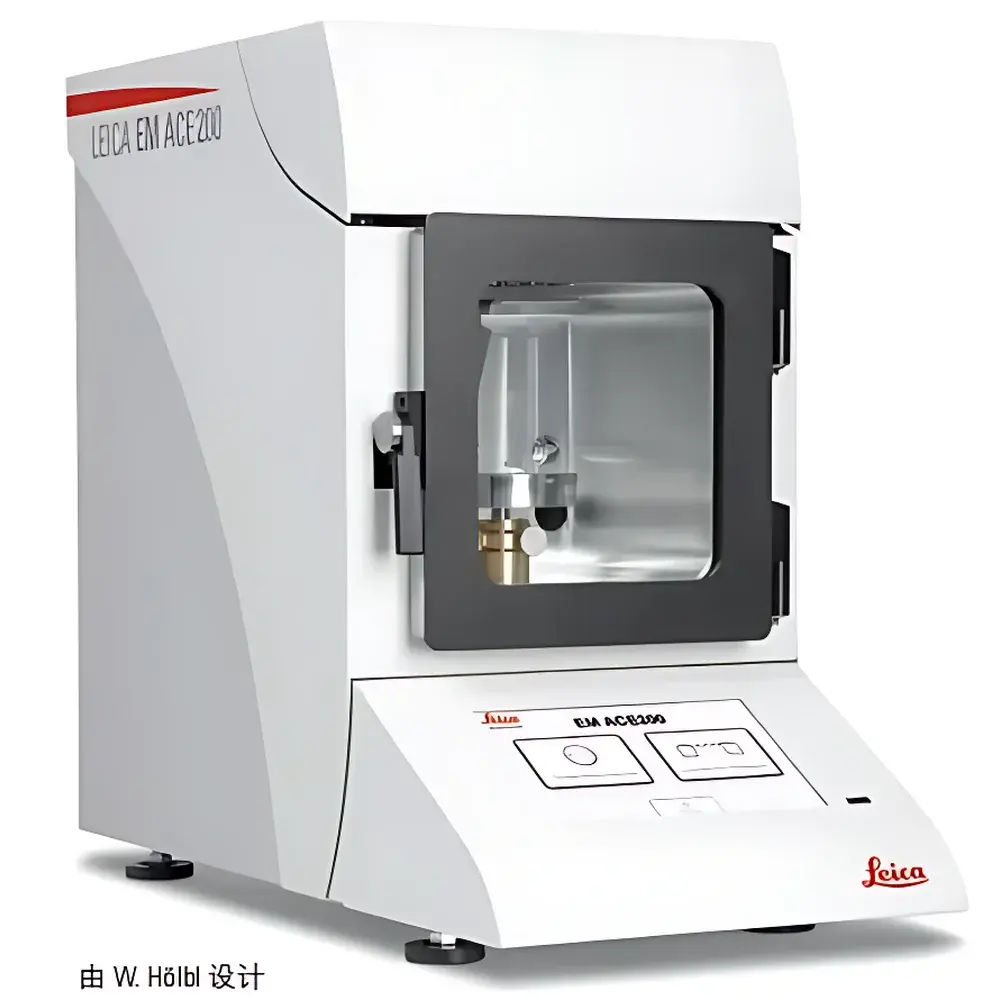
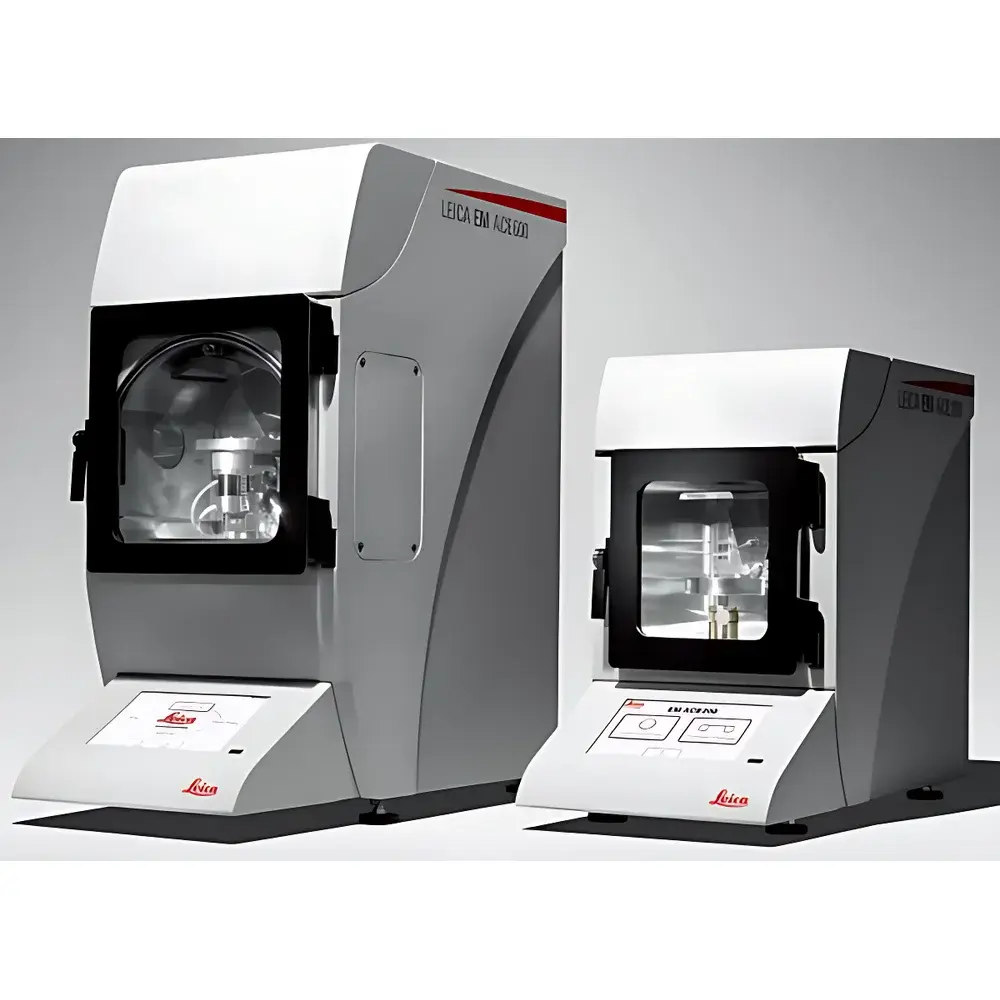
Leica EM ACE200 Desktop Coating System for Electron Microscopy Sample Preparation
| Brand | Leica |
|---|---|
| Origin | Germany |
| Model | EM ACE200 |
| Configuration Options | Sputter Coating / Carbon Evaporation / Dual-Source Interchangeable Setup |
| Optional Modules | Quartz Crystal Thickness Monitor, Planetary Rotating Stage, Glow Discharge Unit |
Overview
The Leica EM ACE200 is a compact, high-precision desktop coating system engineered for reproducible and application-specific sample preparation in scanning electron microscopy (SEM), transmission electron microscopy (TEM), and energy-dispersive X-ray spectroscopy (EDS). It operates on two complementary physical vapor deposition (PVD) principles: magnetron sputtering for conductive metal films (e.g., Au, Pt, Cr, Ir) and resistive thermal evaporation for ultra-thin, electron-transparent carbon films. The system’s modular architecture enables seamless transition between sputtering and carbon evaporation modes—either as dedicated single-source configurations or via an interchangeable source holder within the same vacuum chamber. This dual-capability design eliminates cross-contamination risks while preserving chamber integrity and process repeatability across diverse sample types and analytical requirements.
Key Features
- Modular vacuum chamber with 160 mm internal diameter and ≤5 × 10⁻³ mbar base pressure, compatible with standard SEM stubs, TEM grids, and multi-well sample holders.
- Integrated turbomolecular pumping system with automatic venting and pressure regulation, ensuring rapid pump-down (<90 s to operational vacuum) and stable process conditions.
- Programmable sputter source with adjustable DC power (0–120 W) and argon flow control (0–50 sccm), supporting uniform metal film thicknesses from 2 nm to 20 nm.
- Carbon evaporation module with dual tungsten filaments (max. 3 A per filament), enabling controlled deposition of amorphous carbon films with thickness resolution down to ±0.5 nm (when used with optional quartz crystal monitor).
- Intuitive touchscreen interface with preloaded method templates for common applications—including high-resolution SEM imaging, EDS-compatible carbon support films, and TEM replica preparation.
- CE-marked and compliant with IEC 61000-6-3 (EMC) and IEC 61000-6-2 (immunity) standards for laboratory environments.
Sample Compatibility & Compliance
The EM ACE200 accommodates a broad range of specimen geometries: flat substrates up to 40 mm in diameter, fractured cross-sections, porous materials, and delicate biological specimens mounted on copper or nickel TEM grids. Its planetary rotating stage option ensures angular uniformity for irregular or topographically complex samples—critical for eliminating shadowing effects during sputter coating. The integrated glow discharge unit (optional) applies low-energy plasma treatment (air or argon/oxygen mixtures) to hydrophilize carbon-coated TEM grids, enhancing colloidal stability of negatively stained biomolecules—a prerequisite for high-fidelity cryo-TEM grid preparation. All operational parameters are logged with time-stamped metadata, supporting GLP-compliant documentation and audit readiness per ISO/IEC 17025 and FDA 21 CFR Part 11 when paired with Leica’s EM Connect software suite.
Software & Data Management
Control and monitoring are managed through Leica’s proprietary EM ACE Control Software, running on an embedded industrial PC. The software supports full parameter logging—including chamber pressure history, current/voltage profiles, deposition time, and real-time thickness feedback (if QCM installed)—with export capability to CSV or XML formats. Method files are password-protected and version-controlled, enabling secure sharing across multi-user laboratories. Audit trail functionality records all user actions, parameter changes, and system alerts, fulfilling traceability requirements for regulated environments. Integration with Leica EM Connect allows remote status monitoring and scheduled maintenance notifications via secure HTTPS connection.
Applications
- High-resolution SEM imaging of non-conductive biological tissues, polymers, and ceramics—via thin Au/Pd or Ir coatings that minimize grain size and charging artifacts.
- EDS-optimized carbon film deposition for quantitative elemental mapping, where minimal X-ray absorption and consistent conductivity are essential.
- Preparation of continuous carbon support films on TEM grids for negative staining and single-particle analysis.
- Fabrication of replica films for fracture surface analysis in metallurgy and materials science.
- Glow discharge treatment of holey carbon grids prior to vitrification in cryo-EM workflows.
FAQ
Can the EM ACE200 perform both sputtering and carbon evaporation in a single run?
No—sputtering and carbon evaporation require distinct vacuum conditions and source configurations; however, the interchangeable source holder enables rapid reconfiguration between modes without breaking vacuum or requiring external tools.
Is the quartz crystal monitor compatible with both sputtering and carbon evaporation?
Yes—the optional QCM sensor is calibrated for both metal and carbon deposition rates and provides real-time feedback for thickness control within ±1 nm accuracy under optimized conditions.
What maintenance intervals are recommended for the turbomolecular pump?
Leica recommends annual inspection of the turbomolecular pump bearings and cleaning of the foreline filter; full service is advised every 12,000 operating hours or per manufacturer’s guidelines based on usage profile.
Does the system support automated recipe execution for unattended operation?
Yes—up to 99 user-defined methods can be stored and executed with start/stop triggers, including delayed initiation and post-deposition venting sequences.
How is compliance with ISO 14644-1 Class 5 cleanroom requirements addressed?
While the EM ACE200 itself is not classified as cleanroom equipment, its sealed chamber design, HEPA-filtered venting, and absence of internal oil-based pumps minimize particulate generation—making it suitable for installation in ISO Class 5 environments when housed in appropriate enclosures.



