
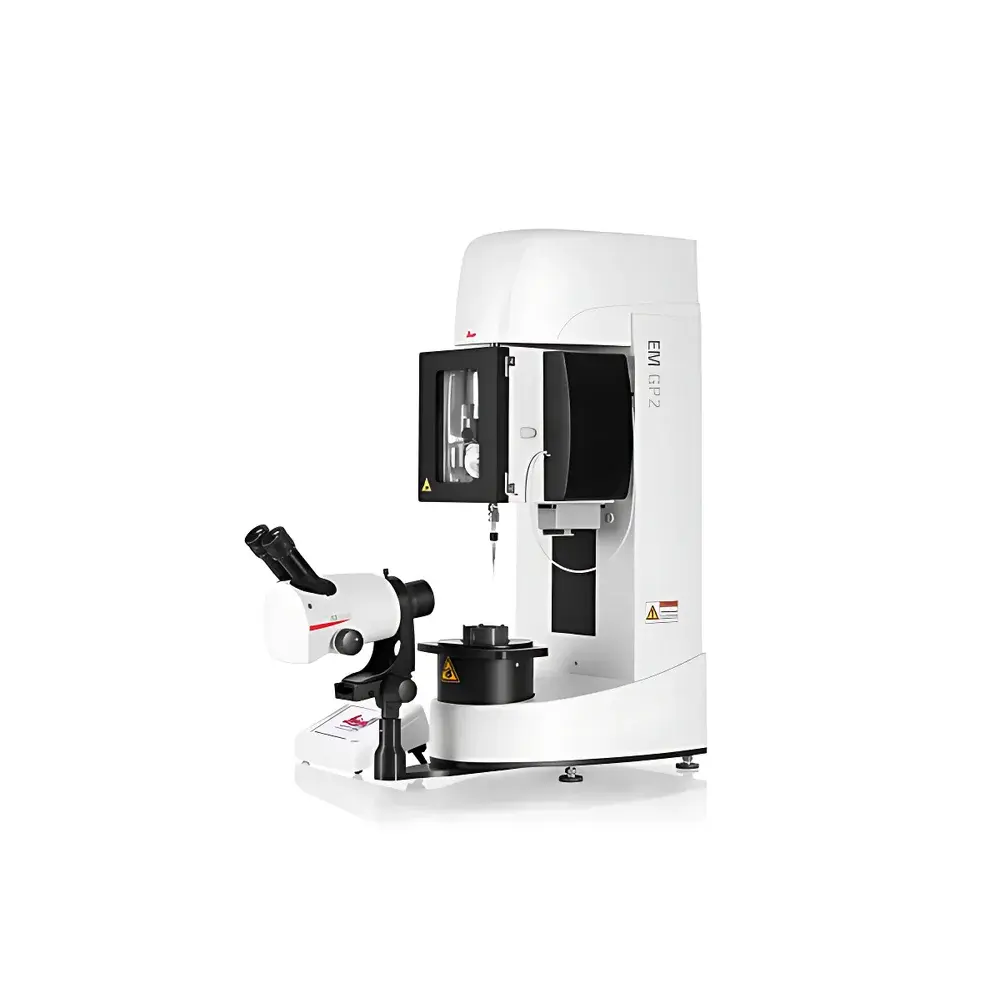
Leica EM GP2 Automated Plunge Freezer
| Brand | Leica |
|---|---|
| Origin | Germany |
| Manufacturer Type | Authorized Distributor |
| Origin Category | Imported |
| Model | EM GP2 |
| Pricing | Available Upon Request |
Overview
The Leica EM GP2 Automated Plunge Freezer is a high-precision, research-grade cryo-preparation system engineered for reproducible vitrification of biological and soft-material specimens prior to transmission electron microscopy (TEM) and cryo-electron tomography (cryo-ET). Operating on the principle of rapid conductive cooling via liquid ethane immersion, the EM GP2 enables controlled, contamination-free vitrification by plunging electron microscopy grids—pre-coated with aqueous or ultra-thin samples—into cryogen at temperatures below −180 °C. This process arrests molecular motion without ice crystal formation, preserving native structural integrity at near-atomic resolution. Designed around user-centric workflow integration, the EM GP2 integrates environmental control, sensor-driven blotting, and modular hardware architecture to support both single-particle analysis (SPA) and high-resolution cryo-ET sample preparation under strictly defined thermal and hygrometric conditions.
Key Features
- Automated blotting with real-time sensor feedback: Precise, programmable blotting duration, pre-blotting delay, post-blotting dwell time, and adjustable blot position ensure uniform thin-film formation across grid surfaces.
- Climate-controlled specimen chamber: Temperature regulation from +4 °C to +60 °C and relative humidity control up to 99% RH enable optimization of sample hydration state prior to freezing—critical for membrane proteins, liposomes, and hydrated macromolecular complexes.
- Dual-cryogen compatibility with integrated cryogen management: Optimized cryogen head design allows rapid, low-loss refilling of liquid ethane; fixed cryogen reservoir position minimizes operator exposure and enhances procedural repeatability.
- Integrated dry nitrogen purge: Continuous laminar flow of pre-cooled, particle-filtered nitrogen maintains an inert, low-moisture environment above the cryogen surface, suppressing frost formation and minimizing background contamination.
- Modular transfer interface: Equipped with standardized connectors compatible with major cryo-TEM transfer systems (e.g., Gatan Cryo-Transfer, FEI/Thermo Fisher AutoGrid, and custom-built cryo-handling stages), ensuring seamless, contamination-minimized specimen handoff.
- Pre-cooled grid storage and handling: Includes dedicated cryo-grid cassettes and transfer containers with integrated thermal mass stabilization for consistent grid temperature during loading and post-plunge handling.
Sample Compatibility & Compliance
The EM GP2 supports a broad spectrum of TEM-compatible substrates including Quantifoil®, UltrAuFoil®, C-flat™, and lacey carbon grids—both with and without functionalized coatings (e.g., graphene oxide, Ni-NTA). It accommodates standard 3.05 mm TEM grids as well as specialized geometries used in high-throughput screening workflows. All operational parameters—including blotting force, environmental setpoints, and cryogen immersion depth—are fully traceable and configurable per GLP/GMP-aligned documentation requirements. The system complies with ISO 13485–aligned quality management frameworks for medical device-related research instrumentation and supports audit-ready metadata logging required under FDA 21 CFR Part 11 for regulated biopharmaceutical development environments.
Software & Data Management
Controlled via Leica’s EM UC7-compatible software suite, the EM GP2 provides full parameter logging, versioned protocol storage, and timestamped event tracking—including environmental sensor readings, blot actuation cycles, cryogen level monitoring, and nitrogen flow verification. Exportable CSV and XML logs integrate natively with LIMS platforms and electronic lab notebooks (ELNs). Optional API access enables bidirectional communication with upstream sample dispensing robots (e.g., Chameleon, Mosquito HV) and downstream cryo-TEM acquisition software (e.g., SerialEM, EPU, cisTEM), facilitating end-to-end digital workflow continuity and FAIR data principles adherence.
Applications
- Single-particle cryo-EM structure determination of membrane proteins, viral capsids, and large macromolecular assemblies.
- Cryo-electron tomography of cellular sections, organelles, and intact bacterial cells.
- Time-resolved cryo-EM studies using microfluidic or spray-based sample application.
- Correlative light and electron microscopy (CLEM) workflows requiring precise grid-level fiducial alignment and thermal history control.
- Quality control of biotherapeutics—including monoclonal antibodies, mRNA-LNPs, and extracellular vesicles—under physiologically relevant hydration states.
FAQ
What cryogens are compatible with the EM GP2?
Liquid ethane is the primary cryogen; propane and ethane/propane mixtures may be used under validated protocols, though ethane remains the standard for optimal vitrification efficiency.
Can the EM GP2 be integrated into automated sample preparation pipelines?
Yes—the system features Ethernet and RS-232 interfaces with open-command syntax, enabling synchronization with robotic liquid handlers, incubators, and cryo-TEM auto-loaders.
Is humidity control essential for all sample types?
While not universally required, RH control significantly improves reproducibility for air-sensitive or hydration-dependent specimens such as GPCR complexes, lipid bilayers, and nucleic acid-protein assemblies.
How does the EM GP2 ensure blotted film thickness consistency?
Through capacitive moisture sensors that dynamically adjust blotting duration based on residual liquid volume, coupled with motorized stage positioning calibrated to ±1 µm accuracy.
Does the system meet regulatory documentation requirements for pharmaceutical development?
Yes—full audit trail generation, electronic signature support, and configurable user access levels comply with ALCOA+ principles and align with ICH M10 and USP guidelines for analytical instrument qualification.






