
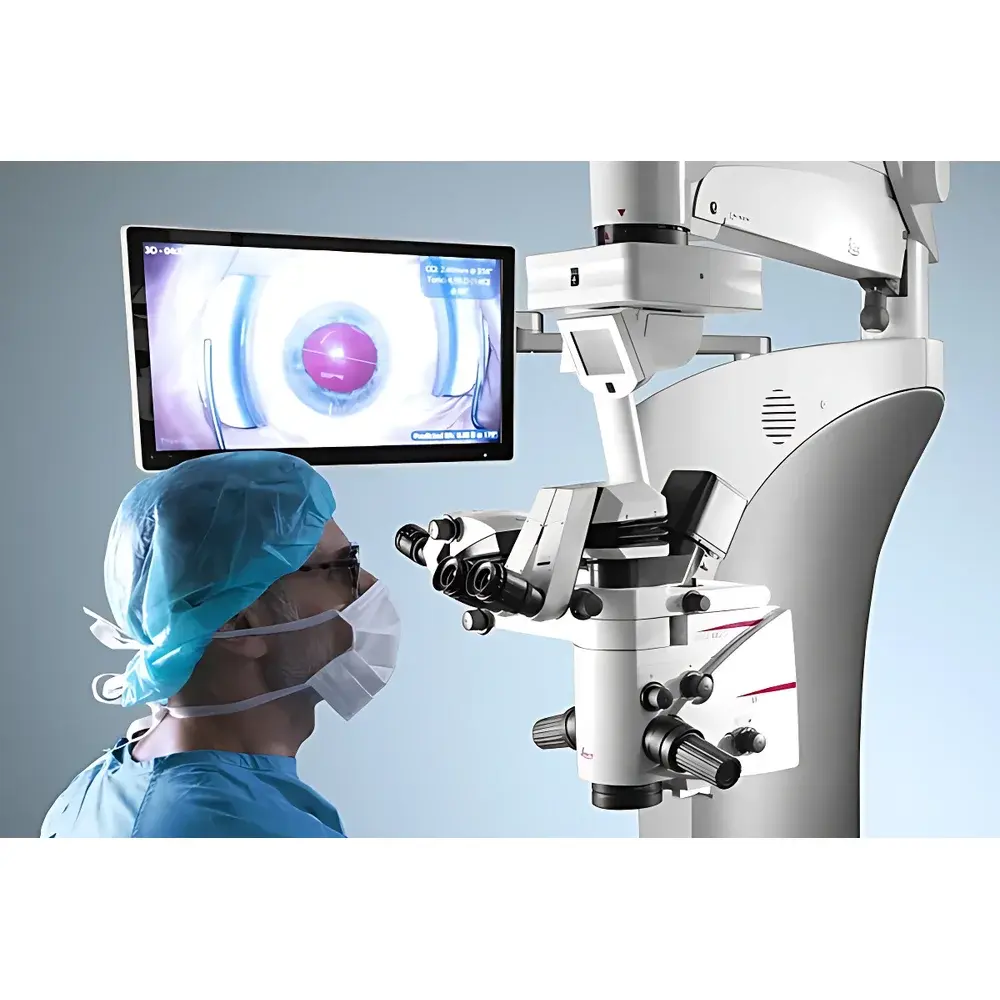
Leica EnFocus Intraoperative OCT Imaging System for Proveo 8 Surgical Microscope
| Brand | Leica |
|---|---|
| Country of Origin | Germany |
| Model | EnFocus Intraoperative OCT Imaging System |
| Application | Ophthalmic Surgery |
| Integration | Fully integrated with Leica Proveo 8 Surgical Microscope |
| Lateral Field of View | Up to 20 × 20 mm |
| Axial Resolution | 2.4 µm |
| Imaging Speed | 30 fps |
| Scan Density | Up to 1000 A-scans × 1000 B-scans |
| Software | Leica InVivo OCT Platform (Four-Quadrant Display, Frame-by-Frame Playback, On-Screen Measurements) |
| Compliance | Designed for GLP-aligned clinical workflows |
Overview
The Leica EnFocus Intraoperative Optical Coherence Tomography (OCT) Imaging System is a high-resolution, real-time cross-sectional imaging module engineered exclusively for seamless integration with the Leica Proveo 8 ophthalmic surgical microscope. Leveraging spectral-domain OCT technology, EnFocus delivers non-contact, micron-level visualization of subsurface ocular microstructure during anterior and posterior segment procedures — including DMEK, DSAEK, DALK, corneal transplantation, glaucoma drainage device implantation, and vitreoretinal membrane peeling. Unlike preoperative or postoperative OCT systems, EnFocus operates within the sterile field, providing dynamic, depth-resolved feedback precisely when anatomical interpretation directly informs surgical decision-making. Its optical architecture incorporates dispersion-compensated interferometry, high-sensitivity photodetectors, and proprietary beam-splitting optics to minimize artifacts and maximize signal fidelity — enabling clear differentiation between tissue layers even in presence of intraoperative blood or opacities.
Key Features
- Subsurface Visualization at 2.4 µm Axial Resolution: Enables precise discrimination of Descemet’s membrane, endothelial graft adherence, subretinal fluid, and lamellar dissection planes.
- Full-Anterior-Segment Coverage: Wide-field scanning up to 20 × 20 mm lateral FOV maintains peripheral surveillance without repositioning — critical during centration-sensitive keratoplasty or angle-based glaucoma interventions.
- Real-Time 30 fps OCT Rendering: Synchronizes with surgical tempo to deliver immediate morphological feedback on tissue response to manipulation, irrigation, or air-fluid exchange.
- Four-Quadrant InVivo Software Interface: Simultaneously displays microscope view (top-left), en face projection (bottom-left), cross-sectional B-scan (top-right), and depth-encoded structural overlay (bottom-right) — standardizing spatial orientation across users.
- Workflow-Integrated Control: Activation via footswitch, ergonomic handle, or 27″ HD touchscreen allows hands-free OCT initiation and parameter adjustment without breaking sterility or visual focus.
- Configurable Presets & DICOM-Compliant Archiving: Predefined scan protocols (e.g., “DMEK Graft Adhesion”, “DALK Needle Depth”) assignable to hardware controls; image export compatible with PACS and MedXChange Evolution4K for traceable, timestamped, metadata-embedded documentation.
Sample Compatibility & Compliance
EnFocus is validated for use with human ocular tissues under standard ophthalmic surgical conditions, including intraoperative aqueous humor, viscoelastic agents, balanced salt solution, and air/gas tamponades. It does not require exogenous contrast or tissue preparation. The system complies with IEC 60601-1 (Medical Electrical Equipment Safety) and IEC 62304 (Software Lifecycle Requirements). When deployed with validated third-party recording solutions (e.g., MedXChange Evolution4K), it supports FDA 21 CFR Part 11–aligned electronic records — including user authentication, audit trails, and immutable storage — meeting GLP/GCP documentation expectations for prospective surgical outcome studies. Regulatory clearance varies by jurisdiction; CE Marking applies for EU markets; U.S. FDA 510(k) clearance is held for specific indications including anterior segment structural assessment during keratoplasty and glaucoma surgery.
Software & Data Management
The Leica InVivo OCT software platform provides deterministic, low-latency processing of raw interferometric data into clinically interpretable B-scans and en face reconstructions. All acquisitions retain full metadata: timestamp, surgeon ID (via login), microscope magnification, scan position coordinates, and calibration status. Measurement tools include calibrated thickness mapping (e.g., stromal bed depth in DALK), distance annotations (e.g., graft-to-host interface gap), and layer segmentation overlays. Export formats include DICOM-SEG, TIFF (16-bit), and CSV for quantitative analysis. Integration with hospital PACS follows IHE XDS-I profiles; local storage adheres to ISO/IEC 27001–based encryption standards. Optional DICOM SR reporting templates facilitate structured documentation aligned with OMOP CDM conventions for multicenter registry participation.
Applications
- Anterior Segment Surgery: Real-time confirmation of Descemet’s membrane integrity during cataract surgery complications; precise needle placement depth control in deep anterior lamellar keratoplasty (DALK); graft centration and interface fluid detection in endothelial keratoplasty (DMEK/DSAEK).
- Glaucoma Surgery: Verification of ab interno trabeculectomy (ABiC) catheter trajectory; positioning accuracy of suprachoroidal shunts or intrascleral reservoirs; assessment of filtering bleb morphology during trabeculectomy.
- Vitreoretinal Procedures: Identification of residual epiretinal or internal limiting membrane fragments post-peel; detection of subretinal hemorrhage or fluid accumulation during macular hole repair; evaluation of retinal reattachment dynamics after pneumatic retinopexy.
- Surgical Training & Quality Assurance: Objective benchmarking of trainee performance against expert-derived OCT-defined anatomical endpoints; retrospective procedural review using frame-accurate playback for root-cause analysis of intraoperative events.
FAQ
Is EnFocus compatible with surgical microscopes other than Proveo 8?
No. EnFocus is mechanically, optically, and electronically engineered as a dedicated module for the Leica Proveo 8 platform. Interchangeability with other microscope models is neither supported nor validated.
Does EnFocus require additional calibration before each procedure?
No. The system performs automated optical path calibration during startup and confirms alignment integrity prior to first acquisition. No user-performed daily calibration is required.
Can EnFocus OCT images be exported for offline analysis in third-party software?
Yes. Raw and processed datasets are exportable in open formats (TIFF, CSV) and DICOM-compliant structures, supporting integration with MATLAB, Python-based OCT analysis toolkits, or commercial ophthalmic analytics platforms.
How is patient data privacy maintained during intraoperative OCT acquisition?
All image metadata are anonymized at point-of-capture unless explicitly linked to EMR via HL7/FHIR interfaces. Local storage uses AES-256 encryption; network transmission requires TLS 1.2+; audit logs record all access and export events per HIPAA and GDPR technical safeguards.
What evidence supports clinical impact of intraoperative OCT in decision-making?
The DISCOVER Study (NCT03259909) demonstrated that 35% of membrane peeling cases showed intraoperative OCT findings discordant with surgeon’s microscopic impression — leading to protocol modification in 22% of those cases. Subsequent publications in Ophthalmology and JAMA Ophthalmology confirm improved anatomical endpoint achievement and reduced reoperation rates in OCT-guided cohorts.
Related Products




