
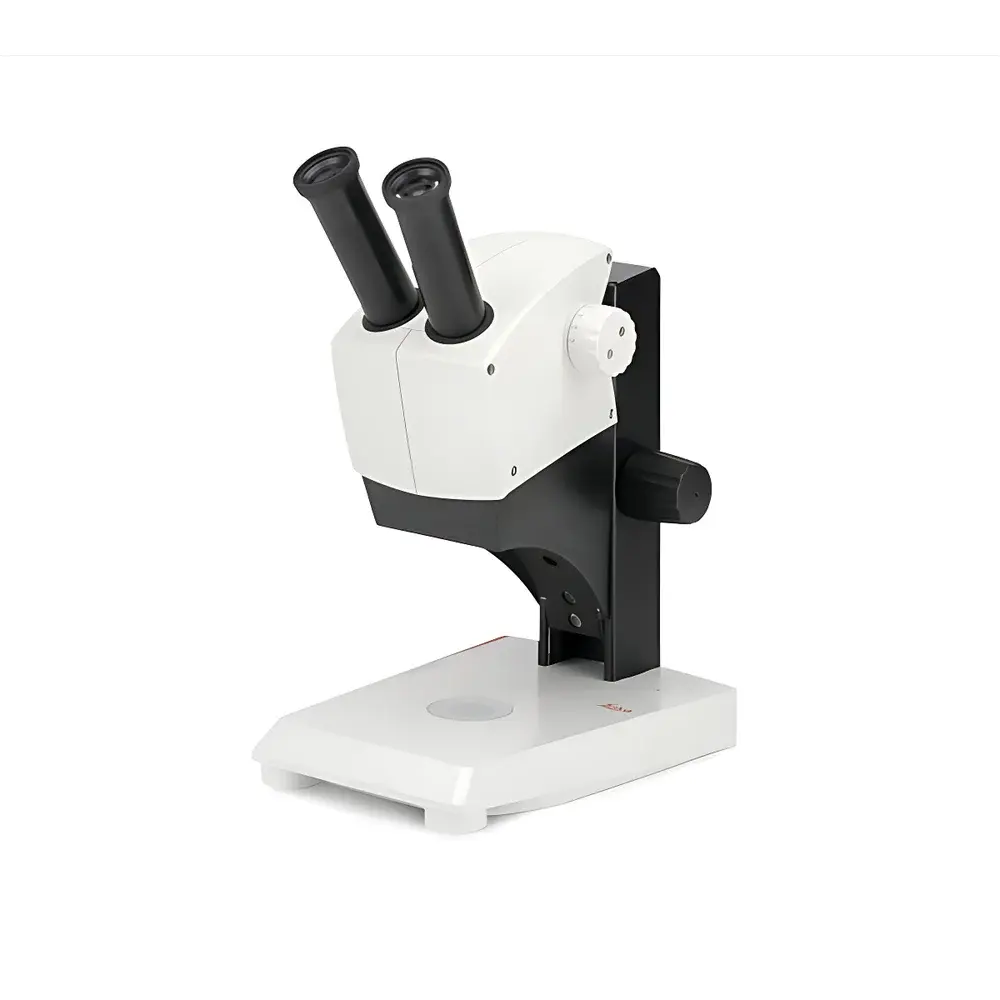
Leica EZ4 E Stereo Microscope
| Brand | Leica |
|---|---|
| Origin | Austria |
| Model | EZ4 E |
| Total Magnification Range | 8×–44× |
| Zoom Ratio | 4.4:1 |
| Working Distance | 100 mm |
| Objective Type | Plan Apochromatic |
| Illumination | LED |
| Camera Resolution | 5 MP CMOS |
| Connectivity | Built-in Wi-Fi, Ethernet (LAN), HDMI, USB, SD Card Slot |
| Software | Leica Application Suite (LAS) for Windows, Leica Acquire for macOS |
| Mobile App | Leica AirLab (iOS/Android) |
| Compliance | CE, RoHS, ISO 9001-certified manufacturing |
Overview
The Leica EZ4 E Stereo Microscope is an education-optimized, integrated digital stereo imaging platform engineered for undergraduate and secondary science laboratories. Based on Greenough optical architecture, it delivers true stereoscopic vision with high depth of field and natural color fidelity across its continuous 8×–44× magnification range. Unlike conventional teaching microscopes requiring external cameras or complex cabling, the EZ4 E embeds a 5-megapixel CMOS sensor directly into the optical path—eliminating parallax error and ensuring pixel-registered image capture at every zoom position. Its 4.4:1 zoom ratio enables seamless transition from gross specimen survey to fine structural observation without objective lens changes, while the 100 mm working distance accommodates bulky samples, dissection tools, and manipulators. Designed for robust classroom deployment, the system operates as a self-contained imaging node—requiring only a single power connection—and supports both wired (Gigabit Ethernet) and wireless (802.11n Wi-Fi) network integration without reliance on institutional IT infrastructure.
Key Features
- Integrated 5 MP CMOS camera with real-time streaming at up to 30 fps—no external frame grabber or driver installation required
- CapSense touch-sensitive control panel with haptic feedback for intuitive zoom, focus, illumination, and capture operation—sealed against dust and liquid ingress (IP54-rated enclosure)
- 7-LED illumination system with independent controls for incident, oblique, and transmitted light—adjustable intensity and color temperature (5,600 K nominal) for optimal contrast across opaque, translucent, and reflective specimens
- Plan apochromatic objective optics delivering flat, chromatically corrected fields across the full zoom range—minimizing edge distortion and spherical aberration
- Dual-mode connectivity: native Wi-Fi access point mode (standalone network) or client mode (integration into existing LAN/WLAN); HDMI output for direct projection; USB 2.0 for legacy PC compatibility
- Onboard SD card slot (microSDHC, up to 128 GB) enabling autonomous image/video acquisition—critical for environments with limited device availability or network restrictions
Sample Compatibility & Compliance
The EZ4 E accommodates diverse sample types common in biology, materials science, electronics inspection, and forensic coursework—including whole insects, plant tissues, circuit boards, mineral sections, and 3D printed prototypes. Its 100 mm working distance permits use with pipettes, forceps, soldering irons, and micro-manipulators. All optical components comply with ISO 10934-1 (stereomicroscope performance standards) and are manufactured under ISO 9001-certified processes in Wetzlar, Germany and Vienna, Austria. The embedded firmware adheres to IEC 62366-1 (usability engineering for medical devices) principles—ensuring intuitive interaction for novice users. While not FDA-cleared, the system meets CE marking requirements for educational instrumentation (2014/30/EU EMC Directive, 2011/65/EU RoHS Directive) and supports audit-ready documentation workflows when used with Leica LAS software’s optional GLP/GMP-compliant metadata logging.
Software & Data Management
Image acquisition and annotation are managed via three interoperable platforms: Leica AirLab (free iOS/Android app) for touch-based capture, markup, and sharing; Leica Application Suite (LAS) for Windows—supporting multi-channel time-lapse, measurement calibration (µm/pixel), and report generation compliant with ISO/IEC 17025 documentation standards; and Leica Acquire for macOS, offering native Metal-accelerated rendering and non-destructive RAW export. All software modules log timestamped metadata—including magnification, illumination settings, exposure parameters, and user ID—enabling traceable data provenance. When deployed in networked labs, LAS supports centralized configuration management and role-based access control (RBAC) for instructors. Export formats include TIFF (uncompressed), JPEG2000 (lossless compression), AVI (motion capture), and PDF reports with embedded scale bars and annotations.
Applications
The EZ4 E serves core pedagogical functions across life sciences and engineering curricula: comparative morphology studies in zoology and botany; solder joint inspection and PCB reverse-engineering in electronics labs; polymer phase separation analysis in materials courses; forensic fiber and toolmark comparison exercises; and live embryonic development tracking in developmental biology. Its low-vibration optical train and thermal-stable LED illumination ensure consistent image quality during extended observation sessions—critical for longitudinal student projects. In inquiry-based learning frameworks, the ability to stream live feeds to multiple tablets or laptops fosters collaborative hypothesis testing and peer-led image analysis—aligning with NGSS Science and Engineering Practices (SEP3: Planning and Carrying Out Investigations; SEP4: Analyzing and Interpreting Data).
FAQ
Does the EZ4 E require a dedicated Wi-Fi router or IT department approval to operate?
No—the microscope functions as a standalone Wi-Fi access point, creating its own local network (SSID: “Leica-EZ4E-XXXX”) that students join directly with tablets or laptops. No institutional network credentials or firewall exceptions are needed.
Can images be captured without any connected device?
Yes—insert a microSD card (up to 128 GB) and use the CapSense panel to initiate capture. Images are saved in standard DCF-compliant JPEG/TIFF format, readable on any computer or projector.
Is the 5 MP camera resolution maintained across the full 8×–44× zoom range?
Yes—the sensor is optically coupled to the zoom body and dynamically resamples pixels to preserve Nyquist-limited resolution at all magnifications, validated per ISO 19012-2 modulation transfer function (MTF) testing.
What calibration standards does the system support for quantitative measurements?
Leica LAS includes built-in stage micrometer calibration routines traceable to NIST SRM 2053; users can define custom scale factors per objective zoom position and export calibrated measurement data in CSV format.
How is firmware updated and maintained across a fleet of classroom instruments?
Updates are distributed via USB drive or network push through Leica’s centralized LabManager software—supporting silent background installation and version rollback capability for lab-wide consistency.




