
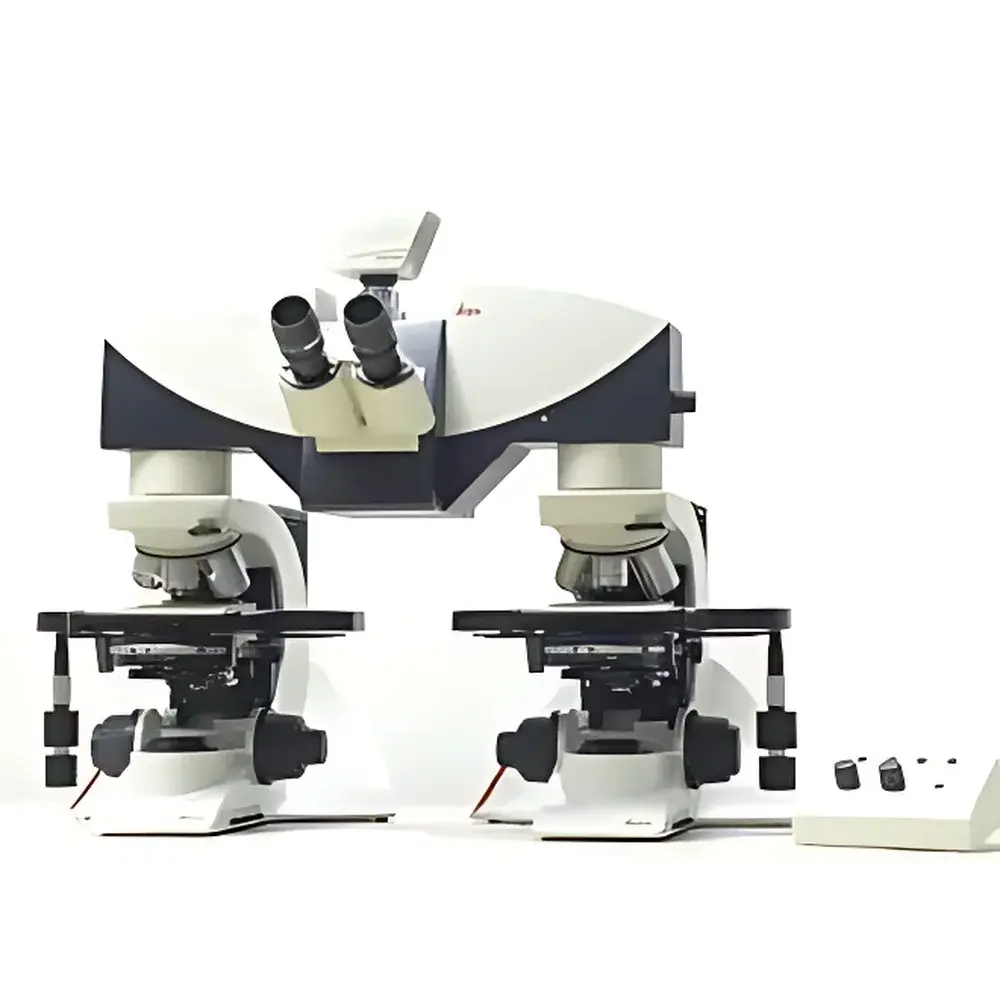
Leica FS CB Comparison Microscope
| Brand | Leica |
|---|---|
| Origin | Germany |
| Model | FS CB |
| Type | Dual-Head Automated Comparison Microscope |
| Max Magnification | 1500× |
| Optical Configuration | Coupled Leica DM-Series Microscopes with Motorized Bridge |
| Viewing Modes | Side-by-Side, Overlay, and Blended Image Display |
| Compliance | Designed for Forensic Ballistics & Toolmark Examination per EN ISO/IEC 17025 Requirements |
Overview
The Leica FS CB Comparison Microscope is a purpose-engineered dual-optical-path instrument designed specifically for forensic firearms and toolmark analysis in law enforcement laboratories. It integrates two high-resolution Leica DM-series upright microscopes—each independently configurable with precision objectives and Koehler illumination—via a motorized, fully synchronized comparison bridge. The system operates on the principle of optical superposition and stereoscopic side-by-side viewing, enabling direct visual correlation of minute surface topography, striation patterns, firing pin impressions, and microscopic toolmarks at magnifications up to 1500×. Unlike conventional manual comparison setups, the FS CB employs an automated bridge mechanism that maintains parfocal alignment, coaxial illumination balance, and identical magnification scaling across both optical channels—critical for minimizing observer bias and ensuring metrologically traceable comparisons in accredited forensic workflows.
Key Features
- Motorized comparison bridge with integrated ergonomic binocular observation tube, reducing operator fatigue during extended examination sessions
- Single-button toggle between three validated viewing modes: side-by-side (dual-field), pixel-aligned overlay (transparency-controlled), and blended composite view for transitional feature assessment
- Independent focus, brightness, and contrast control for each optical path—essential for comparing specimens with differential surface reflectivity or depth-of-field requirements
- Compatible with Leica DFC digital camera systems and LAS X forensic imaging software for calibrated image capture, annotation, and measurement
- Modular design supports integration with optional accessories including polarized light modules, fluorescence illumination units, and motorized XYZ stage controllers
- Robust mechanical architecture compliant with ISO 10993-1 biocompatibility guidelines for optical housing materials and meets IEC 61000-4 electromagnetic immunity standards
Sample Compatibility & Compliance
The Leica FS CB accommodates a broad range of evidentiary specimens without modification: fired cartridge cases, bullets, toolmarked surfaces (e.g., screwdrivers, pliers, cutting implements), shoe sole impressions, and questioned documents with indented writing or altered features. Its optical path design ensures compatibility with both reflective and semi-transmissive samples, including those mounted on standard glass slides or embedded in resin blocks. The system supports documentation workflows aligned with ASTM E1610–22 (Standard Guide for Forensic Paint Analysis and Comparison) and FBI’s Quality Assurance Standards for Forensic Firearms Examination. All image acquisition and annotation functions are audit-trail enabled, satisfying GLP/GMP data integrity requirements under ISO/IEC 17025:2017 Clause 7.5 and supporting FDA 21 CFR Part 11 compliance when deployed with validated software configurations.
Software & Data Management
The FS CB interfaces natively with Leica Application Suite (LAS) X Forensic Edition—a CE-marked, 21 CFR Part 11-ready platform offering role-based user authentication, electronic signature capture, and immutable metadata logging for every captured image or measurement. Software features include automatic magnification calibration verification, geometric distortion correction, multi-layer image annotation with standardized forensic symbol libraries (e.g., NIBIN-compliant mark-up sets), and export to PDF/A-2b or TIFF formats compliant with national digital evidence archiving mandates. Raw image data remains unaltered in proprietary .lei format; processed derivatives are stored with embedded EXIF tags containing instrument ID, operator ID, timestamp, and environmental sensor readings (if connected to lab monitoring systems).
Applications
- Firearms identification via microscopic comparison of breech face marks, firing pin impressions, and ejector signatures on cartridge cases
- Toolmark analysis of cut marks, shear impressions, and compression features on metal, plastic, or wood substrates
- Questioned document examination involving ink differentiation, erasure detection, and indented writing visualization
- Trace evidence correlation—including paint chip layer sequencing, fiber morphology matching, and fracture surface congruence analysis
- Training and proficiency testing within certified forensic training programs adhering to OSAC (Organization of Scientific Area Committees) guidelines
FAQ
Does the Leica FS CB support remote collaboration during live examinations?
Yes—the system can be configured with Leica’s Remote Access Module (RAM), enabling secure, low-latency screen sharing and synchronized bridge control for real-time expert consultation across geographically dispersed laboratories.
Is calibration traceability provided for magnification and measurement functions?
Each unit ships with a factory-issued calibration certificate traceable to PTB (Physikalisch-Technische Bundesanstalt), including verification of graticule linearity, stage movement accuracy (±0.5 µm), and magnification consistency across all objective combinations.
Can the FS CB integrate with existing laboratory information management systems (LIMS)?
Via HL7 and ASTM E1714-compliant API interfaces, the FS CB supports bidirectional data exchange with major LIMS platforms for case assignment, chain-of-custody linkage, and automated report generation.
What maintenance intervals are recommended for forensic operational continuity?
Leica recommends quarterly optical alignment verification and annual full-system certification by an authorized service engineer—both documented in accordance with ISO/IEC 17025 internal audit requirements.



