
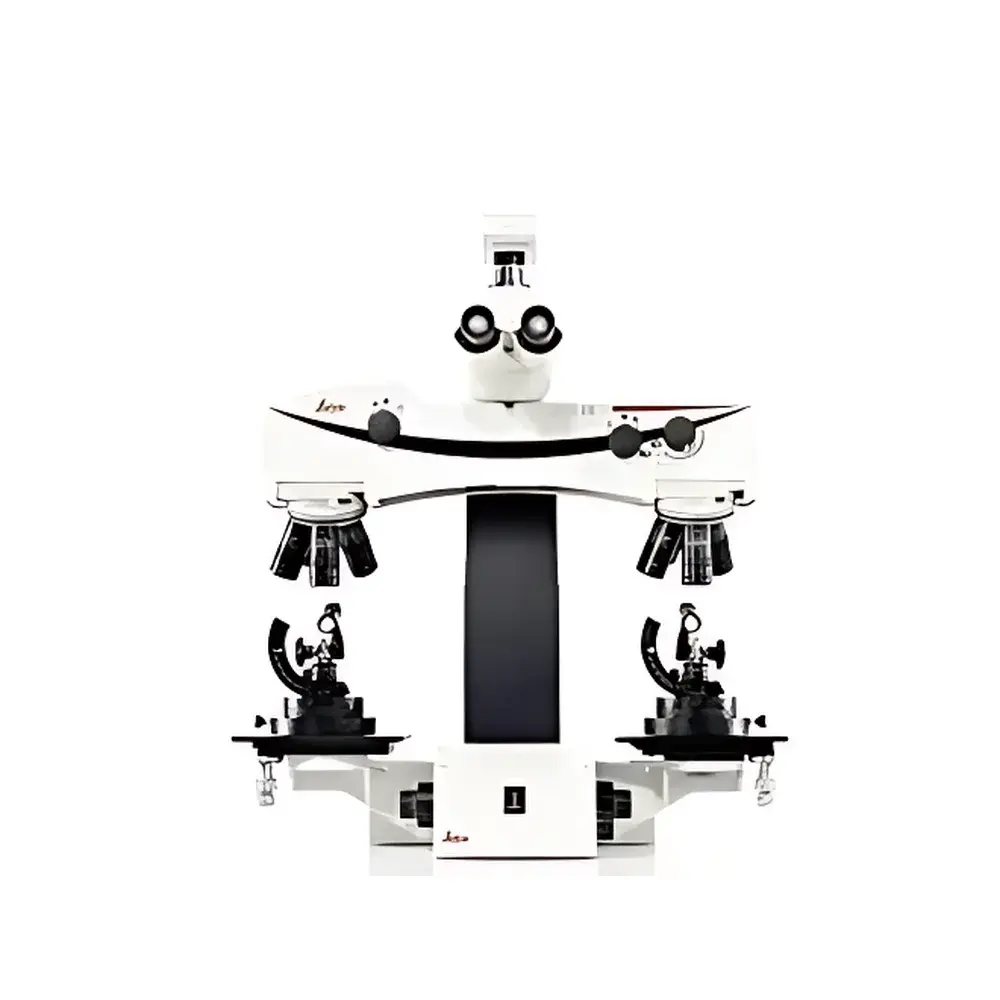
Leica FS M Manual Macro Comparison Microscope
| Brand | Leica |
|---|---|
| Origin | Germany |
| Model | FS M |
| Type | Manual Macro Comparison Microscope |
| Optical Configuration | Dual-Path Simultaneous Viewing System |
| Field of View | 22 mm (vertical, orthoscopic image orientation) |
| Objective Mount | Dual Five-Position Ball-Bearing Nosepieces |
| Objective Compatibility | Achromatic Apochromatic-Corrected Telecentric Macro Objectives with Adjustable Iris Diaphragms |
| Sample Handling | Interchangeable Specialty Fixtures for Cartridge Cases, Toolmarks, Documents, and Irregular Evidence Specimens |
| Compliance | Designed to Support Forensic Documentation per ISO/IEC 17025, ASTM E2926–22, and EN 13987 Standards |
Overview
The Leica FS M Manual Macro Comparison Microscope is a precision-engineered dual-optical-path instrument designed specifically for forensic comparative analysis of macro-scale physical evidence. Operating on the principle of simultaneous side-by-side and superimposed optical comparison, the FS M enables examiners to directly juxtapose two specimens—such as fired cartridge cases, toolmarked surfaces, or questioned documents—within a single visual field without parallax or image distortion. Its orthoscopic (vertically oriented, same-direction movement of sample and image) optical architecture ensures intuitive spatial correlation during manual manipulation, eliminating cognitive load associated with inverted or mirrored coordinate systems. The system’s core optical integrity derives from its rigid, thermally stable comparison bridge housing two independently aligned optical trains, each equipped with a five-position ball-bearing nosepiece supporting Leica’s telecentric apochromat-corrected macro objectives. This design guarantees long-term collimation stability and sub-micron registration repeatability—critical for court-admissible comparisons under GLP-aligned laboratory practices.
Key Features
- Dual five-position ball-bearing objective nosepieces enabling rapid, repeatable switching between magnifications (0.5×–5× typical range with optional objectives)
- 22 mm field-of-view optical path delivering orthoscopic image geometry for natural hand–eye coordination during manual stage translation
- Continuously variable viewing mode selector: full left-eye view, full right-eye view, or precisely registered overlay—adjusted via a single fixed-position rotary knob with tactile detents
- Integrated telecentric achromat-corrected macro objectives featuring built-in adjustable iris diaphragms for real-time depth-of-field and contrast optimization
- Modular specimen stage with quick-release mounting interface accommodating interchangeable forensic fixtures—including cartridge-case cradles, knife-edge clamps, document holders, and custom-machined adapters for irregular evidence
- Mechanically decoupled optical paths minimize vibration coupling and thermal drift, supporting sustained observation sessions required in casework documentation
Sample Compatibility & Compliance
The Leica FS M accommodates a broad spectrum of evidentiary materials encountered in firearms examination, toolmark analysis, questioned document investigation, and trace evidence comparison. Standard accessories include hardened steel cartridge-case supports with adjustable rotational indexing, low-profile knife-edge vise assemblies with non-marring contact surfaces, and transparent document stages with edge illumination ports. All mechanical interfaces comply with DIN 476 and ISO 2768-mK tolerance standards. The system is routinely validated per ASTM E2926–22 (“Standard Practice for Comparison Microscopy of Firearms Evidence”) and supports audit-ready documentation workflows aligned with ISO/IEC 17025:2017 Clause 7.7 (Reporting of Results) and EN 13987 (Forensic Science — Requirements for Examination of Firearm Evidence). Optional digital imaging integration meets evidentiary chain-of-custody requirements under national digital evidence guidelines.
Software & Data Management
While the FS M operates as a fully manual optical platform, it is engineered for seamless integration with third-party forensic imaging software suites (e.g., FTS Compare, Image-Pro Forensic, or NIST Traceable Calibration Tools). Its standardized C-mount and trinocular porting allow attachment of CCD/CMOS sensors compliant with IEEE 1394 or USB3.0 protocols. All digital acquisitions retain embedded metadata—including objective magnification, illumination settings, and stage coordinates—enabling automated report generation with timestamped, user-authenticated audit trails. When deployed in accredited laboratories, the microscope’s mechanical reproducibility supports 21 CFR Part 11–compliant electronic signature workflows when paired with validated software platforms.
Applications
- Firearms identification: direct comparison of breech face impressions, firing pin marks, and ejector signatures on cartridge cases
- Toolmark examination: alignment and congruence assessment of striated and impressed marks from screwdrivers, pliers, or cutting tools
- Questioned document analysis: side-by-side evaluation of handwriting features, ink flow anomalies, or indented writing impressions
- Trace evidence correlation: morphological matching of paint chips, glass fragments, or fractured polymer surfaces
- Training and proficiency testing: standardized presentation of known–known and known–questioned comparisons for examiner competency validation
FAQ
Is the Leica FS M compatible with digital imaging systems?
Yes—the trinocular tube and C-mount adapter support industry-standard monochrome and color scientific cameras with resolution up to 20 MP.
Does the FS M meet international forensic accreditation requirements?
It is routinely deployed in ISO/IEC 17025-accredited laboratories and satisfies technical criteria outlined in ASTM E2926–22 and EN 13987 for comparative microscopy validation.
Can the system be calibrated for measurement traceability?
When used with NIST-traceable stage micrometers and certified reference standards, the FS M supports quantitative dimensional verification per ISO 10360-8.
What maintenance is required for long-term optical alignment stability?
Annual verification of bridge collimation and nosepiece concentricity is recommended; no routine internal optical recalibration is needed due to the passive, mechanically locked optical architecture.
Are replacement fixtures available for specialized evidence types?
Leica offers an expanding catalog of DIN-certified forensic fixtures, including micro-drill bit holders, fractured metal fragment clamps, and layered material section mounts—available through authorized forensic instrumentation distributors.




