
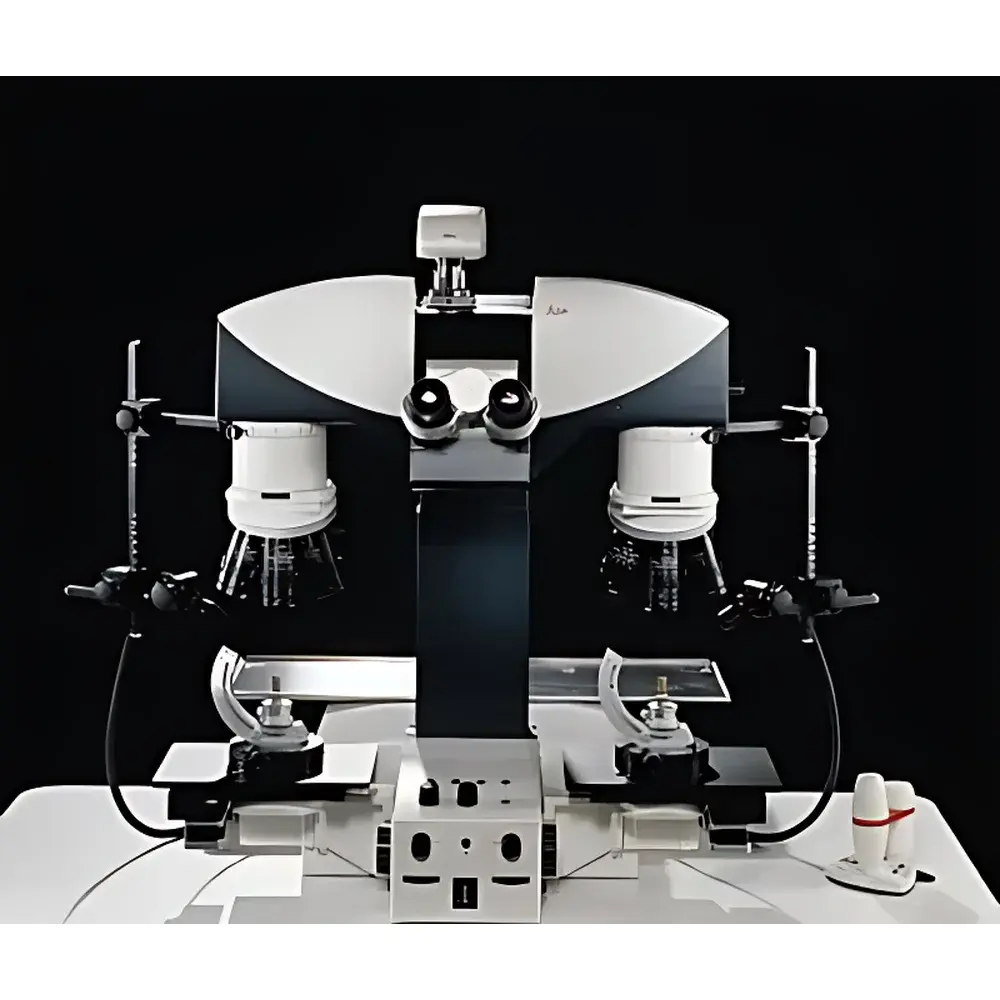
Leica FSC Forensic Comparison Microscope
| Brand | Leica |
|---|---|
| Origin | Germany |
| Model | FSC |
| Optical Magnification Range | 4× – 120× |
| Macro Objectives | 0.4×, 1×, 2×, 4×, 8× (5-position turret) |
| Viewing Field Diameter | 22 mm |
Overview
The Leica FSC Forensic Comparison Microscope is a purpose-built, high-precision optical instrument engineered for comparative analysis of ballistic, toolmark, and trace evidence in forensic laboratories. Designed to meet the stringent requirements of law enforcement and judicial institutions, it operates on the principle of simultaneous side-by-side optical comparison—enabling direct visual correlation of two specimens under identical illumination, magnification, and focus conditions. Its dual optical path architecture incorporates matched objective lenses, synchronized focusing mechanisms, and a motorized comparison bridge that ensures parfocal and parcentric alignment across the entire magnification range. The system supports rigorous documentation workflows through seamless integration with digital imaging platforms, making it suitable for court-admissible evidence examination per international forensic standards including ISO/IEC 17025 and ASTM E2926–23 (Standard Guide for Comparison Microscopy of Firearms Evidence).
Key Features
- Motorized dual-axis X/Y translation stage with programmable positioning and rotational capability—enabling precise spatial registration of complex evidence such as fired cartridge cases and bullet jackets.
- 6-position encoded objective turret with macro objectives (0.4×, 1×, 2×, 4×, 8×), each equipped with integrated iris diaphragms for independent control of depth of field and contrast optimization.
- Optical magnification range from 4× to 120×, calibrated and traceable to NIST-traceable standards; total magnification includes eyepiece and intermediate optics contributions.
- Motorized optical comparison bridge with fine-tuned lateral and angular alignment controls—ensuring consistent stereoscopic overlay and minimizing operator-induced parallax errors.
- Multi-mode illumination system: selectable coaxial episcopic lighting for surface topography, variable-angle oblique lighting for ridge enhancement, and transmitted light base for translucent or semi-transparent evidence (e.g., glass fragments, thin polymer films).
- Dedicated forensic fixture interface supporting standardized ballistic mounting solutions—including bullet cradles, cartridge case holders, wire clamps, lock impression stages, and adjustable tilt platforms—all compliant with AFTE (Association of Firearm and Tool Mark Examiners) recommended practices.
Sample Compatibility & Compliance
The Leica FSC accommodates a broad spectrum of physical evidence types commonly encountered in forensic casework: fired bullets and cartridge cases, toolmarks on metal surfaces, fractured glass, cut wires, impression evidence (e.g., shoeprints, tire treads), and questioned documents. Its large-format specimen stage (≥150 mm × 120 mm) and modular mounting system allow rapid reconfiguration between evidence classes without realignment. All optical components are certified to DIN EN ISO 10110 standards for surface quality and wavefront fidelity. The system conforms to GLP-compliant documentation protocols when paired with Leica LAS X forensic software, supporting audit trails, user access logs, and electronic signature functionality aligned with FDA 21 CFR Part 11 requirements.
Software & Data Management
The microscope integrates natively with Leica LAS X Forensic Edition—a validated software platform supporting image acquisition, annotation, measurement (distance, angle, curvature), side-by-side digital comparison, and report generation. It provides time-stamped metadata embedding (including objective ID, magnification, illumination mode, and stage coordinates), automatic calibration verification, and DICOM-compatible export for laboratory information management systems (LIMS). Raw image data is stored in TIFF or proprietary Leica LIF format with embedded EXIF tags, ensuring chain-of-custody integrity and long-term archival stability. Optional encryption modules support secure network deployment within accredited forensic facilities.
Applications
- Firearms identification via microscopic comparison of breech face marks, firing pin impressions, and ejector markings on cartridge cases.
- Toolmark analysis of screwdrivers, pliers, crowbars, and cutting instruments used in burglary or assault investigations.
- Trace evidence correlation—including paint layer sequencing, fiber morphology, and fracture surface matching.
- Questioned document examination involving ink differentiation, indented writing recovery, and typewriter/printer mechanism analysis.
- Ballistic trajectory reconstruction support through high-magnification surface feature mapping and dimensional metrology.
FAQ
Is the Leica FSC compatible with third-party digital cameras and imaging software?
Yes—the microscope features standard C-mount and F-mount interfaces, and supports GenICam-compliant cameras. SDKs are available for custom integration with non-Leica software environments.
Does the system support automated focus stacking for extended depth-of-field imaging?
When used with Leica LAS X Forensic Edition and compatible motorized Z-drive modules, the FSC supports fully automated focus stacking with sub-micron step resolution and Z-correction algorithms.
Can the optical comparison bridge be manually adjusted if motorized control fails?
Yes—the bridge includes precision manual override knobs with vernier scales for emergency alignment, maintaining operational continuity during maintenance intervals.
What calibration documentation is provided with the instrument?
Each unit ships with a factory calibration certificate referencing ISO/IEC 17025-accredited metrology, covering magnification accuracy, stage linearity, illumination uniformity, and bridge alignment repeatability.
Is remote operation supported for collaborative casework review?
Via Leica’s optional Remote Access Module (RAM), authorized users can perform live viewing, annotation, and synchronized navigation across distributed forensic units—subject to local IT security policy compliance.



