
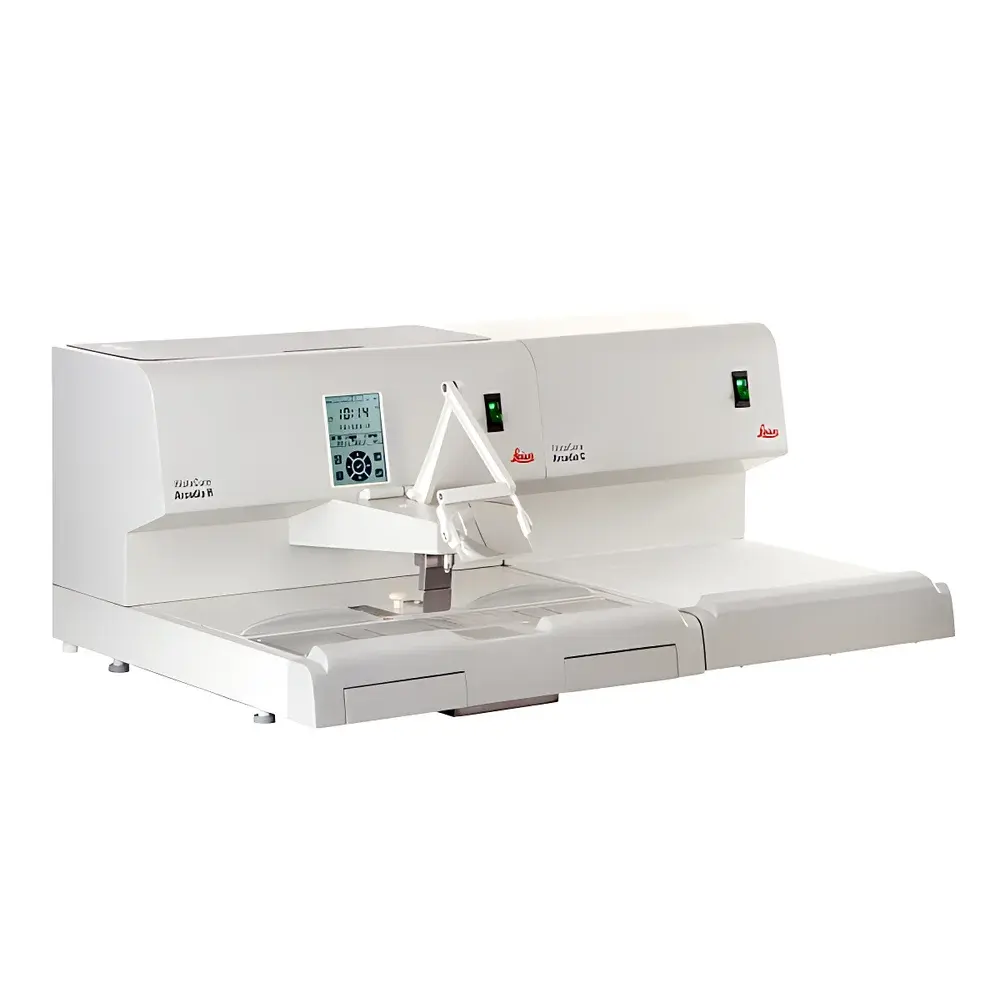
Leica HistoCore Arcadia Tissue Embedding Station
| Brand | Leica |
|---|---|
| Origin | Germany |
| Model | HistoCore Arcadia |
| Operating Temperature Range | 50–75 °C (1 °C increments) |
| Wax Bath Capacity | Up to 4 L |
| Tray Compatibility | ~150 cassettes (Peloris-compatible cassette baskets) |
| Display | 5.7-inch capacitive touchscreen LCD |
| Illumination | White LED |
| Power Supply | 100–120 VAC / 220–240 VAC, 50/60 Hz |
| Max Power Consumption | 1000 VA |
| Ambient Operating Temperature | +20 °C to +30 °C |
| Dimensions (D×W×H) | 636 × 560 × 384 mm |
| Weight | 27 kg |
| Optional Accessories | Ergonomic magnifier, liquid filtration module, footswitch |
| Cold Plate Function | Auto-regulated at −6 °C |
| Minimum Solidification Load | 65 paraffin blocks in 30 minutes |
| Cold Plate Dimensions | 155 × 80 × 100 mm |
| Cold Plate Weight | ~1.5 kg |
| Cold Plate Ambient Range | +15 °C to +40 °C |
Overview
The Leica HistoCore Arcadia is a fully integrated, benchtop tissue embedding station engineered for precision, reproducibility, and workflow efficiency in histopathology laboratories. Designed according to ISO 13485–compliant manufacturing standards and validated for routine use under GLP and CAP-accredited environments, the Arcadia employs dual-temperature control architecture—combining a thermostatically regulated paraffin bath (50–75 °C, ±0.5 °C stability) with an independently controlled cryo-cooling plate (auto-regulated at −6 °C)—to ensure optimal wax infiltration, orientation, and rapid solidification of tissue specimens. Its modular design supports seamless integration into automated histology workflows, including compatibility with Leica Biosystems’ HistoCore PELORIS cassette loading systems and downstream microtomy platforms. The system operates without external cooling water or compressed air, reducing infrastructure dependencies while maintaining compliance with IEC 61010-1 safety requirements for laboratory equipment.
Key Features
- Dual-zone thermal management: Independent control of paraffin bath (50–75 °C, 1 °C resolution) and cryo-plate (−6 °C auto-regulated), enabling simultaneous embedding and rapid block solidification
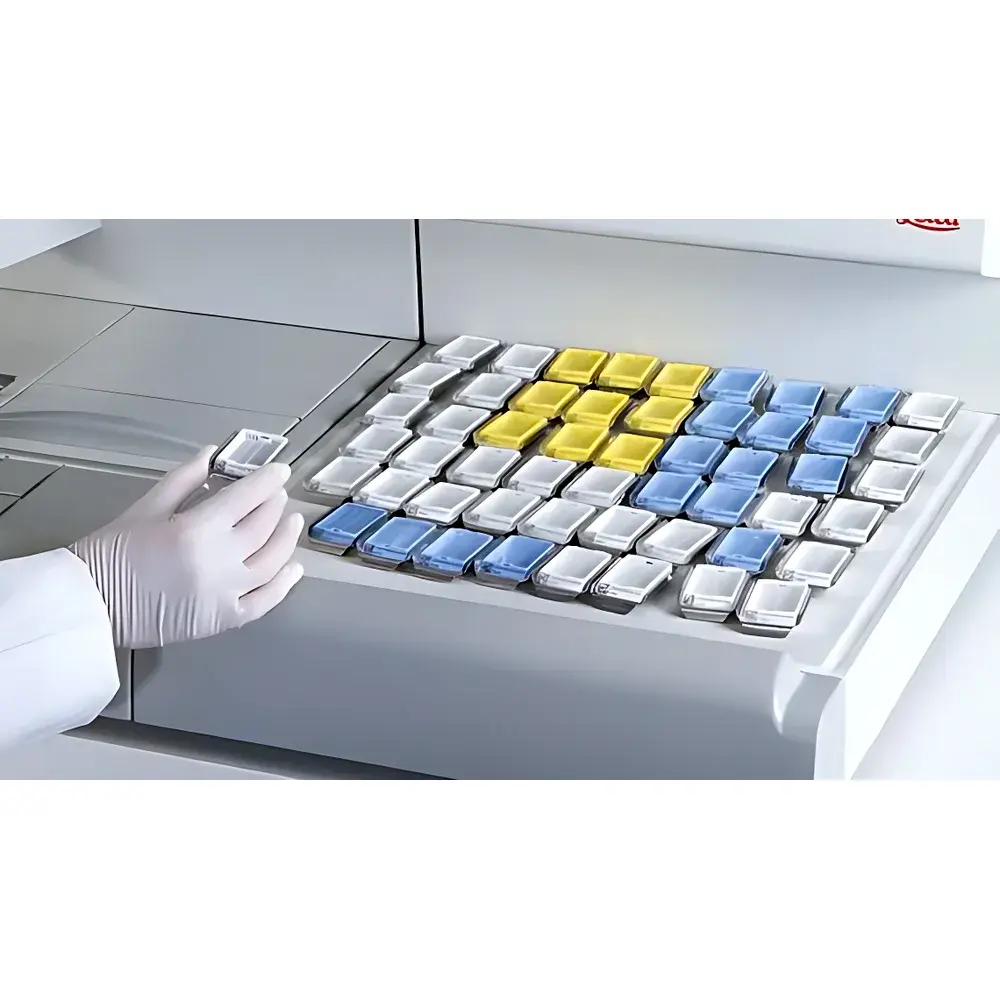
- High-capacity cassette tray: Accommodates up to 150 standard histology cassettes; designed for direct compatibility with Peloris cassette baskets to minimize manual handling
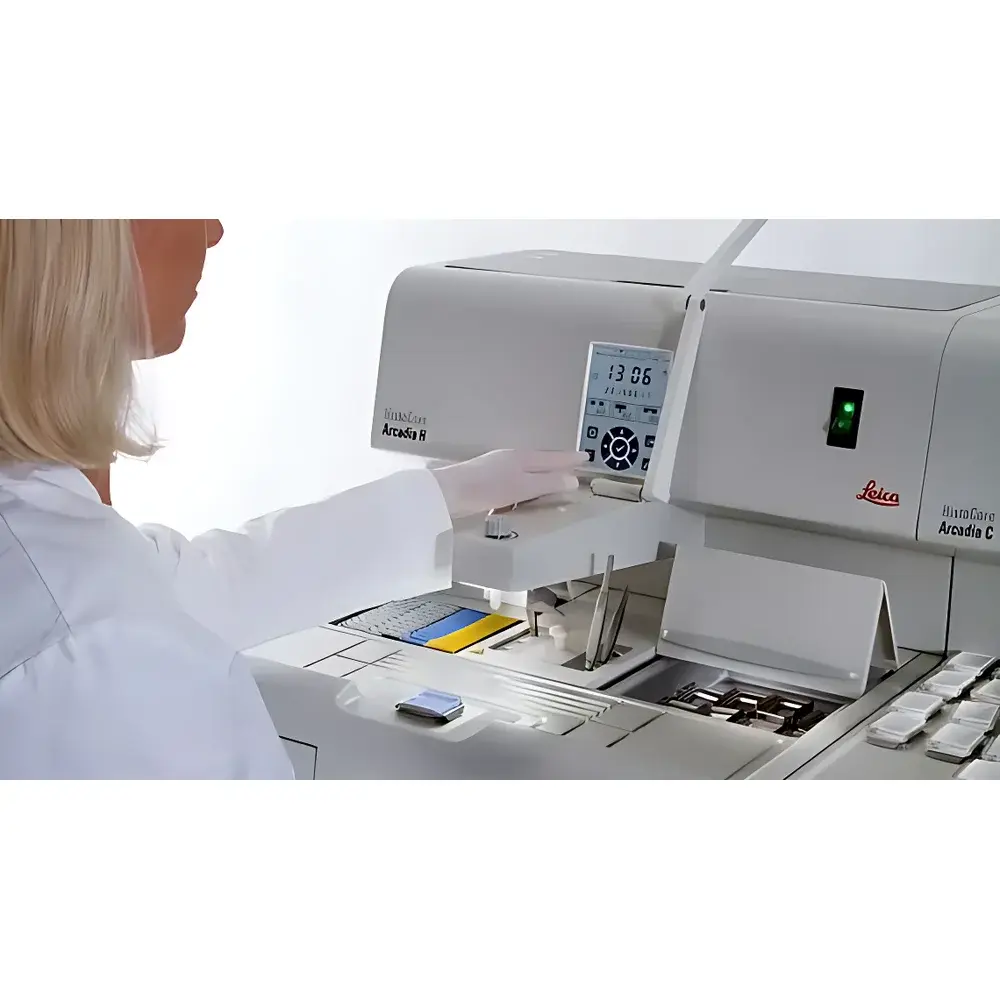
- Intuitive 5.7-inch capacitive touchscreen interface: Graphical workflow navigation with multilingual support (English, German, French, Spanish, Chinese, Japanese), programmable protocols, and real-time temperature logging
- Optimized wax bath geometry: 4 L capacity with uniform thermal distribution and low evaporation rate (<0.8 mL/h at 60 °C), minimizing wax degradation and replenishment frequency
- Integrated white LED illumination: Adjustable intensity and directional focus for precise tissue orientation under ambient lab lighting conditions
- Energy-efficient architecture: Maximum power draw of 1000 VA for main unit; cold plate consumes ≤400 VA, supporting operation in standard laboratory circuits without dedicated lines
Sample Compatibility & Compliance
The HistoCore Arcadia accommodates standard 25 × 25 mm, 30 × 30 mm, and 40 × 40 mm paraffin embedding molds, as well as custom molds up to 50 mm depth. It supports all common embedding media—including paraffin, low-melting-point waxes (e.g., Paraplast® X-tra), and resin-compatible formulations—without modification. The system meets CE marking requirements under Directive 2014/30/EU (EMC) and 2014/35/EU (LVD), and complies with ISO 15195:2018 for calibration traceability of temperature sensors. For regulatory submissions, embedded audit trails (including user ID, timestamp, temperature setpoints, and protocol execution logs) satisfy FDA 21 CFR Part 11 requirements when paired with Leica’s optional HistoCore Connect software suite.
Software & Data Management
The onboard firmware supports protocol storage for up to 20 user-defined embedding sequences, each with configurable dwell times, temperature ramps, and cooling initiation triggers. All operational data—including bath temperature profiles, cold plate activation cycles, and user authentication events—are timestamped and exportable via USB 2.0 to CSV or PDF formats. When connected to Leica’s HistoCore Connect platform (optional), the Arcadia enables remote monitoring, centralized log aggregation across multiple instruments, and automatic backup to network-attached storage (NAS) or cloud-based repositories compliant with HIPAA and GDPR data residency policies.
Applications
The HistoCore Arcadia is routinely deployed in clinical diagnostic labs, academic pathology departments, and pharmaceutical CMC (Chemistry, Manufacturing, and Controls) facilities for high-throughput tissue processing prior to sectioning. Key use cases include: routine surgical specimen embedding with strict turnaround time (TAT) requirements; research-grade serial sectioning of delicate neural or embryonic tissues requiring minimal thermal stress; quality control of biobanked samples where wax penetration consistency directly impacts downstream IHC/IF staining fidelity; and GLP-compliant toxicology studies where full traceability of embedding parameters is mandated by OECD Test Guidelines 407 and 422.
FAQ
Does the Arcadia require external cooling water or refrigerant lines?
No—the cryo-plate uses a sealed, maintenance-free thermoelectric (Peltier) cooling system; no plumbing or consumable refrigerants are needed.
Can the system validate temperature accuracy per ISO/IEC 17025?
Yes—built-in PT100 sensors are factory-calibrated against NIST-traceable references; users may perform in-house verification using Class A platinum resistance thermometers.
Is the touchscreen interface compatible with gloved operation?
Yes—the capacitive display responds reliably to standard nitrile and latex gloves, and includes haptic feedback confirmation for critical actions.
What is the minimum recommended ambient humidity range for stable operation?
The system is rated for 30–70% non-condensing relative humidity; operation outside this range may affect touchscreen responsiveness and wax viscosity consistency.
How does the Arcadia handle wax overflow or spillage during filling?
The bath features a recessed fill port with drip guard and integrated overflow channel directing excess wax to a removable collection reservoir beneath the base chassis.



