
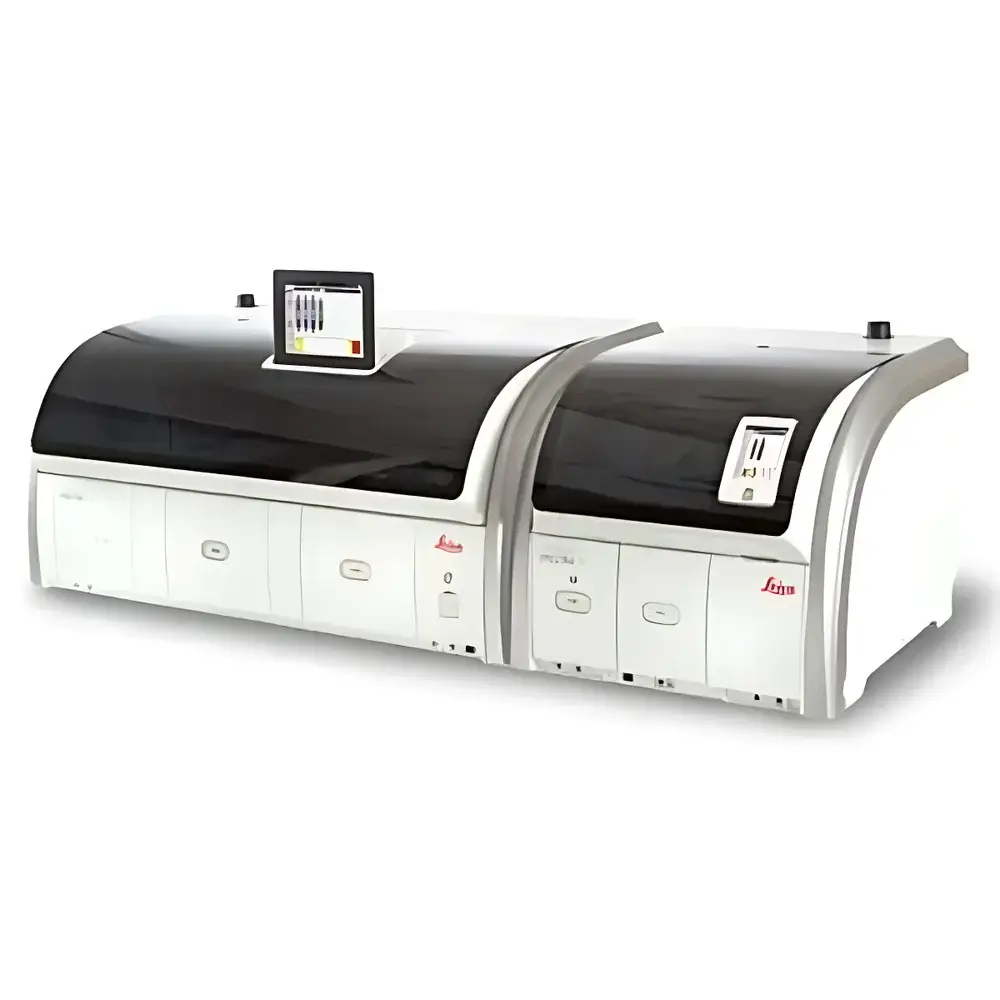
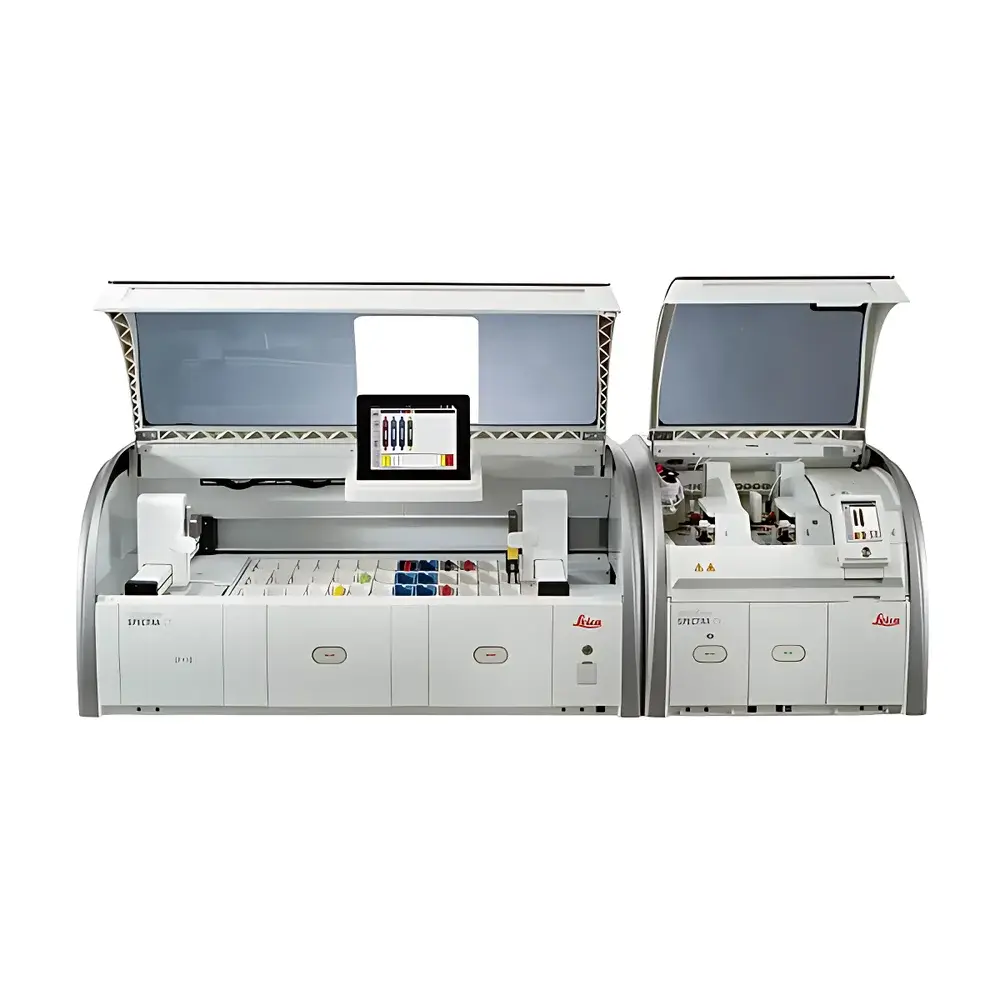
Leica HistoCore SPECTRA ST-CV Automated H&E and Special Staining System
| Brand | Leica Biosystems |
|---|---|
| Origin | Germany |
| Model | HistoCore SPECTRA ST-CV |
| Dimensions (closed) | 135.4 × 78.5 × 58.5 cm |
| Dimensions (open) | 135.4 × 78.5 × 94.3 cm |
| Weight (empty) | 185 kg |
| Weight (loaded) | ~220 kg |
| Power Supply | 100–240 V AC |
| Throughput | up to 330 H&E slides/hour |
| Slide Capacity | 1,600 slides per run |
| Staining Reagent Volume | 380 mL per bottle |
| Slide Rack Capacity | 30 racks (5 dedicated to special stains) |
| Tube Stations | 36 |
| Tube Wash Stations | 6 |
| Input/Output Drawer Slots | 5 per drawer (max. 150 slides continuous load) |
| Integrated Drying Oven | 6-rack capacity |
| Drying Time | ≤5 min |
Overview
The Leica HistoCore SPECTRA ST-CV is a fully automated, high-throughput tissue staining platform engineered for precision, reproducibility, and regulatory traceability in diagnostic histopathology laboratories. Based on programmable robotic liquid handling and dual-arm architecture, the system executes standardized Hematoxylin and Eosin (H&E) staining protocols alongside concurrent special stain workflows—without cross-contamination or manual intervention. Its core operational principle relies on precise reagent dispensing, temperature-controlled incubation, timed immersion cycles, and integrated thermal drying—eliminating reliance on external ovens and minimizing pre-analytical variability. Designed to meet the throughput demands of centralized pathology labs and reference centers, the SPECTRA ST-CV delivers consistent nuclear and cytoplasmic contrast across all 1,600 slides in a single batch, maintaining inter-slide coefficient of variation (CV) below 3% for optical density measurements under validated conditions.
Key Features
- Dual robotic arm architecture enabling simultaneous H&E and special stain processing on a single platform—up to 52 independent tube stations support parallel multi-protocol operation.
- Integrated 6-rack hot-air drying oven with programmable temperature ramping (45–75°C), achieving full slide dryness in ≤5 minutes—enabling immediate downstream scanning or microscopic review.
- RFID-enabled consumables management: Each reagent bottle, cover slip cartridge, and mounting medium vial carries an embedded tag that auto-registers lot number, expiration date, and real-time usage—synchronizing with the LIMS via HL7 or ASTM E1384 interfaces.
- Slide-by-slide counting via optical sensor array and rack-level identification—providing granular tracking of slide throughput, reagent consumption per slide, and predictive maintenance alerts based on cumulative mechanical cycles.
- Color-coded, barcode-scanned slide racks ensure protocol-specific orientation and prevent misloading; each rack supports 50 standard 25 × 75 mm glass slides with reinforced edge retention during agitation.
- Intuitive touchscreen interface with context-aware workflow guidance, pre-loaded SOPs compliant with CAP and ISO 15189, and password-protected method editing access levels (Operator, Supervisor, Administrator).
Sample Compatibility & Compliance
The SPECTRA ST-CV accommodates routine formalin-fixed paraffin-embedded (FFPE) tissue sections mounted on standard glass slides (25 × 75 mm), including charged, APES-coated, and poly-L-lysine substrates. It supports both manual and automated section transfer from microtomes into compatible racks, with optional integration into Leica’s BOND RX™ ecosystem for end-to-end IHC-to-H&E coordination. All staining chemistries—including SPECTRA Hemalast®, SPECTRA Hematoxylin®, SPECTRA Differentiator®, SPECTRA Bluing®, and SPECTRA Eosin®—are formulated to comply with CLSI H20-A3 and ISO 13032:2021 standards for histological quality control. The system is CE-marked under IVDR 2017/746 Annex II Class B and certified to c-CSA-us for North American clinical use. Full audit trail logging—including user actions, reagent lot changes, temperature deviations, and slide count verification—is retained for ≥10 years and exportable in PDF/A-2 or CSV format for regulatory inspection.
Software & Data Management
HistoCore Connect software provides centralized fleet management for multi-unit installations, supporting remote diagnostics, firmware updates, and performance benchmarking across sites. Each instrument logs timestamped events with digital signatures, adhering to FDA 21 CFR Part 11 requirements for electronic records and signatures—including role-based access control, biometric login options, and immutable audit trails. Raw log files include metadata such as ambient humidity, internal chamber temperature variance (±0.3°C), reagent viscosity compensation values, and mechanical arm positional accuracy (±0.1 mm). Data export supports DICOM-SR for structured reporting integration and HL7 ADT messages for patient demographic synchronization. Optional cloud backup via Leica’s SecureLink™ gateway ensures HIPAA-compliant offsite redundancy without compromising local data sovereignty.
Applications
- Routine diagnostic H&E staining for surgical pathology, cytology, and frozen section turnaround—reducing average TAT from 24h to <8h for urgent cases.
- High-volume special stain deployment (e.g., Masson’s Trichrome, PAS, Alcian Blue, Ziehl-Neelsen) alongside H&E in shared batches—optimizing reagent utilization and technician labor allocation.
- Research-grade tissue banking where staining consistency across longitudinal cohorts is critical for digital pathology algorithm training and AI model validation.
- GLP-compliant toxicologic pathology studies requiring full traceability of staining parameters per OECD 407 and ICH S5(R3) guidelines.
- Academic core facilities supporting multi-investigator projects with customizable protocol libraries, version-controlled SOPs, and automated QC report generation.
FAQ
What is the maximum number of slides processed per run?
The system handles up to 1,600 slides per uninterrupted staining cycle, with guaranteed uniformity across all positions when using validated SPECTRA reagents and consumables.
Does the SPECTRA ST-CV require external drying equipment?
No—the integrated 6-rack thermal drying oven eliminates dependency on standalone slide dryers, reducing footprint and eliminating manual slide transfer steps.
How does RFID improve reagent inventory management?
Each reagent container and consumable pack is uniquely tagged; the system automatically decrements stock levels, flags near-expiry items, and prevents initiation of protocols with expired or low-volume reagents.
Is the software compatible with hospital LIMS systems?
Yes—HistoCore Connect supports ASTM E1384, HL7 v2.x, and custom API integrations for bidirectional data exchange, including patient ID, accession number, and staining completion status.
What regulatory standards does the system support for audit readiness?
Full compliance with FDA 21 CFR Part 11, ISO 13485:2016, CAP Checklist ANP.30150, and EU IVDR 2017/746—including electronic signature validation, change control documentation, and retrospective event reconstruction capabilities.



