
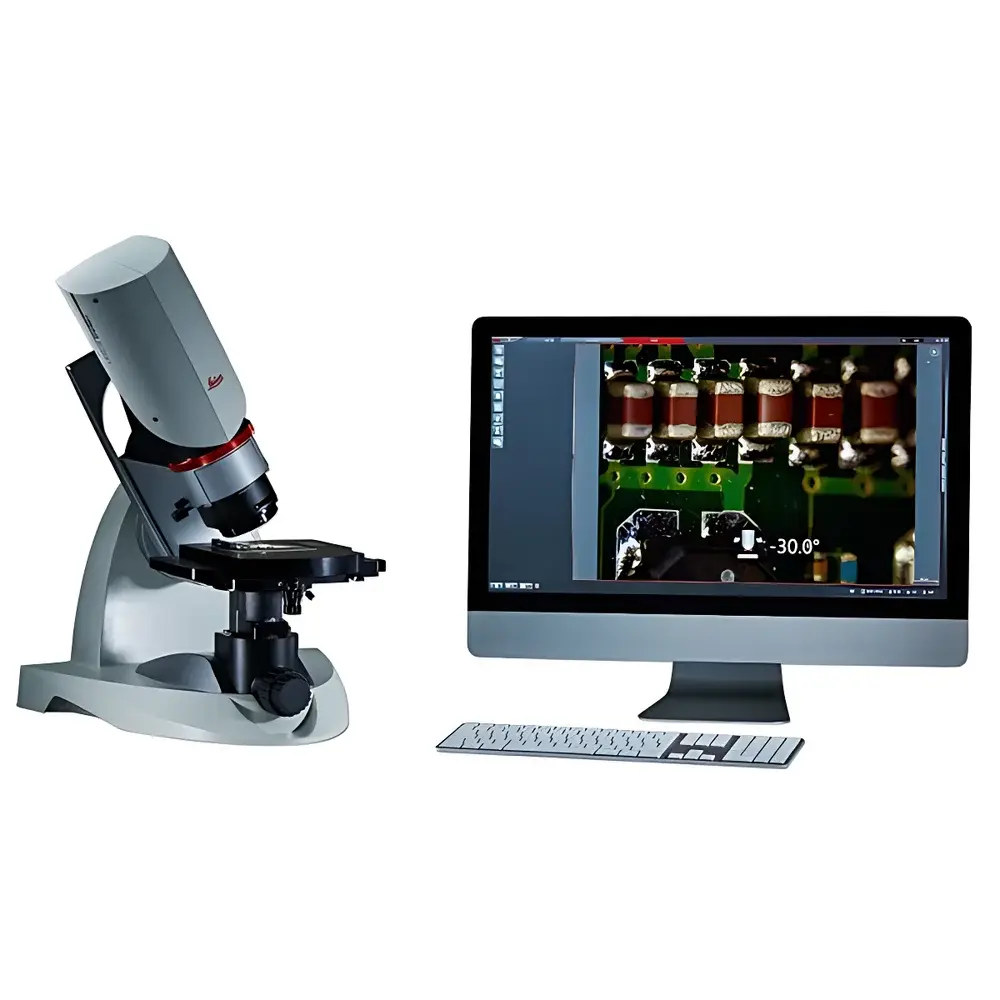
Leica LAS X ID Industrial Software Platform
| Brand | Leica |
|---|---|
| Origin | Germany |
| Manufacturer Type | Authorized Distributor |
| Origin Category | Imported |
| Model | LAS X ID |
| Pricing | Upon Request |
Overview
Leica LAS X ID is a purpose-built industrial software platform developed by Leica Microsystems for high-precision microscopic imaging, quantitative analysis, and standardized documentation in quality control (QC), failure analysis, and materials science laboratories. Built on the proven architecture of the Leica Application Suite X (LAS X) family, LAS X ID implements a modular, workflow-driven design optimized for repeatable, auditable, and operator-independent microscopy operations. It operates on the principle of structured image acquisition—where hardware configuration, illumination parameters, stage positioning, camera settings, and analytical routines are encapsulated into executable protocols—ensuring measurement traceability and procedural consistency across shifts and operators. The platform supports integration with Leica DMi8, DM6 M, and DVM6 industrial microscopes, as well as compatible motorized stages, LED illumination systems, and scientific CMOS cameras. Its core objective is to transform complex optical metrology tasks into streamlined, compliant, and reproducible digital workflows.
Key Features
- Full-Screen Sample-Centric Interface: Maximizes visual focus on the specimen; functional controls (e.g., illumination presets, camera capture, Z-stack acquisition) appear only on demand via mouse hover or click—minimizing interface clutter without sacrificing access.
- Protocol-Driven Imaging: Enables creation and execution of step-by-step acquisition protocols—including multi-position tiling, Z-series stacking, and multi-channel fluorescence registration—ensuring identical parameter sets across users and sessions.
- Automated Report Generation: Ships with preconfigured, ISO/IEC 17025-aligned report templates for dimensional metrology, grain size analysis, inclusion rating (ASTM E112, E45), and surface defect quantification; fully customizable via drag-and-drop layout editor and exportable as PDF, TIFF, or structured XML.
- User Profile Management: Supports role-based profiles with granular permission control—novice operators receive simplified UIs with locked critical parameters, while senior analysts access advanced measurement tools, scripting (via Python API), and batch processing modules.
- Batch Image Processing & Cross-System Calibration: Allows bulk import of TIFF, JPEG2000, or Leica LIF files from multiple instruments; includes pixel-size recalibration engine to harmonize measurements across different microscope platforms and magnification setups.
- Auto-Save & Audit Trail: All acquisition metadata (time stamp, objective ID, exposure time, stage coordinates, user login) is embedded in image headers and logged in an internal SQLite database; optional export for GLP/GMP audit compliance (21 CFR Part 11-ready when deployed with validated IT infrastructure).
Sample Compatibility & Compliance
Leica LAS X ID supports routine analysis of metallurgical specimens (polished cross-sections, fracture surfaces), electronic components (PCB traces, solder joints), composite laminates, and ceramic coatings. It natively interprets calibration standards traceable to NIST SRM references (e.g., stage micrometers, line-pair resolution targets). The software complies with key industry frameworks: ASTM E112 (grain size), ASTM E45 (inclusion rating), ISO 9276 (particle size distribution), and ISO 16232 (automotive component cleanliness). When deployed in regulated environments, LAS X ID supports electronic signatures, change logs, and locked report templates—facilitating alignment with ISO 13485, IATF 16949, and FDA QSR requirements.
Software & Data Management
Running on Windows 10/11 (64-bit), LAS X ID utilizes a client-server architecture option for centralized license management and shared protocol libraries. Raw data is stored in open-format LIF containers (based on HDF5), ensuring long-term readability without proprietary lock-in. The integrated Python scripting interface (LAS X Scripting Module) enables automation of repetitive tasks—such as batch measurement of pore area fraction per ASTM E2109—or integration with external statistical packages (e.g., JMP, MATLAB). Data export options include CSV (for Excel-based SPC charts), OME-TIFF (for Fiji/ImageJ compatibility), and DICOM-SR (for enterprise PACS integration in hybrid lab-hospital settings). All exported reports retain embedded metadata for full chain-of-custody verification.
Applications
- Metallographic QC in foundries and heat-treatment facilities
- Defect root-cause analysis in semiconductor packaging and MEMS fabrication
- Coating thickness and adhesion assessment per ISO 2808 and ASTM D4138
- Particle contamination analysis on aerospace turbine blades (per ISO 16232 Class C–F)
- Weld seam inspection and porosity quantification in pressure vessel manufacturing
- Non-destructive evaluation of additive-manufactured part microstructure (powder bed fusion, binder jetting)
FAQ
Is LAS X ID compatible with non-Leica microscope hardware?
No—LAS X ID is engineered exclusively for Leica industrial microscopes with native hardware drivers. Third-party cameras or stages require custom SDK integration and are not supported out-of-the-box.
Does LAS X ID support 21 CFR Part 11 compliance?
Yes—when deployed with validated system configuration, electronic signature modules, and controlled change management procedures, LAS X ID meets technical prerequisites for Part 11 adherence. Full validation documentation is available under NDA upon request.
Can measurement templates be shared across networked workstations?
Yes—protocol files (.lasxproto), report templates (.lasxreport), and user profiles (.lasxprofile) are portable XML-based assets that synchronize via shared network drives or Leica’s optional LAS X Server.
What file formats can LAS X ID import for re-analysis?
TIFF (with embedded calibration), JPEG2000, PNG, BMP, and native Leica LIF files. RAW sensor data from Leica cameras is preserved in LIF containers for lossless reprocessing.
Is Python scripting available in all LAS X ID license tiers?
Scripting capability requires the LAS X ID Advanced or Enterprise license tier; the Base tier supports only GUI-driven workflows and template-based reporting.





