
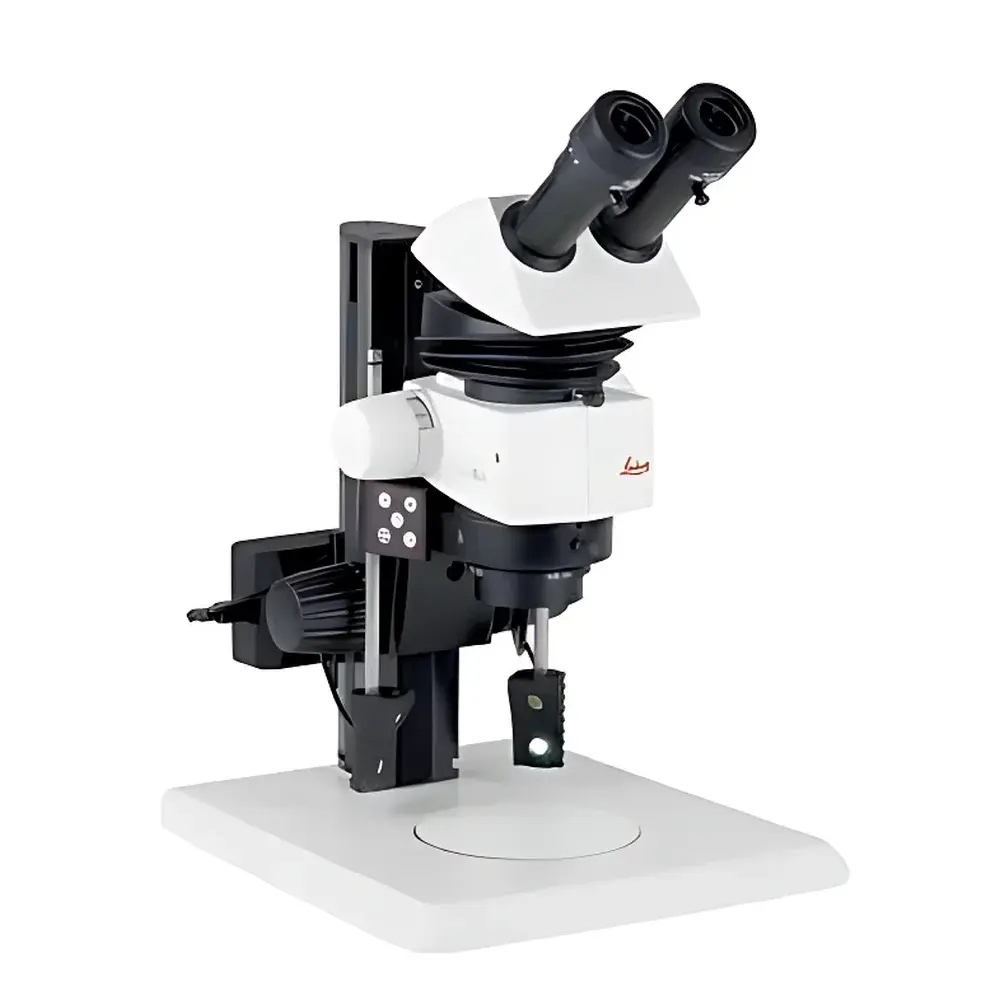
Leica LED3000 MCI Multi-Contrast Illuminator for Stereo Microscopy
| Brand | Leica |
|---|---|
| Origin | Germany |
| Model | LED3000 MCI |
| Light Source | Four High-Performance White LEDs |
| LED Lifetime | ≥50,000 hours |
| Color Temperature | ~5,600 K (Neutral White) |
| Control Interface | Integrated Rotary Knob & Dedicated LED Switches |
| Compatibility | Leica M-series and Z-series Stereo Microscopes |
| Bus Interface | Leica CAN Bus (Supports daisy-chaining with LED3000 RL, NVI, etc.) |
| Footprint | Compact, Benchtop-Integrated Design |
| Power Consumption | <12 W |
| Compliance | CE, RoHS, IEC 61000-6-3/6-4 |
Overview
The Leica LED3000 MCI is a purpose-engineered multi-contrast illuminator designed exclusively for Leica stereo microscopes—including the M-series (e.g., M205 A, M165 FC) and Z-series platforms. Unlike conventional coaxial or ring-light illumination systems, the LED3000 MCI implements a dual-arc, four-LED optical architecture to generate controlled, directional contrast variation across specimen surfaces. Its core principle relies on differential surface reflectance modulation: two independently positioned LED arcs—each housing two high-CRI white LEDs—emit light from distinct azimuthal and elevation angles (±20° and ±45° relative to the optical axis). This enables systematic enhancement of topographic features such as micro-scratches, grain boundaries, solder joint contours, or low-contrast biological tissue interfaces without staining or physical sample modification. The system operates on Leica’s proprietary CAN bus protocol, ensuring deterministic communication latency and synchronization with microscope control units—critical for GLP-compliant documentation workflows in regulated manufacturing and R&D environments.
Key Features
- Dual-arc illumination geometry with four individually addressable neutral-white LEDs (5600 K), delivering consistent spectral output and eliminating color shift over time.
- Reproducible contrast presets enabled by mechanical detent positions on the rotary intensity/contrast selector—essential for SOP-driven inspection repeatability across shifts or operators.
- Compact, fully integrated benchtop housing (<120 mm footprint) that eliminates external cabling clutter and preserves ergonomic working distance.
- Direct hardware-level LED activation: each of the four LEDs can be toggled on/off via dedicated tactile switches—enabling rapid empirical optimization of shadowing effects during live observation.
- Native Leica CAN bus compatibility allows seamless integration with secondary lighting modules (e.g., LED3000 RL for reflected light, NVI for near-vertical illumination) without additional controllers or software layers.
- Energy-efficient operation (<12 W total draw) with no warm-up delay, zero UV emission, and maintenance-free performance over ≥50,000 hours—aligned with ISO 14001 laboratory sustainability objectives.
Sample Compatibility & Compliance
The LED3000 MCI is validated for use with non-fluorescent, non-autofluorescent specimens across industrial QA/QC, electronics assembly verification, forensic toolmark analysis, and botanical morphology studies. It supports samples ranging from polished metal substrates (e.g., ASTM E3-22 metallographic standards) to unmounted insect exoskeletons or PCB solder joints. No optical filters or polarizers are required; contrast differentiation arises solely from geometric illumination variance. The device conforms to IEC 61000-6-3 (emission) and IEC 61000-6-4 (immunity) for electromagnetic compatibility in shared lab environments. As a Class 1 LED product per IEC 62471, it poses no photobiological hazard—eliminating need for operator training under ANSI Z136.1. Its firmware architecture supports audit-trail-capable configuration logging when paired with Leica Application Suite (LAS X) v3.7+, satisfying FDA 21 CFR Part 11 requirements for electronic records in medical device manufacturing.
Software & Data Management
While the LED3000 MCI operates autonomously via front-panel controls, its CAN bus interface enables bidirectional parameter exchange with Leica LAS X software. Users may save and recall up to 8 user-defined illumination profiles—including individual LED status, relative intensity ratios, and arc orientation states—directly from the software interface. All profile changes are timestamped and logged with operator ID (when integrated with Windows Active Directory authentication). Raw illumination metadata (e.g., active LED IDs, duration of use per session) is exportable as CSV for preventive maintenance scheduling. No cloud connectivity or third-party SDKs are implemented—ensuring full data sovereignty within on-premise network architectures compliant with GDPR and HIPAA data residency mandates.
Applications
- Electronics: Inspection of fine-pitch BGA solder joints, conformal coating uniformity, and flex-circuit trace integrity where traditional brightfield obscures subtle height differentials.
- Precision Machining: Detection of micro-burr formation on stainless steel surgical instruments per ISO 13485 clause 7.5.3.
- Forensics: Enhancement of latent toolmark striations on cartridge casings without chemical treatment—supporting SWGFAST guideline 4.2.1.
- Academic Research: Comparative morphological analysis of diatom frustules or pollen wall ultrastructure under variable oblique illumination—reducing reliance on SEM for preliminary screening.
- Pharmaceutical Packaging: Visual verification of aluminum foil seal integrity on blister packs per USP guidance, where specular reflection artifacts hinder defect recognition.
FAQ
Can the LED3000 MCI be used with non-Leica stereo microscopes?
No—it requires native Leica CAN bus signaling and mechanical coupling specific to M/Z-series dovetail mounts. Adapters or third-party controllers are not supported.
Is firmware update capability available?
Yes—updates are delivered exclusively via Leica Service Mode using LAS X software and require authorized service engineer credentials.
Does the unit support TTL or analog dimming inputs?
No—intensity control is exclusively through the integrated rotary encoder or LAS X software; no external voltage or pulse-width modulation interfaces are provided.
What is the recommended calibration interval?
Leica specifies no routine photometric calibration; however, annual verification of LED output stability against NIST-traceable luminance standards is advised for ISO/IEC 17025-accredited labs.
How is heat dissipation managed during extended operation?
Passive aluminum heatsinking combined with thermal throttling circuitry maintains junction temperature below 65°C—verified per IEC 60068-2-14 thermal shock testing.




