
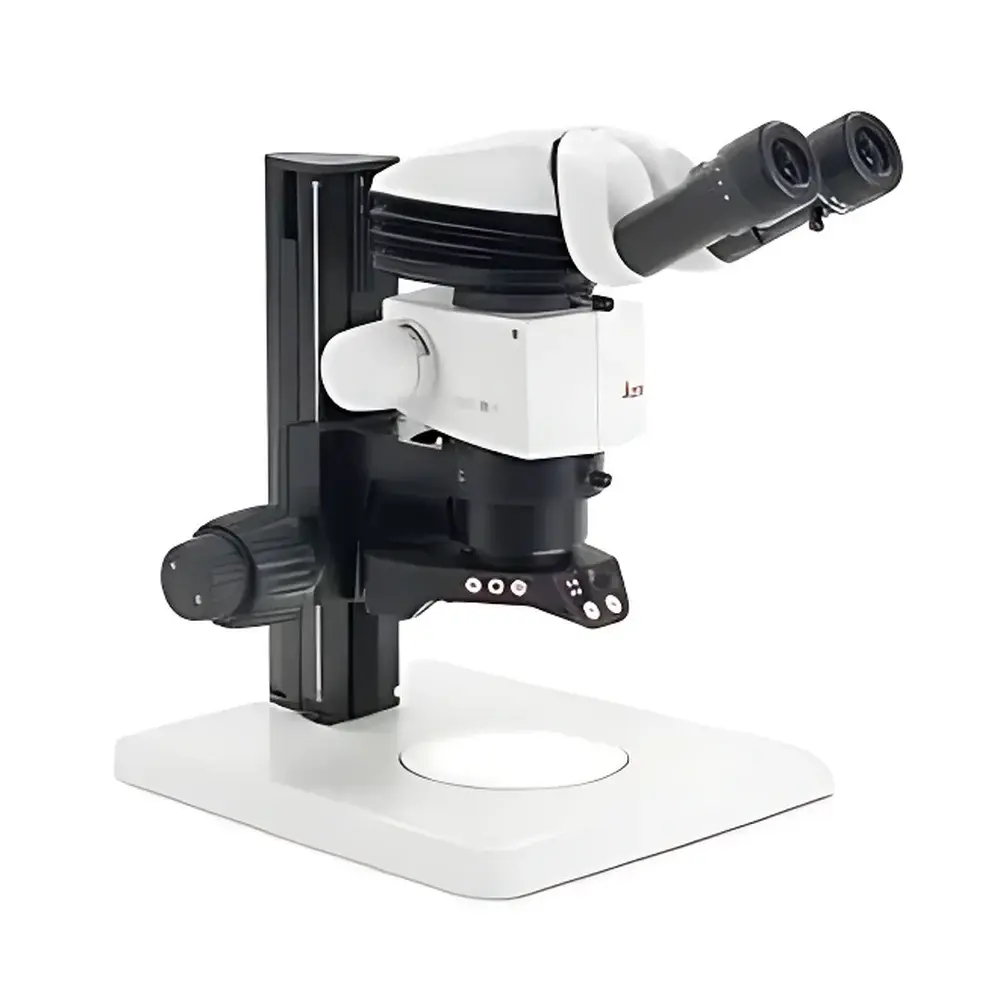
Leica LED3000 RL Ring Light Illuminator
| Brand | Leica |
|---|---|
| Origin | Germany |
| Model | LED3000 RL |
| Light Source | High-Efficiency White LEDs |
| Color Temperature | 5,200 K (Constant) |
| Illumination Field Diameter | Up to 120 mm (Uniform Illumination) |
| Adjustable Segments | 4 Independent Quadrants (0°–90°–180°–270°) + 2 Semi-Rings (0°–180° and 90°–270°) |
| Working Distance Compatibility | 60–150 mm |
| Objective Mount Thread | M58×0.75 |
| Integrated Control Interface | Leica Application Suite (LAS) X via USB or optional footswitch |
| Diffuser & Polarizer Accessories | Optional, mechanically attachable |
| Power Supply | 100–240 V AC, 50/60 Hz, external power adapter |
Overview
The Leica LED3000 RL Ring Light Illuminator is an engineered optical illumination solution designed specifically for stereo microscopes—particularly Leica M-series and Z-series platforms—where consistent, shadow-free, and spatially controllable lighting is critical for high-fidelity visual inspection, documentation, and quantitative analysis. Unlike conventional ring lights relying on simple LED arrays and reflectors, the LED3000 RL employs a proprietary collimation and homogenization architecture centered on Leica’s custom-designed fixed-focus lens system. This optical train ensures uniform photon distribution across the entire field of view—up to 120 mm in diameter—at a stable correlated color temperature of 5,200 K, minimizing chromatic drift during extended operation and eliminating the need for manual white balance recalibration between sessions. Its design adheres to the fundamental photometric requirements of stereomicroscopy: high spatial coherence, minimal vignetting, and low thermal load on sensitive biological or electronic specimens.
Key Features
- Four-quadrant independent LED control enables precise directional contrast modulation—ideal for revealing surface topography, edge definition, or subsurface features in opaque or semi-transparent samples.
- Dual semi-ring activation (0°–180° and 90°–270°) supports oblique illumination strategies without mechanical repositioning, facilitating rapid comparison of lighting geometries during failure analysis or forensic documentation.
- Integrated diffuser and polarizer accessory ports allow in-line attenuation of specular reflections from metallic, polymeric, or coated surfaces—supporting ISO 10993-compliant material inspection and IPC-A-610 electronic assembly verification.
- M58×0.75 objective-thread mounting ensures mechanical compatibility with Leica PlanApo, HCX, and S series objectives; optimized working distance range (60–150 mm) accommodates macro tools, micromanipulators, and soldering stations without obstruction.
- USB-based communication with Leica LAS X software enables full parameter logging—including segment intensity values, exposure time synchronization, and illumination state timestamps—meeting GLP/GMP audit trail requirements per FDA 21 CFR Part 11 when configured with user authentication and electronic signature modules.
Sample Compatibility & Compliance
The LED3000 RL is validated for use with live biological specimens (e.g., zebrafish embryos, Drosophila larvae), precision machined components (aerospace turbine blades, medical implants), printed circuit boards, and archival materials (paper, parchment, coinage). Its non-UV, low-heat output (<1.2 W total radiant flux in visible spectrum) complies with IEC 62471 Photobiological Safety classification (Risk Group 0). When deployed with LAS X’s “Illumination Profile Manager”, users can define and lock illumination presets per sample type—ensuring repeatability across operators and shifts. The system conforms to EN 61000-6-3 (EMC emission limits) and EN 61000-6-2 (immunity standards), making it suitable for regulated laboratory environments operating under ISO/IEC 17025 or CLIA frameworks.
Software & Data Management
Fully embedded within Leica LAS X v3.7+, the LED3000 RL supports bidirectional communication: illumination states are saved as metadata alongside acquired images (TIFF, JPEG2000, or Leica’s native LIF format), enabling retrospective reconstruction of acquisition conditions. The “Illumination History Log” records timestamped changes to quadrant intensities, diffuser/polarizer engagement status, and firmware version—exportable as CSV for QA review. Optional integration with Leica’s DM6 B or M205 FA microscope platforms permits synchronized hardware-triggered illumination sequencing during time-lapse or multi-angle imaging protocols.
Applications
- Quality control of solder joints and conformal coatings in electronics manufacturing (IPC-A-610 Class 3 compliance).
- Non-destructive evaluation of composite layup integrity and fiber orientation in aerospace composites.
- Microsurgical training and intraoperative documentation under standardized lighting conditions.
- Forensic trace evidence examination—e.g., toolmark analysis, gunshot residue morphology, or fiber birefringence assessment using polarized illumination.
- Botanical specimen imaging requiring consistent spectral rendering across herbarium digitization workflows (aligned with CEN/TS 16153:2011).
FAQ
Is the LED3000 RL compatible with non-Leica stereo microscopes?
Yes—when used with an M58×0.75 step-down adapter ring and appropriate mounting bracket; however, full LAS X integration and preset recall require Leica hardware-level handshake protocols.
Can illumination profiles be exported and shared across multiple instruments?
Yes—LAS X allows export of .ilp (illumination profile) files, which retain all quadrant intensities, accessory states, and metadata tags; import is supported on any LAS X-equipped Leica system running v3.5 or later.
Does the unit generate audible noise or electromagnetic interference during operation?
No—fanless thermal management and shielded DC-DC conversion ensure silent operation and compliance with EN 61000-6-3 Class B emission limits for laboratory environments.
What is the expected service life of the LED array under continuous use?
Rated for ≥50,000 hours at nominal drive current (L70 lifetime per IES LM-80), with no measurable color shift beyond ±150 K over rated lifespan.
Are calibration certificates available for illumination uniformity and color temperature?
Yes—NIST-traceable photometric validation reports (including irradiance mapping and CCT verification) are provided upon request for GxP-regulated installations.





