
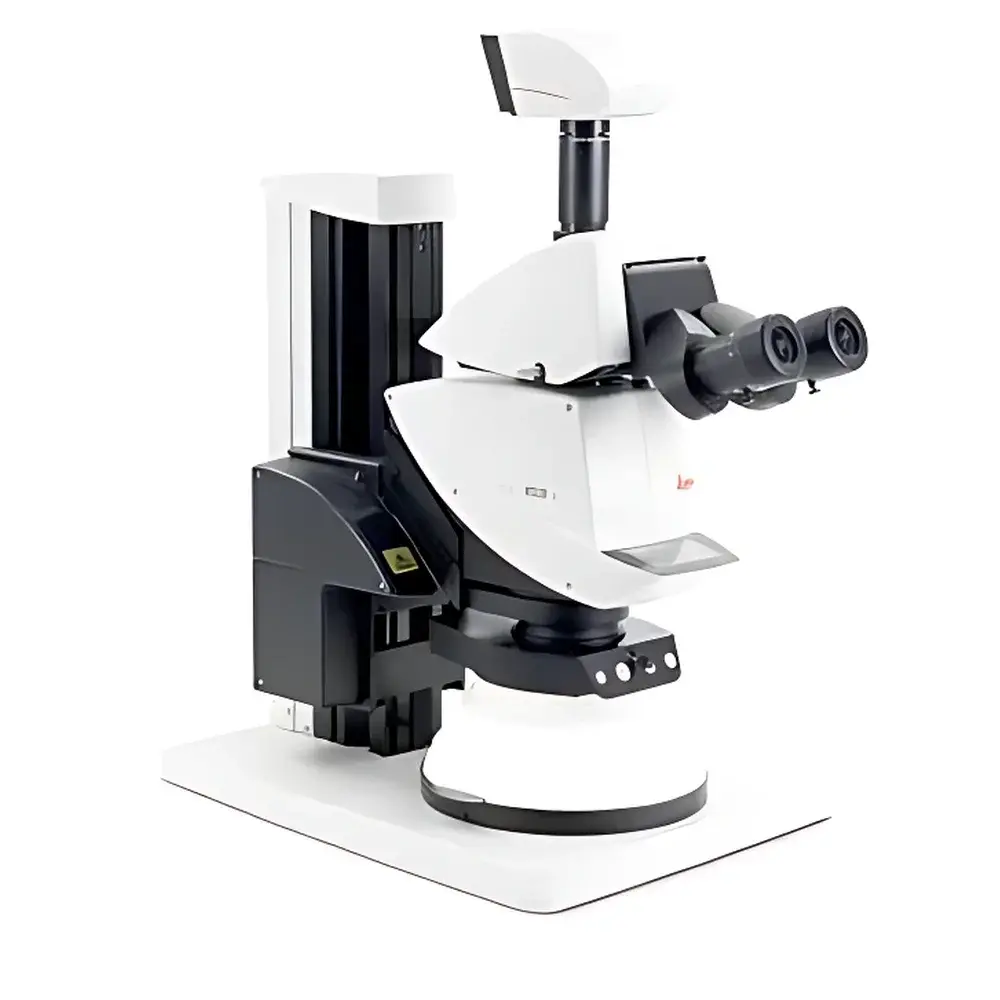
Leica LED5000 HDI High-Diffusion Dome Illuminator for Stereo Microscopes
| Brand | Leica |
|---|---|
| Origin | Germany |
| Model | LED5000 HDI |
| Illumination Type | Flexible Hemispherical Diffuse LED Lighting |
| Compatibility | Leica M-series and Z-series Stereo Microscopes |
| Light Source | Uniform White LED Array (CCT ≈ 5,600 K) |
| Dome Material | Medical-Grade Silicone Rubber (FlexiDome™) |
| Optical Diffusion | >99.8% Lambertian Emission Profile |
| Working Distance Range | 45–120 mm |
| Power Supply | 24 V DC via Leica Microscope Interface |
| Compliance | CE, RoHS, IEC 61000-6-3 |
Overview
The Leica LED5000 HDI is a purpose-engineered high-diffusion dome illuminator designed specifically for demanding surface inspection and high-fidelity imaging applications on Leica stereo microscopes (M-series and Z-series platforms). It operates on the optical principle of hemispherical diffuse illumination—leveraging a precisely engineered silicone FlexiDome™ structure to transform directional LED emission into near-Lambertian light distribution. This geometry eliminates specular highlights and shadowing while delivering spatially uniform irradiance across the entire field of view, even at oblique viewing angles typical in stereo microscopy. Unlike conventional ring lights or coaxial illuminators, the LED5000 HDI decouples illumination geometry from optical path constraints, enabling consistent contrast control over highly reflective, low-texture, or topographically complex specimens—including polished metals, silicon wafers, PCB solder joints, and biological tissue sections. Its integration with Leica’s digital imaging ecosystem ensures synchronized exposure control and hardware-triggered acquisition—critical for reproducible metrology-grade documentation under GLP/GMP-aligned workflows.
Key Features
- FlexiDome™ silicone dome structure: Enables tactile sample access without defocusing; maintains optical alignment during manual manipulation.
- High-diffusion optical performance: Achieves >99.8% Lambertian emission profile, minimizing angular dependence and maximizing dynamic range utilization in monochrome and RGB imaging.
- Integrated thermal management: Passive heat dissipation design sustains stable color temperature (5,600 K ± 150 K) and luminous flux (>1,200 lux at 70 mm working distance) over extended operation cycles.
- Native compatibility: Direct electrical and mechanical interface with Leica M125, M205, M205 A, Z6, Z16, and Z30 stereo microscope stands via standardized 24 V DC bus and mounting flange.
- No external controller required: Fully managed through Leica Application Suite (LAS) X firmware; supports automatic intensity ramping, preset recall, and TTL synchronization with camera shutter.
Sample Compatibility & Compliance
The LED5000 HDI excels with specimens exhibiting minimal inherent reflectance variation—such as anodized aluminum, matte-finish ceramics, electroplated surfaces, and translucent polymer films—where conventional lighting induces false edge enhancement or obscures subtle topographic gradients. Its uniform irradiance profile meets ASTM E2912-22 requirements for illumination consistency in optical microscopy-based dimensional verification. The device conforms to IEC 61000-6-3 (EMC emission limits), RoHS Directive 2011/65/EU, and carries CE marking per EU Machinery Directive 2006/42/EC. All materials in direct contact with samples comply with ISO 10993-5 cytotoxicity standards, supporting regulated life science and medical device inspection protocols.
Software & Data Management
Controlled natively within Leica LAS X v3.7+, the LED5000 HDI supports audit-trail-enabled illumination parameter logging—including intensity level, duration, and activation timestamp—aligned with FDA 21 CFR Part 11 electronic record requirements when deployed in validated environments. Illumination presets can be embedded directly into LAS Montage and StereoExplorer acquisition sequences, ensuring identical lighting conditions across multi-position tile scans or time-lapse series. Exported metadata includes EXIF-compliant illumination descriptors, enabling traceable correlation between image pixel values and photometric input conditions—a prerequisite for quantitative reflectance analysis and machine vision training datasets.
Applications
- Failure analysis of microelectronic packages and solder interconnects under non-contact, low-contrast illumination.
- Surface defect mapping on precision-machined aerospace components where directional glare masks micro-cracks or porosity.
- Documentation of forensic evidence (e.g., tool marks, fiber morphology) requiring photogrammetric consistency across variable specimen orientations.
- Quality assurance of additive-manufactured metal parts, where powder-layer fusion boundaries must be resolved without highlight saturation.
- Live stereoscopic imaging of live zebrafish embryos or Drosophila larvae, where gentle, shadow-free illumination minimizes photostress during prolonged observation.
FAQ
Can the LED5000 HDI be used with non-Leica stereo microscopes?
No—it requires proprietary mechanical mounting interfaces and 24 V DC power delivery via Leica microscope stands; third-party adapters are not supported or validated.
Does the FlexiDome™ structure degrade over time with repeated deformation?
Medical-grade silicone rubber exhibits >100,000 compression cycles without permanent set or optical haze accumulation under standard laboratory conditions (23 °C, 50% RH).
Is intensity calibration traceable to NIST standards?
While the unit does not include built-in photometric calibration, Leica provides optional traceable irradiance validation reports (per ISO/IEC 17025) upon request for GxP-regulated installations.
How does the LED5000 HDI compare to traditional fiber-optic dome lights?
It eliminates coupling losses, chromatic shift, and thermal drift associated with halogen-based fiber systems—delivering superior spectral stability, longer service life (>50,000 h L70), and zero maintenance.
Can illumination uniformity be verified empirically?
Yes—Leica supplies a calibrated uniformity test target (Cat. No. 11590010) and recommended procedure in Application Note AN-LED5000-01 for quantitative flat-field assessment using a scientific CMOS camera.




