
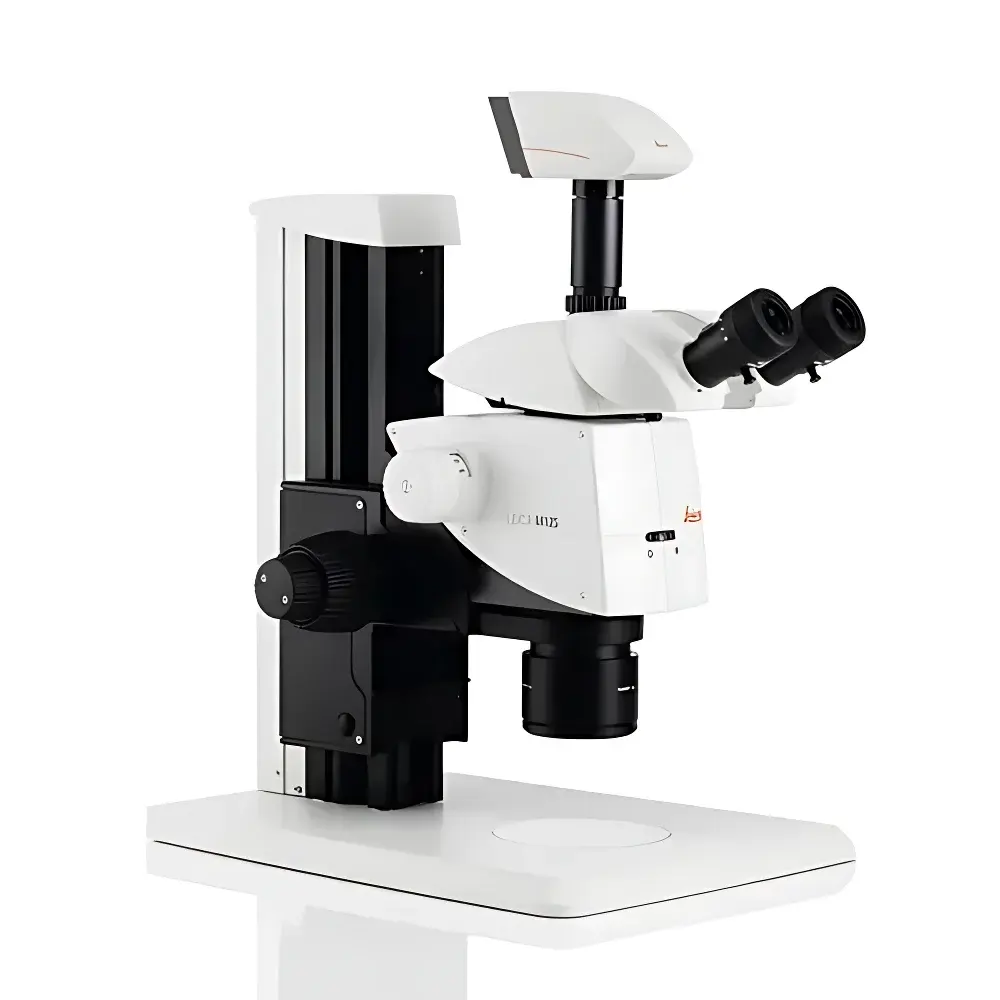
Leica M125 Stereo Microscope
| Brand | Leica |
|---|---|
| Origin | Germany |
| Model | M125 |
| Zoom Ratio | 12.5:1 |
| Magnification Range | 8×–100× (with 1.0× PlanApo objective) |
| Optical Resolution | 1.15 µm |
| Numerical Aperture (max) | 0.288 |
| Objective Type | PlanApo, fully apochromatic correction |
| Compatibility | Leica LED5000 incident light systems, Leica TL3000–TL5000 transmitted light bases |
| Ergonomic Accessories | Available |
| Digital Imaging | Compatible with Leica DFC series and other C-mount cameras |
Overview
The Leica M125 Stereo Microscope is a research-grade modular stereomicroscope engineered for high-precision visual inspection, materials analysis, and quality control in industrial, academic, and regulatory laboratory environments. Built upon Leica Microsystems’ long-standing optical heritage, the M125 employs a Greenough-style optical path with fully apochromatic (APO) correction across the visible spectrum—specifically correcting lateral chromatic aberration for red, green, and blue wavelengths. This ensures faithful color reproduction, exceptional contrast fidelity, and diffraction-limited resolution up to 1.15 µm at maximum magnification. Its 12.5:1 continuous zoom ratio enables seamless transition from macro- to micro-scale observation without objective swapping or mechanical reconfiguration—making it particularly suited for multi-step workflows such as PCB defect mapping, polymer morphology assessment, semiconductor packaging inspection, and precision assembly verification.
Key Features
- Fully apochromatic optics delivering natural color fidelity and zero lateral chromatic aberration across the entire magnification range
- 12.5:1 zoom system with calibrated magnification settings (8×–100× using standard 1.0× PlanApo objective)
- Maximum numerical aperture of 0.288, enabling theoretical resolution of 864 line pairs per millimeter (LP/mm) under optimal illumination and sample conditions
- Modular design supporting rapid integration of ergonomic viewing tubes (inclined, binocular, trinocular), adjustable focus mechanisms, and motorized Z-axis drives
- Optimized for both incident and transmitted light configurations via compatibility with Leica LED5000 series ring lights, coaxial illuminators, and TL3000–TL5000 transmitted light bases—including dome illumination for highly reflective or topographically complex specimens
- C-mount port and standardized trinocular tube interface ensure seamless coupling with Leica DFC digital cameras and third-party imaging platforms compliant with USB3.0, HDMI, or GigE Vision protocols
Sample Compatibility & Compliance
The Leica M125 accommodates a broad spectrum of solid, opaque, and semi-transparent specimens—including printed circuit boards, injection-molded polymers, metallurgical cross-sections, solder joints, biological tissue sections, and microelectromechanical systems (MEMS). Its large working distance (up to 110 mm at lowest magnification) and depth of field support manipulation tools, micromanipulators, and environmental chambers. The system conforms to ISO 10934-1 (optical microscopy—nomenclature and definitions), ISO 9241-5 (ergonomic requirements for workstations), and supports audit-ready documentation when integrated with Leica Application Suite X (LAS X) software under GLP/GMP frameworks. While not intrinsically certified for hazardous locations, its LED-based illumination complies with IEC 62471 (photobiological safety of lamps and lamp systems).
Software & Data Management
When paired with Leica LAS X software, the M125 enables full metrology functionality—including calibrated 2D measurements (length, angle, area, particle count), multi-focus image stacking (Z-stacking), annotation layers, and report generation compliant with FDA 21 CFR Part 11 requirements (user authentication, electronic signatures, audit trails). Image metadata—including magnification, objective ID, illumination mode, exposure time, and calibration timestamp—is embedded automatically into TIFF and JPEG2000 files. LAS X supports DICOM export for integration into enterprise LIMS or PACS environments and offers API access for custom automation scripts in Python or MATLAB.
Applications
- Electronics manufacturing: Solder joint inspection, trace continuity verification, component placement accuracy assessment
- Materials science: Polymer phase separation analysis, filler dispersion evaluation, fracture surface characterization
- Quality assurance labs: Visual defect classification per ASTM E2594 (standard practice for digital imaging in nondestructive evaluation)
- Forensic laboratories: Toolmark comparison, fiber identification, gunshot residue morphology
- Academic research: Developmental biology specimen screening, microdissection guidance, teaching demonstrations requiring high-fidelity stereoscopic visualization
FAQ
What is the maximum useful magnification achievable with the Leica M125?
The practical upper limit is 100× with the 1.0× PlanApo objective; higher nominal magnifications do not yield additional resolvable detail due to optical diffraction limits and diminishing signal-to-noise ratio.
Can the M125 be used for quantitative measurement tasks?
Yes—when calibrated using NIST-traceable stage micrometers and operated with LAS X software, it supports ISO/IEC 17025-compliant dimensional metrology with documented uncertainty budgets.
Is the M125 compatible with fluorescence observation?
No—the Greenough optical architecture and standard illumination modules are not designed for epi-fluorescence; users requiring fluorescence should consider the Leica M205 FA or M205 FCA models.
Does Leica provide validation documentation for regulated industries?
Yes—IQ/OQ documentation packages, including installation checklists, operational test protocols, and calibration certificates, are available upon request for GxP-aligned deployments.
How does the M125 compare to the earlier M165 C model?
The M125 prioritizes optical fidelity and modularity over motorization; the M165 C offers integrated motorized zoom/focus but uses a slightly lower NA optical path and lacks full APO correction across the entire zoom range.




