
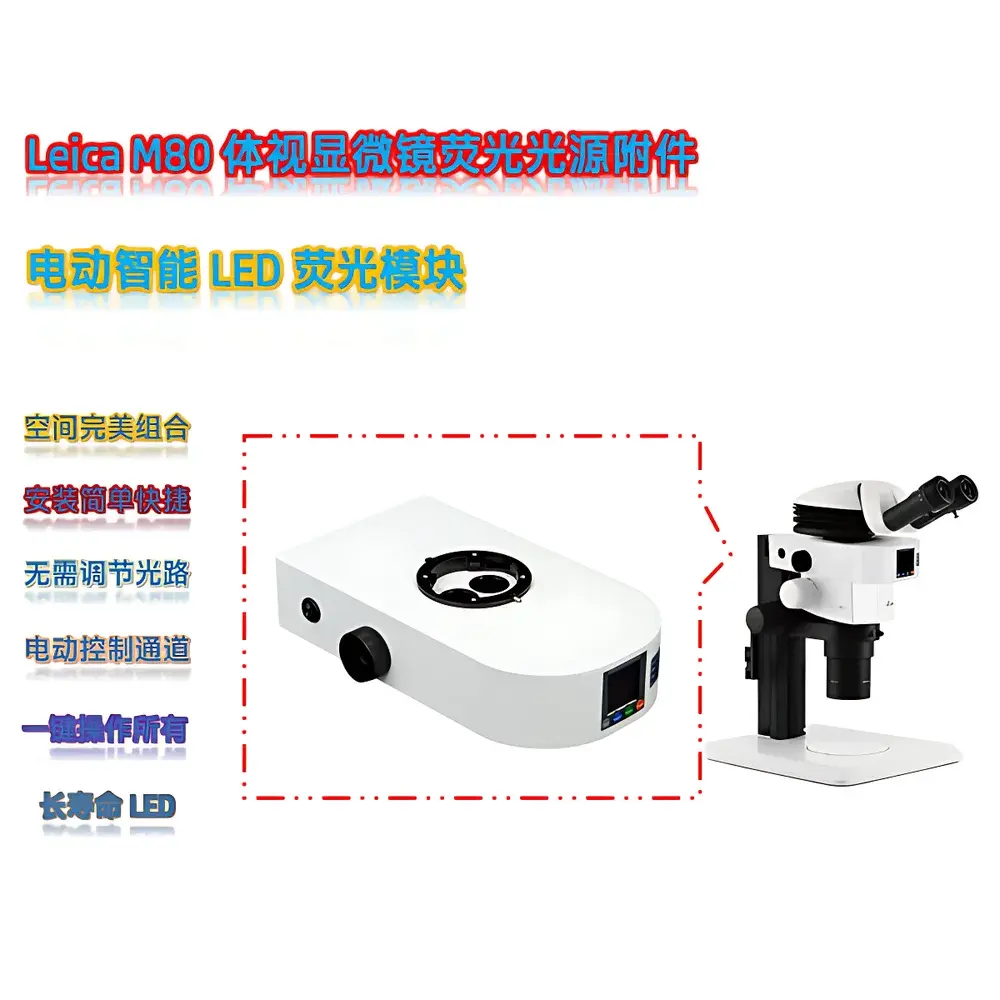
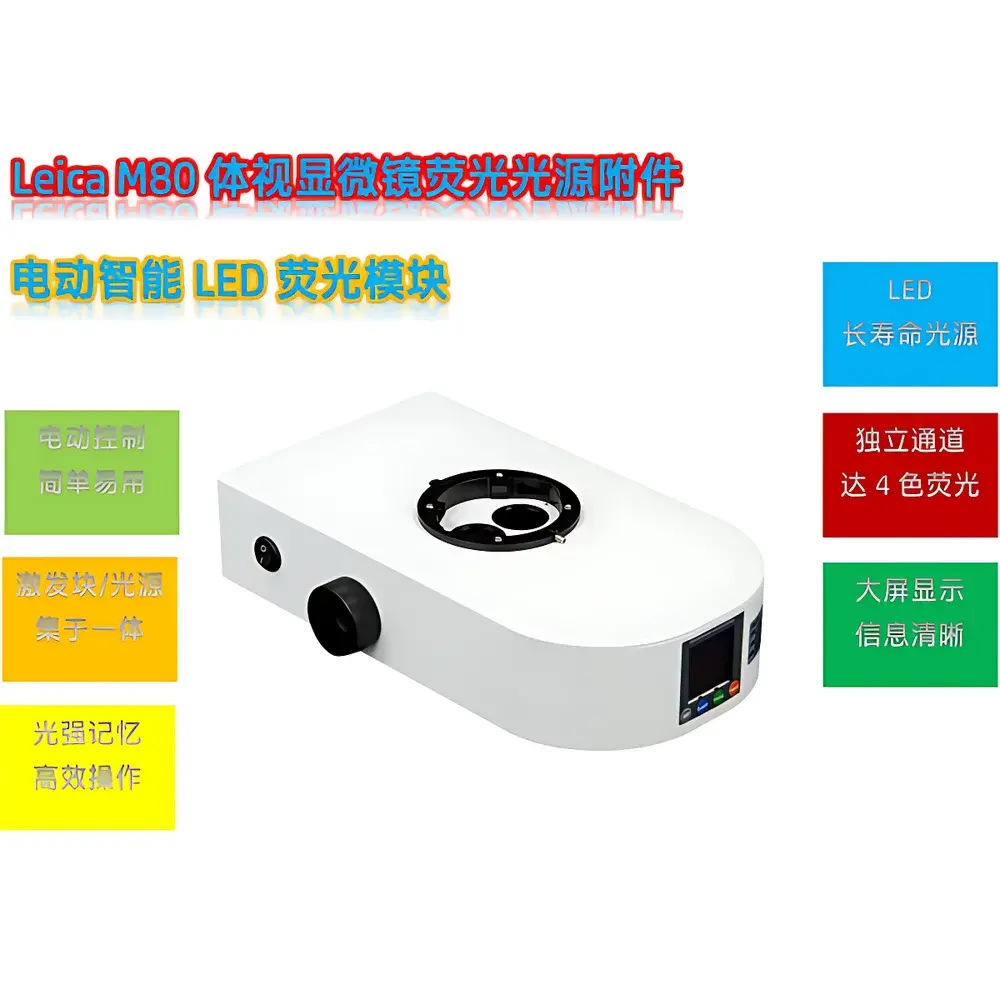
Leica M80 Stereo Fluorescence Microscope with UV-B-G-R LED Illumination Module M80-UVBGR-E
| Brand | Leica |
|---|---|
| Origin | Guangdong, China |
| Manufacturer Type | OEM/ODM Producer |
| Country of Origin | China |
| Model | M80-UVBGR-E |
| Instrument Type | Stereo Fluorescence Microscope |
| Excitation Source | High-Power LED (10 W) |
| Fluorescence Filter Sets | UV (DAPI), B (GFP/FITC), G (Cy3/TRITC), R (mCherry/Cy5) — customizable |
| Filter Configuration | Bandpass, Longpass, and Wideband options available |
| Control Interface | Rotary Knob, Touchscreen Display, or PC Software (RS232/USB protocol support) |
| Light Intensity Memory Function | Yes |
| Cooling Method | Active Air-Cooled Thermal Management |
| Regulatory Status | Not a Medical Device |
| Classification | Research-Grade Fluorescence Imaging System |
| Compliance | Designed for ISO/IEC 17025-aligned laboratory environments |
Overview
The Leica M80 Stereo Fluorescence Microscope with UV-B-G-R LED Illumination Module (Model M80-UVBGR-E) is an integrated optical platform engineered for high-fidelity, multi-channel fluorescence visualization in live specimen observation, developmental biology, zebrafish screening, Drosophila dissection, and small-animal tissue analysis. Unlike conventional epifluorescence systems, this module leverages a modular, coaxial LED excitation architecture optimized for stereoscopic depth perception—enabling simultaneous structural context and fluorescent signal localization without parallax distortion. The system operates on the principle of widefield epi-illumination, where high-intensity, spectrally defined LEDs deliver precise excitation energy to fluorophores while minimizing phototoxicity and thermal load. Its optical path is fully compatible with Leica M80 base optics, preserving native magnification range (6.3×–50×), working distance (>110 mm), and ergonomic viewing geometry.
Key Features
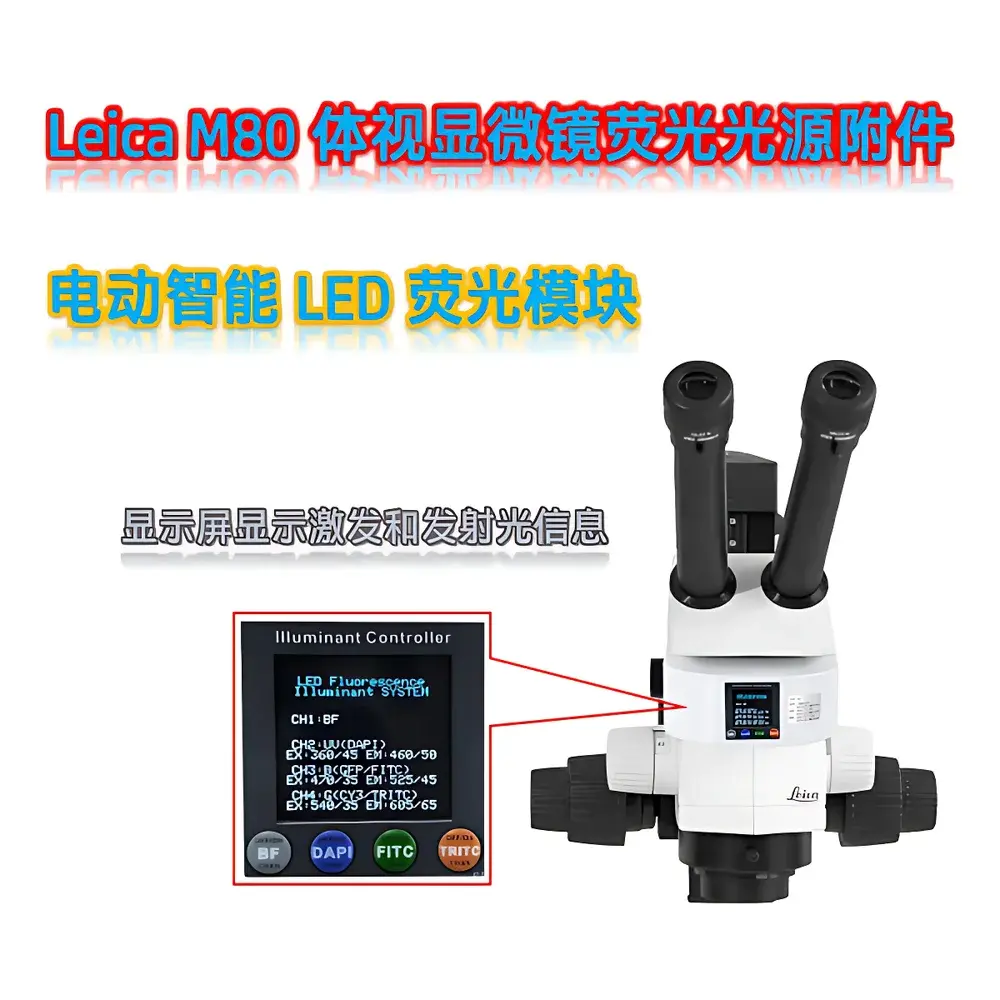
- 10 W multi-wavelength LED light engine with independently addressable UV (360/45 nm), blue (470/35 nm), green (540/35 nm & 570/43 nm), and red (635/30 nm) channels—each thermally stabilized via active air-cooling and pulse-width modulation for stable irradiance over extended imaging sessions.
- Pre-aligned, interchangeable fluorescence filter cubes supporting bandpass (e.g., DAPI: 360/45 → 460/50 nm; GFP: 470/35 → 525/45 nm; Cy3: 540/35 → 605/65 nm; mCherry: 570/43 → 630/40 nm; Cy5: 635/30 → 692/40 nm), longpass, and wideband configurations—ensuring minimal spectral crosstalk and optimal signal-to-noise ratio.
- Real-time intensity memory function: automatically recalls and re-applies user-defined irradiance levels per channel during sequential multi-fluorophore imaging—eliminating manual recalibration between acquisitions.
- Integrated 7-inch capacitive touchscreen with intuitive GUI for direct control of excitation channel selection, intensity ramping, exposure timing, and illumination mode (continuous/pulsed). Also supports external hardware triggering and TTL synchronization.
- Full RS232 and USB communication protocols enable seamless integration into automated imaging workflows—including compatibility with third-party acquisition software (e.g., NIS-Elements, MetaMorph, μManager) and custom LabVIEW or Python-based control scripts.
- No warm-up or cooldown delay: LED sources achieve full spectral output within <100 ms of activation, supporting rapid experimental iteration and time-lapse fluorescence monitoring under physiological conditions.
Sample Compatibility & Compliance
The M80-UVBGR-E accommodates live and fixed specimens ranging from translucent embryos (zebrafish, Xenopus) to opaque tissues (mouse ear biopsies, plant root tips), whole-mount immunolabeled samples, and microfluidic devices. Its long working distance and large field-of-view facilitate manipulation under fluorescence guidance using micromanipulators or patch-clamp rigs. All optical components meet RoHS Directive 2011/65/EU material restrictions. While not classified as a medical device under FDA 21 CFR Part 809 or EU MDR 2017/745, the system is routinely deployed in preclinical research laboratories operating under GLP-compliant quality management systems. Optional firmware logging features support 21 CFR Part 11–compliant electronic records when paired with validated acquisition software.
Software & Data Management
The module interfaces natively with Leica Application Suite X (LAS X) v3.7+ for synchronized image capture, multi-channel overlay registration, and quantitative intensity profiling across Z-stacks. Raw TIFF export preserves bit-depth fidelity (16-bit), while metadata embedding includes excitation/emission filter IDs, LED current settings, exposure duration, and timestamped environmental logs. For enterprise deployment, API-level access enables integration into LIMS or ELN platforms via HTTP RESTful endpoints or OPC UA middleware. Audit trail functionality—tracking user login, filter changes, intensity adjustments, and acquisition events—is available upon configuration with compliant authentication modules.
Applications
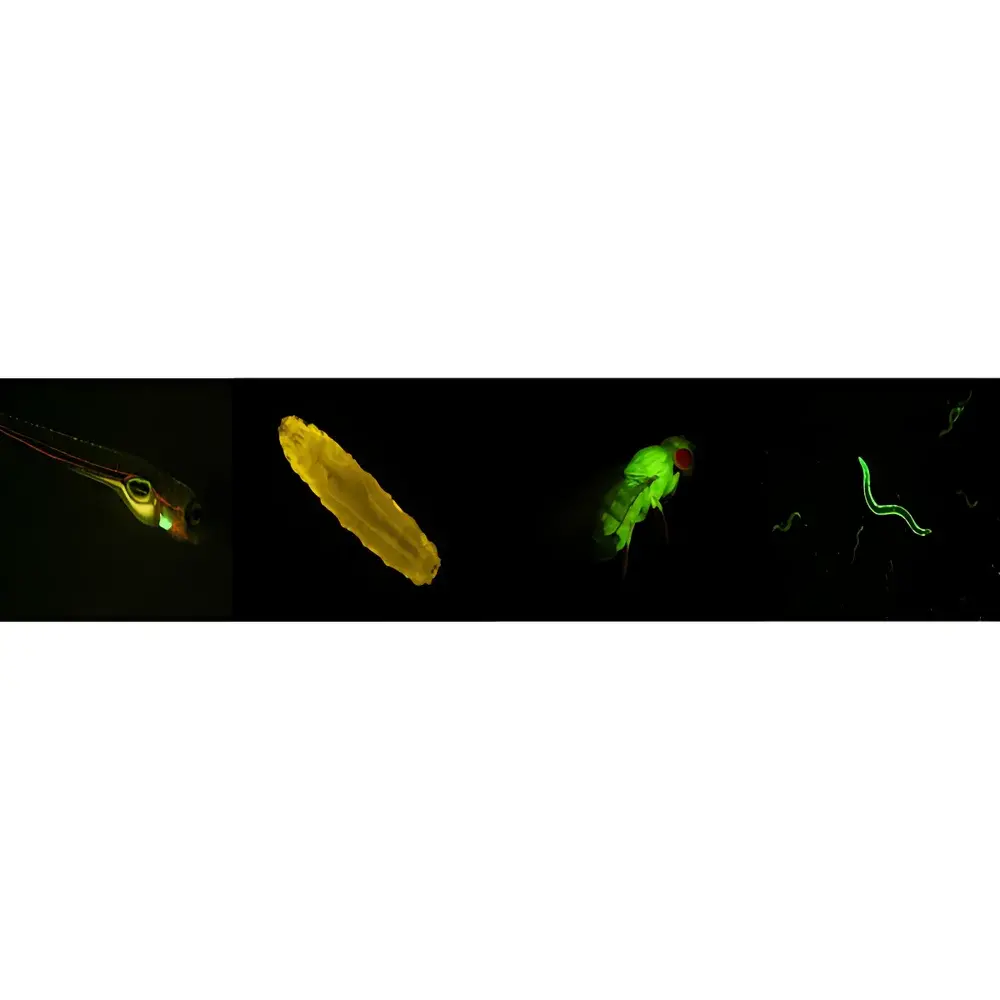
- Live transgenic model organism screening (e.g., GFP-labeled neural circuits in C. elegans, mCherry-tagged tumor xenografts in chick chorioallantoic membrane assays).
- Intraoperative fluorescence-guided dissection of fluorescently labeled vasculature or tumor margins in ex vivo surgical specimens.
- High-content phenotypic analysis in CRISPR-edited zebrafish lines expressing dual-reporter constructs (e.g., DAPI nuclear counterstain + GFP lineage marker).
- Quality control of fluorescent bead standards in flow cytometry calibration workflows.
- Plant science applications including chlorophyll autofluorescence suppression (via 470 nm excitation) and simultaneous detection of GFP-tagged stress-response proteins and propidium iodide–stained cell death zones.
FAQ
Is the M80-UVBGR-E compatible with non-Leica stereo microscope bases?
No—it is mechanically and optically engineered exclusively for the Leica M80 platform, requiring precise alignment of the illumination axis with the objective’s telecentric path.
Can I add custom excitation bands beyond UV/B/G/R?
Yes—custom filter cubes and LED driver firmware can be commissioned for wavelengths between 340–780 nm, subject to minimum order quantity and optical feasibility review.
Does the system support time-gated fluorescence acquisition?
Not natively; however, external TTL gating via the USB/RS232 interface allows synchronization with pulsed light sources or fast-shutter systems for lifetime-sensitive applications.
What maintenance is required for long-term LED performance?
None beyond periodic dust removal from heat sinks and filter surfaces; LED lifetimes exceed 25,000 hours at nominal drive current, with no lamp replacement or alignment needed.
Is remote software control supported over Ethernet or Wi-Fi?
The standard interface is USB 2.0 and RS232; Ethernet/Wi-Fi connectivity requires an optional industrial-grade USB-to-Ethernet bridge with static IP configuration and firewall-safe port mapping.




