
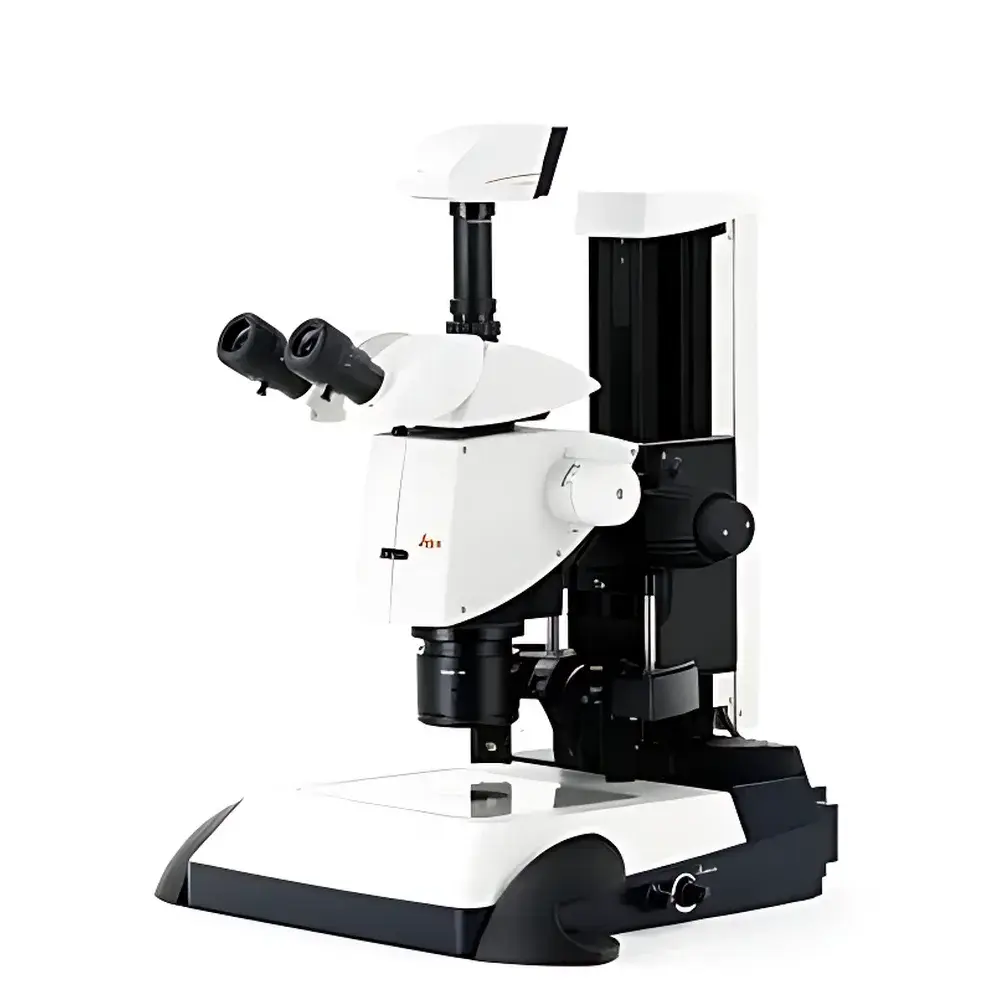
Leica MCI Stereo Microscope with LED5000 Illumination System
| Brand | Leica |
|---|---|
| Origin | Germany |
| Model | MCI |
| Illumination Type | Integrated Triple-Arc LED (3 × Adjustable LED Arcs) |
| Color Temperature | 5700 K |
| LED Lifetime | 50,000 hours |
| Software Integration | Leica LAS (Leica Application Suite) |
| Compliance | CE, ISO 9001, IEC 61000-6-3 (EMC), IEC 62471 (Photobiological Safety) |
| Optical Design | Greenough-type stereo optical path |
| Magnification Range | Standard 6.3×–50× (with optional eyepieces and objectives) |
| Working Distance | Up to 110 mm (depending on objective) |
| Illumination Control | Motorized, software-synchronized, preset storage capability |
Overview
The Leica MCI Stereo Microscope is a high-precision, research-grade Greenough-style stereomicroscope engineered for demanding visual inspection, quality control, and documentation tasks in industrial, academic, and regulatory environments. It forms the optical core of the Leica LED5000 MCI platform—distinguished by its proprietary triple-arc LED illumination system. Unlike conventional coaxial or ring-light configurations, this architecture employs three independently adjustable LED arcs mounted on a rotating carrier, each capable of precise angular positioning up to ±90° relative to the optical axis. This design enables dynamic control over incident light directionality, enabling optimized shadow management, surface texture enhancement, and differential contrast generation without mechanical sample repositioning. The system operates at a calibrated correlated color temperature of 5700 K, delivering daylight-balanced spectral output that eliminates the yellow cast inherent to halogen-based illumination. With no warm-up time, zero intensity drift, and flicker-free emission, the LED5000 illumination ensures consistent photometric performance across extended observation sessions—critical for fatigue-sensitive applications such as electronics solder joint inspection or pharmaceutical particulate analysis.
Key Features
- Triple-arc LED illumination system with independent angular adjustment (±90° per arc) for directional contrast optimization and minimal shadow interference
- Stable 5700 K daylight-spectrum output ensuring accurate color fidelity without manual white balance calibration
- 50,000-hour LED lifetime—equivalent to >10 years of continuous daily use at 8 hours/day—reducing maintenance cycles and total cost of ownership
- Motorized illumination control fully synchronized with Leica LAS software; all illumination parameters (intensity, arc position, activation state) stored directly with image metadata
- Greenough optical design with high NA objectives, providing exceptional depth of field, resolution, and ergonomic viewing geometry
- Modular platform compatible with motorized zoom bodies, encoded focus drives, and digital camera interfaces compliant with USB 3.0 and GigE Vision standards
Sample Compatibility & Compliance
The Leica MCI accommodates a broad range of non-destructive inspection samples—from silicon wafers and PCB assemblies to botanical specimens and polymer components—without requiring conductive coating or vacuum environments. Its long working distance (up to 110 mm with 0.5× objective) supports integration with manipulators, micromanipulators, and environmental chambers. From a regulatory perspective, the system conforms to ISO 9001 for manufacturing quality assurance, CE marking under the EU Machinery Directive 2006/42/EC and EMC Directive 2014/30/EU, and IEC 62471 for photobiological safety classification (Risk Group 1 – Exempt). When operated with Leica LAS v4.13 or later and configured with audit trail logging, user access controls, and electronic signature support, the platform meets foundational requirements for GLP-compliant documentation workflows and aligns with FDA 21 CFR Part 11 principles for electronic records and signatures in regulated laboratories.
Software & Data Management
Leica LAS (Leica Application Suite) serves as the unified control and documentation layer for the MCI platform. Version 4.13+ provides full bidirectional communication with the LED5000 illumination module, enabling programmable lighting presets, time-lapse illumination sequencing, and hardware-triggered exposure synchronization. All illumination states—including arc angles, intensity levels, and active arc combinations—are embedded into TIFF and JPEG image headers as EXIF-compatible tags. This metadata persistence ensures full traceability during technical review, internal audits, or regulatory submissions. LAS also supports automated report generation (PDF/XLSX), batch image processing with measurement overlays (length, area, angle), and secure network deployment via Leica LAS X Server—enabling centralized instrument management across multi-site facilities while maintaining role-based access permissions.
Applications
- Electronics manufacturing: Solder joint void detection, wire bond inspection, conformal coating uniformity assessment
- Medical device QA: Surface defect mapping on catheters, stent strut integrity verification, packaging seal inspection
- Materials science: Fracture surface topography analysis, powder morphology characterization, composite fiber alignment evaluation
- Life sciences: Dissection documentation, embryonic development staging, histological slide screening prior to sectioning
- Jewelry and precision machining: Scratch depth estimation, plating thickness homogeneity, engraving fidelity validation
FAQ
Does the Leica MCI require periodic recalibration of illumination color temperature?
No. The LED5000 system uses factory-calibrated phosphor-converted LEDs with stable spectral output over its operational lifetime; no user recalibration or white balance adjustment is necessary.
Can illumination presets be recalled remotely via network command?
Yes—when deployed with Leica LAS X Server and appropriate network configuration, illumination states can be triggered via HTTP API calls or scheduled through the LAS Task Scheduler.
Is the triple-arc illumination compatible with fluorescence accessories?
No. The LED5000 MCI is designed exclusively for brightfield, darkfield, and oblique reflected-light imaging; fluorescence modules require separate Leica DMi8 or DM6 B platforms with dedicated excitation sources.
What is the maximum frame rate achievable when capturing video with full-resolution illumination synchronization?
At native 2048 × 1536 resolution (via Leica DFC9000 GT camera), synchronized illumination capture supports up to 60 fps with rolling shutter; global shutter mode reduces this to 30 fps to maintain temporal coherence across all three arcs.




