
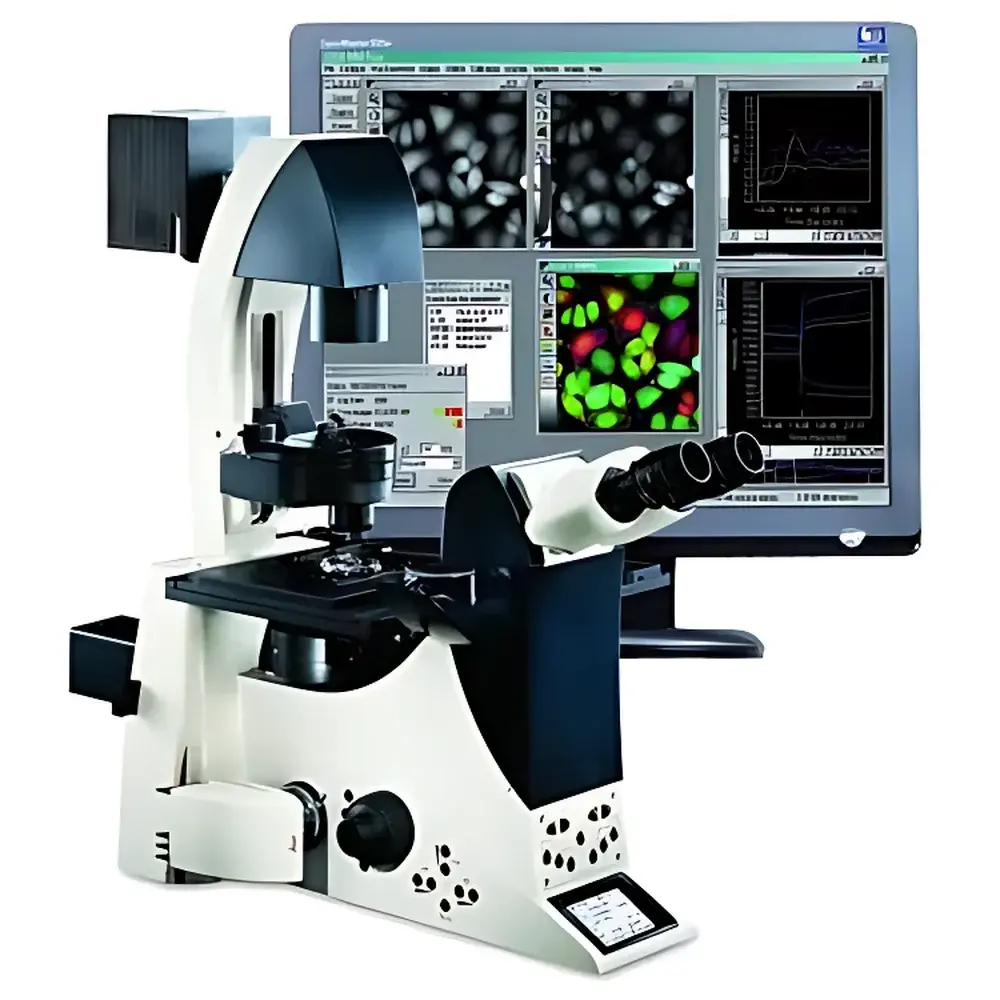
Leica MM AF Imaging Software
| Brand | Leica |
|---|---|
| Origin | Germany |
| Model | Leica MM AF |
| Software Type | MetaMorph®-powered Multidimensional Microscopy Acquisition & Analysis Platform |
| Compatibility | Fully compatible with Leica LAS AF file format |
| Deployment | Standalone desktop application for Windows OS |
| Regulatory Context | Designed to support GLP-compliant imaging workflows |
Overview
Leica MM AF Imaging Software is a high-performance, MetaMorph®-integrated platform engineered for quantitative multidimensional microscopy in life science research. Built specifically to interface with Leica Microsystems’ inverted and upright fluorescence microscopes—including the DMi8, DMI6000 B, and THUNDER systems—it delivers synchronized control of hardware components (cameras, filter wheels, motorized stages, environmental chambers, and illumination sources) while enabling rigorous acquisition, processing, and analytical workflows. The software operates on a modular architecture grounded in calibrated pixel-based spatial referencing and time-stamped metadata embedding, ensuring traceability and reproducibility across experiments. Its core measurement paradigm supports intensity-based quantification, spatial colocalization analysis (Pearson’s and Manders’ coefficients), morphometric profiling (cell area, perimeter, circularity, Feret diameter), dynamic parameter tracking (fluorescence recovery after photobleaching—FRAP, fluorescence resonance energy transfer—FRET, calcium transient kinetics), and volumetric reconstruction from Z-stacks or light-sheet acquisitions. Unlike generic image viewers, Leica MM AF implements physics-aware algorithms for background subtraction, flat-field correction, deconvolution (via constrained iterative or Wiener methods), and noise modeling aligned with EMCCD, sCMOS, and CMOS detector characteristics.
Key Features
- Fully automated multidimensional acquisition: Define up to 5 dimensions (X, Y, Z, λ, t, position, condition) with hardware-synchronized triggering and precise timing resolution down to 1 ms step intervals.
- Macro-driven workflow standardization: Record, edit, and deploy repeatable acquisition and analysis protocols via built-in script editor supporting Python-based extensions for custom logic.
- Native Leica LAS AF file compatibility: Seamlessly import, export, and interoperate with .lif datasets—including metadata preservation for objective magnification, NA, exposure time, binning, and calibration units.
- Application-specific modules: Optional licensed add-ons include Leica MM Multidimensional Tracking (for subpixel centroid-based motility analysis with drift correction) and Leica MM Cell Health (for real-time viability assessment using dual-channel ratiometric dyes such as Calcein-AM/PI or Annexin V-FITC/7-AAD).
- GPU-accelerated processing engine: Real-time rendering of large-volume stacks (>100 GB) with on-the-fly interpolation, maximum-intensity projection, and surface rendering using OpenCL-compatible graphics hardware.
- Compliance-enabling infrastructure: Configurable user access levels, electronic signature support, and optional 21 CFR Part 11–compliant audit trail logging (when deployed with validated IT environment and documented SOPs).
Sample Compatibility & Compliance
Leica MM AF supports imaging modalities spanning widefield epifluorescence, confocal (spinning disk and resonant scanner variants), TIRF, and structured illumination microscopy (SIM). It natively handles live-cell samples maintained under controlled CO₂, temperature, and humidity conditions via integration with environmental control units (e.g., OkoLab, PeCon). Fixed tissue sections, organoids, zebrafish embryos, C. elegans, and adherent or suspension mammalian cell cultures are routinely imaged with consistent metadata capture. The software conforms to ISO/IEC 17025 documentation principles for measurement uncertainty propagation in morphometric outputs and aligns with ASTM E2914–13 guidelines for fluorescence intensity standardization when used with NIST-traceable reference standards.
Software & Data Management
Data integrity is enforced through embedded DICOM-SR–style metadata schemas compliant with the OME-XML specification. All acquisitions generate timestamped, immutable .lif files containing raw pixel data, instrument configuration logs, and user annotations. Export options include TIFF (with BigTIFF support), HDF5 (for hierarchical storage of time-series volumes), and CSV/TSV for quantitative results. Integration with laboratory information management systems (LIMS) is achievable via RESTful API endpoints (available under enterprise licensing). Version-controlled macro libraries can be centrally managed and distributed across networked workstations, supporting cross-lab protocol harmonization in multicenter studies.
Applications
- Long-term live-cell tracking of mitotic progression, organelle dynamics, or pathogen internalization in primary human macrophages.
- 3D reconstruction and quantitative volume analysis of tumor spheroids treated with kinase inhibitors.
- Colocalization mapping of receptor–ligand interactions at synaptic terminals using dual-color STED-compatible labeling.
- High-content screening of CRISPR-Cas9 knockout lines assessing nuclear translocation kinetics of transcription factors.
- Time-resolved FRET biosensor imaging to resolve conformational changes during GPCR activation.
FAQ
Is Leica MM AF compatible with non-Leica microscope hardware?
No—Leica MM AF is exclusively designed for native communication with Leica microscope control buses (e.g., Leica Hardware Interface Protocol). Third-party devices require Leica-certified adapter modules and may lack full feature parity.
Does the software support batch processing of previously acquired .lif files?
Yes—offline analysis mode enables macro-driven batch quantification, including region-of-interest (ROI) extraction, intensity normalization against internal controls, and statistical summarization across experimental replicates.
Can audit trails be exported for regulatory submission?
Audit trail records (user actions, parameter changes, file modifications) are stored in encrypted SQLite databases and can be exported as PDF or CSV reports upon request, provided the system is configured in validated mode per organizational SOPs.
What operating systems are supported?
Windows 10 Pro (64-bit) and Windows 11 Enterprise (64-bit) with minimum 32 GB RAM, NVIDIA Quadro or RTX-series GPU (8 GB VRAM), and SSD-based storage for optimal performance.
Is training or technical support included with purchase?
Leica Microsystems provides initial remote installation validation, two-day virtual administrator training, and access to the Leica Knowledge Base and certified application scientists for method optimization support. Extended service contracts cover version upgrades and priority escalation paths.
Related Products




