
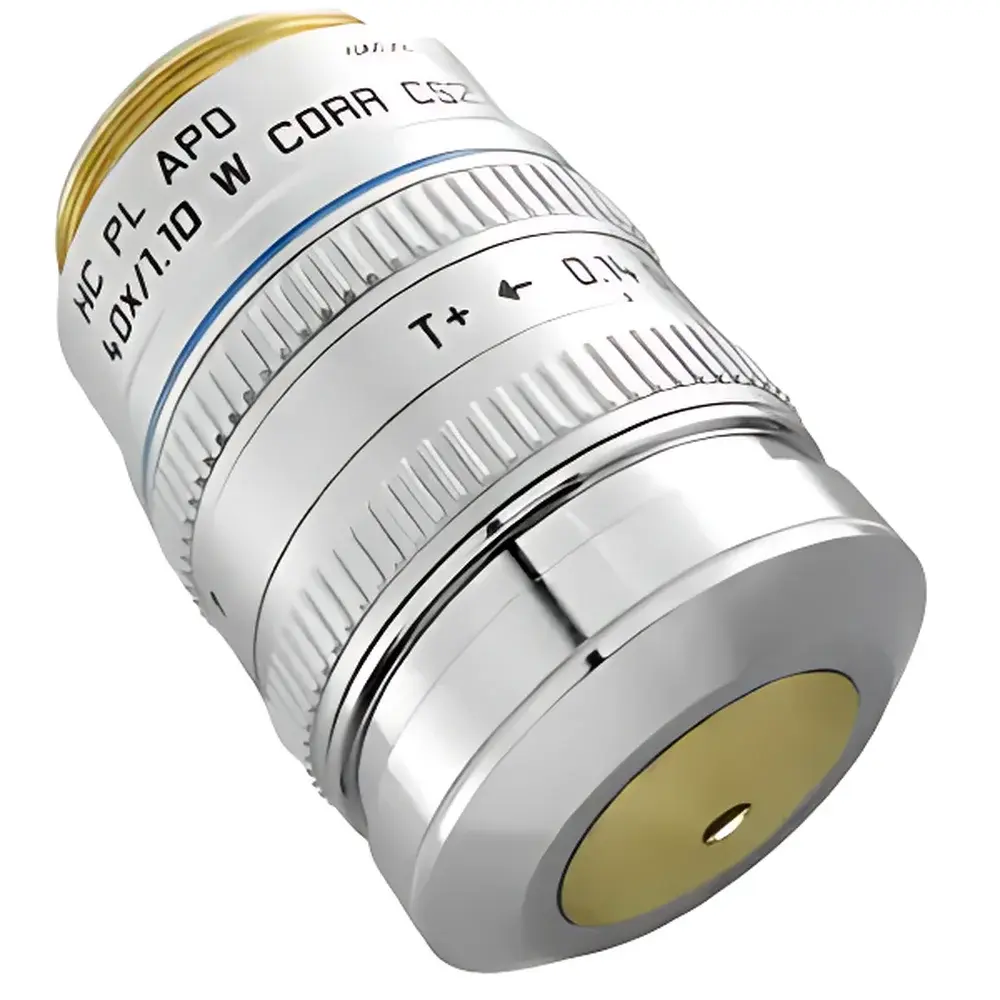
Leica PL APO Chromatic-Corrected Objective Lens
| Brand | Leica |
|---|---|
| Origin | Shanghai, China |
| Manufacturer Type | Authorized Distributor |
| Product Category | Domestic |
| Model | PL APO Apochromatic Objective |
| Component Type | Optical Element |
| Field Flatness | Up to 25 mm |
| Chromatic Correction | Red, Green, and Blue wavelengths (3-color) |
| Axial Chromatic Aberration | ≤ 1.0× objective depth of field |
| Transmission Range | ≥85% from 470–1200 nm (IR-APO variant) |
| NA Range | Up to 1.4–1.6 (model-dependent) |
| Application Scope | Visible & near-IR imaging, multiphoton microscopy, CARS, confocal, live-cell water immersion, UV-stable confocal (CS2 series) |
Overview
The Leica PL APO apochromatic objective lens represents the highest tier of optical correction in modern light microscopy. Engineered for precision across the visible spectrum—and extended into the near-infrared (NIR) and ultraviolet (UV) domains—these objectives employ advanced multi-element glass formulations and proprietary anti-reflective coatings to achieve diffraction-limited performance. Unlike achromatic or semi-apochromatic lenses, PL APO objectives correct spherical aberration and chromatic dispersion across three primary wavelengths (typically 488 nm, 561 nm, and 647 nm), ensuring axial and lateral colocalization of multicolor fluorophores with sub-200 nm resolution at maximum numerical aperture (NA). This level of correction is essential for quantitative fluorescence imaging, super-resolution modalities requiring precise point-spread function (PSF) stability, and nonlinear techniques such as coherent anti-Stokes Raman scattering (CARS) and optical parametric oscillator (OPO)-based excitation.
Key Features
- True apochromatic correction across red, green, and blue wavelengths—with axial chromatic error ≤ 1.0× the objective’s depth of field
- Field flatness up to 25 mm, enabling full-frame uniformity on large-format sCMOS and EMCCD sensors
- High-transmission NIR-optimized variants (PL IRAPO) with >85% transmission from 470–1200 nm, supporting dual- and triple-channel multiphoton excitation
- Confocal-optimized PL APO CS2 series featuring enhanced UV chromatic correction, co-developed with Leica TCS SP8 and STELLARIS platforms for stable 355–405 nm performance
- Water-immersion PL APO W variants equipped with motorized motCORR™ focus compensation, dynamically correcting for cover-slip thickness, temperature drift, and refractive index mismatch in live-cell preparations
- NA values ranging from 0.95 to 1.6, enabling maximal light collection efficiency and spatial resolution governed by the Abbe diffraction limit
Sample Compatibility & Compliance
Leica PL APO objectives are validated for use with standard #1.5H cover glasses (0.17 mm thickness), but support adjustable correction collars for variable sample media—including aqueous buffers, glycerol-based mounting media, and tissue clearing reagents (e.g., CLARITY, iDISCO+, CUBIC). The CS2 and IRAPO lines comply with ISO 8578:2017 (microscope objective labeling and specification), and meet mechanical tube length and parfocal distance requirements per DIN 6888 and JIS B 7131. For regulated environments, these objectives are compatible with GLP/GMP-compliant imaging workflows when integrated into Leica DMi8 or DM6 B systems equipped with audit-trail-enabled software (Leica Application Suite X v4.13+), satisfying traceability requirements under FDA 21 CFR Part 11.
Software & Data Management
PL APO objectives are natively recognized by Leica LAS X software, which auto-loads calibrated optical parameters—including magnification, NA, working distance, and chromatic shift profiles—into acquisition metadata. This enables automated PSF modeling, deconvolution alignment, and spectral unmixing workflows without manual parameter entry. When used with Leica’s HyVolution deconvolution engine or STED module, the objective’s documented chromatic residuals are incorporated into iterative restoration algorithms. Objective-specific calibration files are stored in LAS X’s embedded database and exportable in FAIR-compliant JSON-LD format for integration with laboratory information management systems (LIMS) and image data repositories (e.g., OMERO, IDR).
Applications
- Multiphoton deep-tissue imaging: IR-APO objectives maintain wavefront fidelity under 750–1100 nm pulsed excitation, minimizing group-velocity dispersion-induced pulse broadening
- Quantitative colocalization analysis: Sub-pixel chromatic registration accuracy supports rigorous Pearson’s correlation and Mander’s overlap coefficient calculation
- Live-cell dynamics: Water-immersion PL APO W objectives with motCORR™ enable long-term time-lapse imaging without focal drift due to thermal expansion or osmotic shifts
- CARS and SRS spectroscopy: Broadband transmission and minimal dispersion ensure phase-matching integrity across Stokes and pump beam paths
- UV-confocal imaging: CS2 series delivers consistent 355 nm PSF stability across the entire FOV—critical for DAPI/Hoechst quantification in nuclear morphology studies
- Expansion microscopy (ExM): High-field flatness and low spherical aberration preserve structural fidelity during post-expansion imaging of chemically enlarged specimens
FAQ
What distinguishes a PL APO objective from a semi-apochromat?
A PL APO corrects chromatic aberration at three discrete wavelengths (typically 486 nm, 588 nm, and 656 nm), whereas semi-apochromats correct only two. This results in ≤1.0× depth-of-field axial color error versus ≤2.0× for semi-apochromats—critical for multicolor co-registration.
Can PL APO objectives be used with non-Leica microscopes?
Yes—they conform to standardized RMS (Royal Microscopical Society) thread specifications (M25×0.75) and finite conjugate (160 mm) or infinity-corrected optical paths. However, full motCORR™ and CS2 UV calibration require Leica’s proprietary controller interface.
Is there documentation available for chromatic residual maps?
Yes—Leica provides downloadable Zemax-compatible .ZBF files and measured axial chromatic shift datasets (in µm vs. wavelength) upon request for optical modeling and system integration.
How does the motCORR™ system interface with automated stages?
It integrates via Leica’s LIF (Leica Instrument Framework) protocol over Ethernet, allowing synchronization with Z-stage position, temperature feedback loops, and environmental chamber controllers.
Are PL APO objectives suitable for STED nanoscopy?
The CS2 and IRAPO variants are explicitly qualified for STED applications; their high NA, low dispersion, and UV-stable coatings minimize depletion beam distortion and maintain doughnut PSF integrity.



