
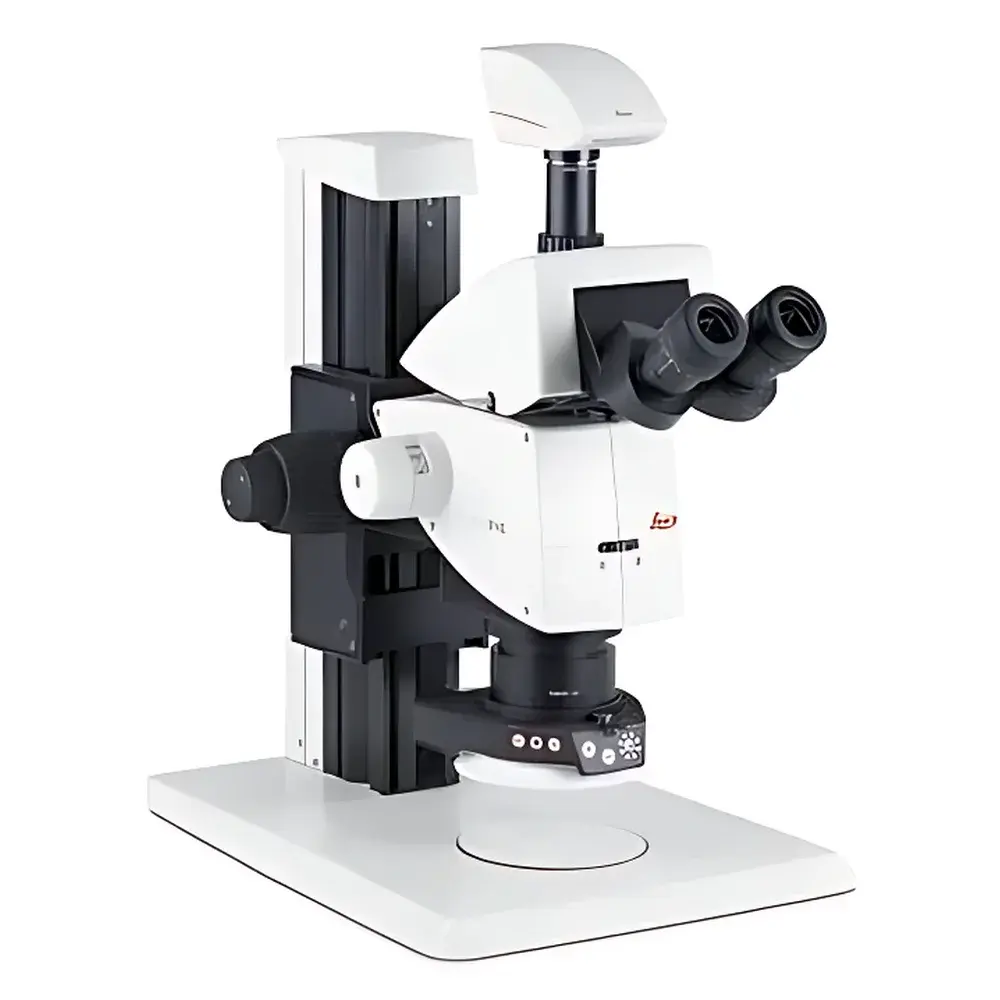
Leica M Series Stereo Microscope LED5000 RL
| Brand | Leica |
|---|---|
| Origin | Germany |
| Model | LED5000 RL |
| Illumination Type | Integrated Ring Light with 40 High-Output LEDs |
| Color Temperature | 5600 K |
| LED Lifetime | ≥50,000 hours |
| Software Integration | Leica Application Suite (LAS) |
| Compliance | CE, ISO 9001, IEC 61000-6-3/6-4 |
| Lighting Control | Fully programmable via LAS, auto-stored with image metadata |
Overview
The Leica M Series Stereo Microscope LED5000 RL is an ergonomically engineered, high-resolution stereomicroscopic system designed for routine and advanced inspection, quality control, and documentation in industrial, academic, and clinical laboratory environments. Built upon Leica Microsystems’ decades-long heritage in optical precision engineering, this instrument employs Greenough optical design principles to deliver true stereoscopic vision with high depth of field, natural spatial perception, and exceptional contrast across magnifications ranging from 6.3× to 100× (with optional auxiliary objectives and eyepieces). Its core innovation lies in the integrated LED5000 RL ring illumination module — a purpose-built, 40-LED coaxial and oblique illumination system delivering consistent 5600 K daylight-balanced light without color shift or thermal drift. Unlike traditional halogen-based systems, this solid-state illumination eliminates infrared emission, reduces sample heating, and ensures long-term photostability — critical for prolonged visual examination and digital documentation of light-sensitive specimens.
Key Features
- 40 high-output white LEDs arranged in four independently controllable quadrants — enabling precise directional lighting control (full ring, half-ring, quarter-arc, or spot mode) for optimal shadow management and surface texture enhancement.
- Stable 5600 K correlated color temperature (CCT) output — calibrated to match natural daylight, ensuring accurate color rendition without post-acquisition white balance correction or spectral compensation.
- Uniform luminance distribution (±5% variation across field of view) — achieved through optimized diffuser optics and LED array geometry, minimizing hotspots and glare during extended observation sessions.
- Integrated firmware-level dimming with linear intensity response — supporting fine-grained brightness adjustment from 1% to 100% in 0.1% increments, fully synchronized with LAS software commands.
- Zero-maintenance LED architecture — rated for ≥50,000 hours at full output (L70), eliminating lamp replacement cycles, warm-up delays, and associated calibration recalibrations.
- Ergonomic modular base with adjustable inclination (0–30°), height-adjustable focusing column, and optional motorized Z-drive — compliant with ISO 9241-5 and EN 61000-3-2 standards for operator comfort and electromagnetic compatibility.
Sample Compatibility & Compliance
The LED5000 RL supports a broad range of opaque, translucent, and reflective samples — including printed circuit boards (PCBs), metallurgical cross-sections, botanical specimens, entomological preparations, micro-soldering assemblies, and forensic evidence. Its cold-light illumination avoids thermal deformation of polymer-based or wax-mounted samples. The system conforms to multiple international regulatory frameworks: CE marking under the EU Medical Device Regulation (MDR 2017/745) for diagnostic support applications; compliance with ISO 13485:2016 for quality management in medical device manufacturing environments; and adherence to ASTM E2912–22 for illumination uniformity verification in optical metrology. All electrical components meet IEC 61000-6-3 (EMI emission) and IEC 61000-6-4 (immunity) requirements. For regulated laboratories, LAS software supports audit trails, user access levels, and electronic signature workflows aligned with FDA 21 CFR Part 11 and EU Annex 11 guidelines.
Software & Data Management
The LED5000 RL is natively integrated with Leica Application Suite (LAS X Core v3.7+), providing deterministic synchronization between hardware illumination states and image acquisition metadata. Each captured image or video frame embeds complete illumination parameters — including active LED quadrant configuration, intensity value (%), CCT setting, and exposure time — within standardized EXIF and TIFF tags. This enables full experimental reproducibility: users can reapply identical lighting conditions across instruments or sessions by loading saved image profiles. LAS X also supports automated illumination sequencing (e.g., multi-angle reflectance imaging), batch annotation, measurement overlays (ISO 10360-compliant distance/angle tools), and export to LIMS-compatible formats (CSV, XML, DICOM-SR). All software modules undergo annual penetration testing and are validated per GAMP 5 principles for use in GLP and GMP environments.
Applications
This microscope serves as a primary inspection platform in electronics manufacturing (IPC-A-610 solder joint evaluation), precision machining (surface defect mapping per ISO 4287), life science core facilities (dissection and micro-manipulation), and regulatory-compliant documentation workflows (e.g., USP environmental monitoring records). Its stable, flicker-free illumination meets the requirements of ISO/IEC 17025 accredited testing labs for visual assessment repeatability. In research settings, the quadrant-controlled LED array facilitates quantitative reflectance analysis when paired with calibrated monochrome cameras and spectral reference tiles — supporting publications requiring traceable illumination protocols (e.g., Journal of Microscopy reporting standards).
FAQ
Does the LED5000 RL require manual white balance calibration?
No. The fixed 5600 K LED spectrum eliminates chromatic drift; automatic white balance is unnecessary for consistent color fidelity across sessions.
Can illumination settings be recalled independently of magnification changes?
Yes. LAS X stores illumination presets separately from objective or zoom configurations, allowing independent recall of lighting states regardless of optical setup.
Is the LED5000 RL compatible with third-party camera systems?
It supports C-mount and F-mount adapters for integration with industry-standard CMOS/CCD sensors, though full quadrant control and metadata embedding require Leica DFC series cameras and LAS X licensing.
What is the warranty coverage for the LED module?
Leica provides a 5-year limited warranty on the LED5000 RL illumination system, covering lumen maintenance (≥70% initial output) and electronic driver functionality under normal operating conditions.
How does the system ensure long-term illumination stability for quantitative imaging?
Built-in thermal sensors dynamically adjust LED drive current to maintain constant CCT and irradiance; calibration certificates (traceable to PTB standards) are provided with each unit shipment.



