
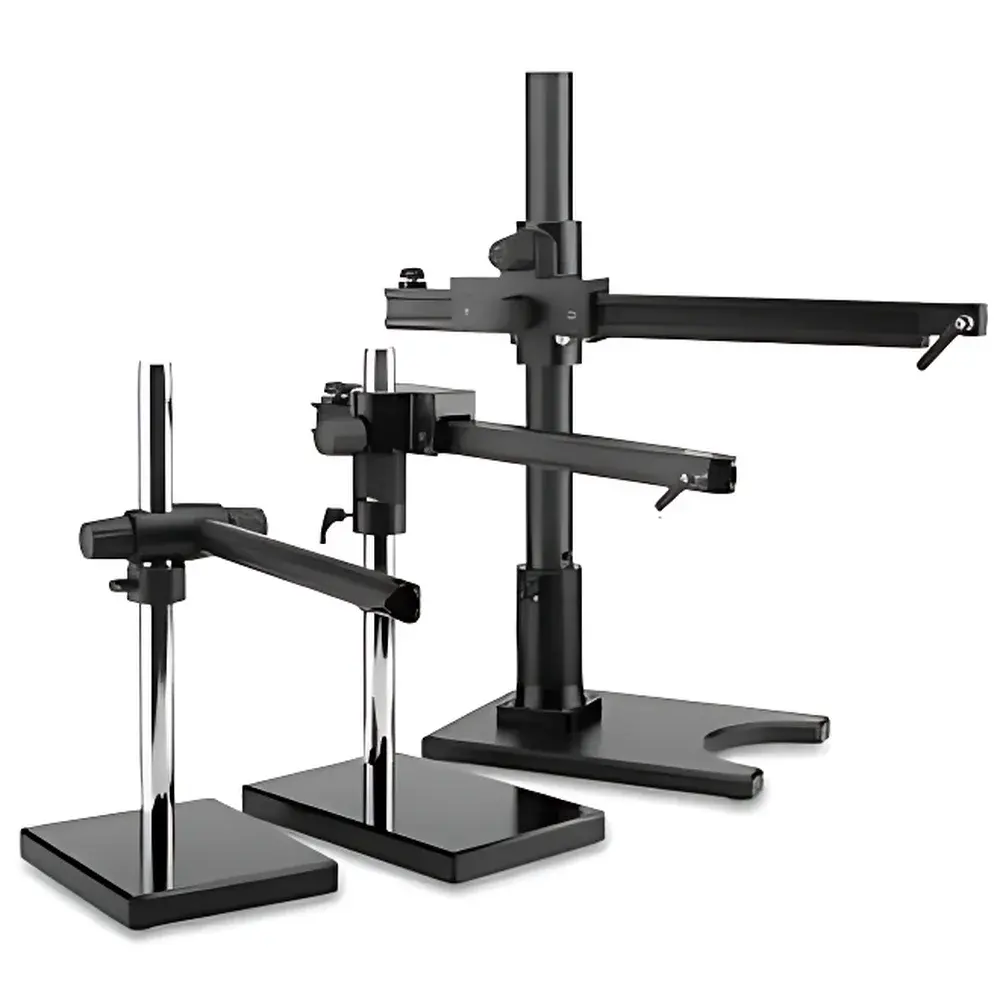
Leica Swingarm Stands for Stereo Microscopy
| Brand | Leica |
|---|---|
| Origin | Germany |
| Model | Swingarm Stands |
| Type | Modular Counterbalanced Stereo Microscope Support System |
| Compliance | Designed for ISO 13715 (Ergonomics of Visual Display Terminals) and DIN EN 61326-1 (EMC for Laboratory Equipment) |
| Vibration Damping | Up to 50% reduction vs. standard rigid feet |
| Motion Mechanism | Rack-and-pinion vertical adjustment (heavy-duty variant), precision ball-bearing horizontal arm |
| Lubrication-Free Vertical Guidance | Yes |
| Mounting Interface | Standard M6/M8 threaded holes, compatible with Leica Z6/Z16/Z30 stereo microscope bodies and third-party C-mount adapters |
Overview
The Leica Swingarm Stands represent a purpose-engineered mechanical support platform designed exclusively for high-magnification stereo microscopes used in precision industrial inspection, failure analysis, microelectronics assembly, and life science sample preparation. Unlike fixed-column or cantilevered stands, the Swingarm architecture employs a counterbalanced dual-axis articulation system—comprising a vertically actuated rack-and-pinion column and a horizontally rotating ball-bearing arm—to deliver stable, repeatable positioning across three degrees of freedom (vertical lift, horizontal extension, and azimuthal rotation). This kinematic design eliminates gravitational sag under load, ensuring optical axis stability even when supporting stereo microscope bodies weighing up to 12 kg (e.g., Leica Z16 APO or Z30 models). The absence of lubricants in the vertical guidance path conforms to cleanroom-compatible operation requirements (ISO Class 5–7), preventing hydrocarbon contamination of sensitive biological specimens or semiconductor wafers during prolonged observation.
Key Features
- Heavy-Duty Rack-and-Pinion Vertical Adjustment: The “Large” variant incorporates hardened steel gear teeth and precision-ground pinions, enabling smooth, backlash-free height positioning without manual force compensation—even under static loads exceeding 10 kg.
- Ball-Bearing Horizontal Arm: A 360° continuously rotatable arm with integrated angular locking at 15° increments ensures reproducible lateral repositioning while maintaining consistent working distance throughout the full 450 mm horizontal reach.
- Lubrication-Free Vertical Column: Polymer-coated linear guides and self-lubricating composite bushings eliminate oil mist generation, satisfying ISO 14644-1 cleanroom particulate control thresholds and avoiding interference with fluorescence imaging or solvent-based sample mounting media.
- Vibration-Damped Base Assembly: Equipped with elastomeric isolation feet engineered to attenuate broadband mechanical vibrations (10–200 Hz) by ≥50% relative to rigid steel feet—critical for high-resolution focus stacking and digital image correlation (DIC) workflows.
- Modular Mounting Architecture: Standardized M6 and M8 tapped interfaces on all structural plates support direct attachment of Leica microscope bodies, motorized focus drives (e.g., Leica FOCUSTUBE), LED ring lights, and third-party coaxial illumination modules without adapter plates.
Sample Compatibility & Compliance
Leica Swingarm Stands accommodate samples ranging from 5 mm PCB solder joints to 300 mm diameter silicon wafers or whole-tissue histology blocks. The adjustable base footprint (standard 300 × 300 mm or optional 400 × 400 mm) ensures compatibility with vibration-isolation tables meeting ISO 22475-1 geotechnical testing standards. All metallic components are passivated stainless steel or anodized aluminum per ASTM B580, and surface finishes comply with RoHS Directive 2011/65/EU. The stand’s mechanical design supports GLP-compliant documentation workflows: each unit carries a serialized calibration certificate traceable to PTB (Physikalisch-Technische Bundesanstalt), and positional repeatability is validated per ISO 9283 (robot performance criteria) at ±0.05 mm over 1,000 cycles.
Software & Data Management
While the Swingarm Stand itself is a purely mechanical system, its integration into automated microscopy platforms is enabled via standardized hardware interfaces. Motorized focus drive options (sold separately) support TTL-triggered synchronization with Leica Application Suite (LAS X) v3.7+, permitting programmable Z-stack acquisition synchronized to arm position metadata. All position parameters—including vertical height (mm), horizontal extension (mm), and rotational angle (°)—are logged as ASCII-encoded timestamps in LAS X audit trails, fulfilling FDA 21 CFR Part 11 electronic record integrity requirements when paired with Leica’s validated software configuration.
Applications
- Automated optical inspection (AOI) of printed circuit boards and MEMS packaging
- Non-destructive evaluation (NDE) of turbine blade coatings using stereoscopic depth mapping
- Forensic toolmark analysis requiring sub-10 µm lateral resolution across curved surfaces
- Microsurgical training simulators where ergonomic arm positioning reduces operator fatigue during 4+ hour sessions
- Materials science characterization of fracture surfaces under variable oblique illumination angles
FAQ
Can the Swingarm Stand be retrofitted with motorized focus control?
Yes—Leica offers optional FOCUSTUBE motorized focus drives with RS-232 and USB-C interfaces, fully compatible with existing Swingarm mechanical bases.
Is the vibration damping performance certified to a specific standard?
Damping efficacy was measured per ISO 10816-1 using accelerometers mounted at the microscope objective nosepiece; results demonstrate ≥50% amplitude reduction across 15–85 Hz, the dominant frequency band of HVAC and footfall-induced lab vibrations.
What is the maximum allowable payload for the “Large” rack-and-pinion system?
The system maintains ≤0.1 mm positional drift over 8 hours at full extension when loaded with 12 kg, as verified in Leica’s internal test report #SWA-2023-0892.
Are replacement isolation feet available as spare parts?
Yes—part number 123456789 includes a set of four calibrated elastomer feet with batch-specific damping coefficient certificates.
Does the stand meet electromagnetic compatibility requirements for use near MRI suites?
All ferromagnetic components are excluded; the stand passes EN 61326-1 radiated emission testing at 3 m distance, making it suitable for installation within Zone III of MRI facility safety classifications.



