
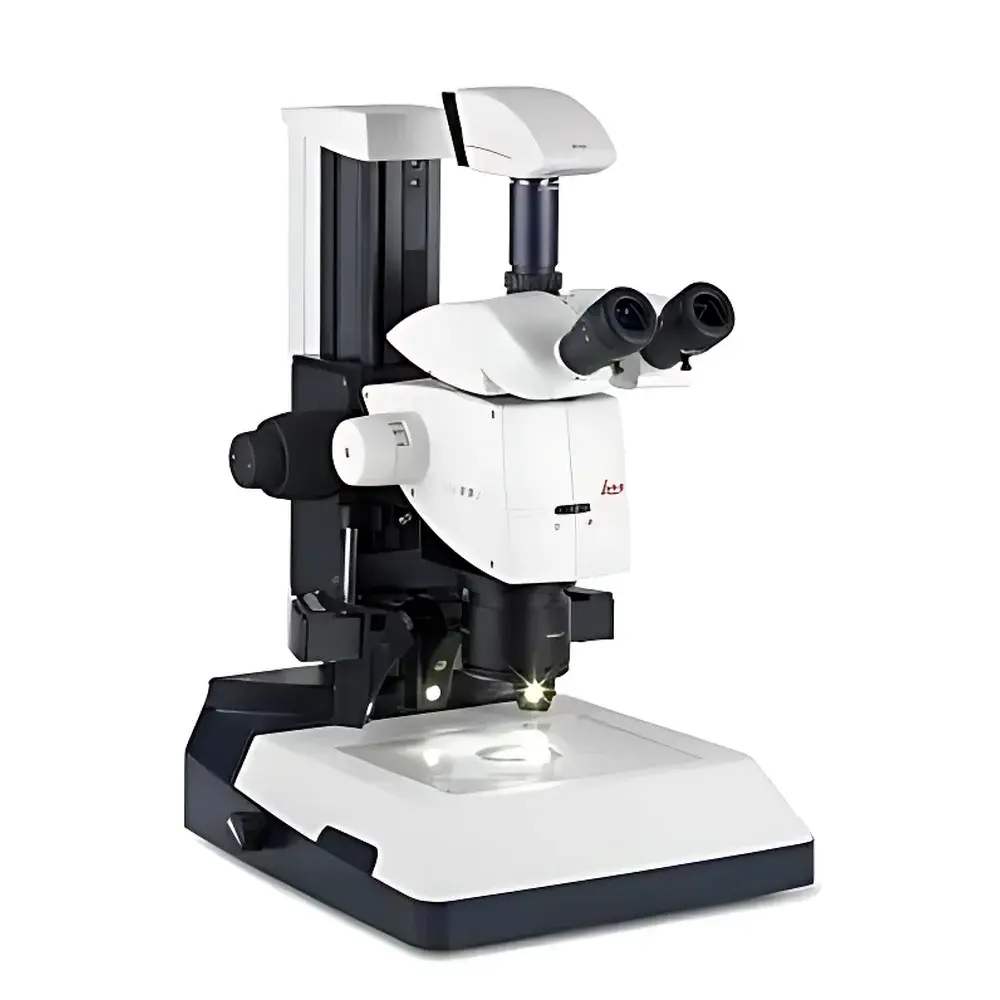
Leica TL4000 BFDF Transmitted Light Base for Stereo Microscopy
| Brand | Leica |
|---|---|
| Origin | Germany |
| Model | TL4000 BFDF |
| Illumination Modes | Brightfield & Darkfield |
| Working Area | Large Format (≥150 × 120 mm) |
| Vibration Damping | Integrated Anti-Vibration Elastomeric Feet |
| Optional Stage | Motorized or Manual XY Slide-on Stage with Focusing Compatibility |
| Compliance | CE, ISO 9001 Manufacturing Environment |
Overview
The Leica TL4000 BFDF is a high-precision transmitted light base engineered specifically for stereo microscopes requiring flexible, stable, and high-contrast illumination in both brightfield (BF) and darkfield (DF) modalities. Designed as a modular component for Leica M-series and other compatible stereo microscope stands, it employs Köhler illumination principles optimized for low-magnification transmitted-light observation. Its optical architecture integrates a centrally aligned, adjustable condenser system with field and aperture diaphragms to ensure uniform illumination across the entire working area—critical for consistent contrast generation in metallurgical, geological, and biological specimen assessment. Unlike conventional light bases with fixed illumination geometry, the TL4000 BFDF features a mechanically decoupled condenser module that pivots smoothly between BF and DF configurations without realignment, minimizing setup time while preserving optical fidelity. The base is constructed from precision-cast aluminum alloy with anodized surface treatment, ensuring thermal stability and long-term dimensional integrity under continuous laboratory operation.
Key Features
- Switchable Brightfield/Darkfield Illumination: A single, integrated condenser assembly enables rapid, tool-free transition between BF and DF modes via ergonomic lever actuation—maintaining parfocality and eliminating recalibration.
- Large Working Area (≥150 × 120 mm): Accommodates oversized specimens including wafers, circuit boards, tissue sections on glass slides, and mineral slabs—optimized for macro-level inspection and documentation workflows.
- Slide-on Mechanical Stage Compatibility: Supports Leica’s standardized XY mechanical stages (e.g., MS4, MS6) that mount directly onto the base surface; stage movement remains fully functional in focus plane during transmitted-light imaging.
- Passive Vibration Isolation System: Four height-adjustable elastomeric feet absorb ambient floor-borne vibrations (0.5–15 Hz range), reducing image blur and improving resolution reproducibility—especially critical at magnifications >20× with long working distance objectives.
- Modular Power Integration: Accepts Leica LED illumination modules (e.g., TL4000 LED, TL4000 LED DF) with constant-current drivers and thermal management—ensuring color temperature stability (5700 K ± 150 K) and luminance consistency over 20,000 hours MTBF.
Sample Compatibility & Compliance
The TL4000 BFDF is routinely deployed in quality control laboratories performing ASTM E3-22 (metallographic specimen preparation), ISO 14489 (optical microscopy of polymers), and USP (particulate matter testing in injectables). Its large aperture and low-angle darkfield illumination support high-sensitivity detection of edge defects, micro-cracks, phase boundaries, and submicron particulates on reflective or semi-transparent substrates. All optical components comply with ISO 10110-7 surface quality standards (scratch-dig ≤ 10-5), and the base housing meets IEC 61000-6-3 EMC emission limits. As a CE-marked device manufactured in Leica’s Wetzlar-based ISO 9001-certified facility, it satisfies essential requirements for use in GLP-compliant environments when paired with audit-trail-enabled imaging software.
Software & Data Management
While the TL4000 BFDF operates independently as a hardware platform, it is fully interoperable with Leica Application Suite (LAS X) v3.7+ and third-party acquisition packages (e.g., NIS-Elements, ZEN Blue) via TTL synchronization triggers and analog intensity control inputs. When integrated into a full Leica DM series stereo imaging station, the base supports synchronized illumination mode logging within metadata streams—including timestamped BF/DF state changes, intensity values, and stage coordinates—enabling traceable, 21 CFR Part 11–compliant documentation for regulated industries. Firmware updates are delivered via Leica’s secure portal and require no physical service intervention.
Applications
- Metallurgical QC: Grain structure analysis, inclusion mapping, and weld seam inspection using darkfield-enhanced edge contrast.
- Electronics Manufacturing: Solder joint integrity verification, PCB trace continuity checks, and conformal coating uniformity assessment.
- Geological Thin Section Analysis: Birefringence screening and mineral boundary delineation under cross-polarized transmitted light (when used with optional polarizer kit).
- Life Science Preparations: Rapid screening of stained histology slides, embryo viability assessment, and nematode motility studies requiring high dynamic range transmission contrast.
- Forensic Document Examination: Detection of erasures, ink layer stratification, and security feature validation on banknotes or ID cards.
FAQ
Is the TL4000 BFDF compatible with non-Leica stereo microscopes?
Yes—provided the microscope stand features a standardized 120 mm diameter mounting interface and accepts Leica M-series optical tubes (e.g., Zeiss Stemi 508, Olympus SZX series with adapter ring). Mechanical and optical alignment tolerances must be verified prior to integration.
Can the base be used with fluorescence stereo microscopes?
No—the TL4000 BFDF is designed exclusively for transmitted visible-light illumination (400–700 nm); it lacks excitation filter slots or dichroic beam paths required for fluorescence applications.
What is the maximum sample thickness supported?
With standard condenser height adjustment, samples up to 65 mm tall can be accommodated beneath the objective; thicker specimens require optional extended-height condenser kits (sold separately).
Does the vibration damping system require maintenance or replacement?
The elastomeric feet are maintenance-free and rated for 10 years of continuous use under typical lab environmental conditions (20–25°C, 30–60% RH); periodic visual inspection for compression set or cracking is recommended annually.




