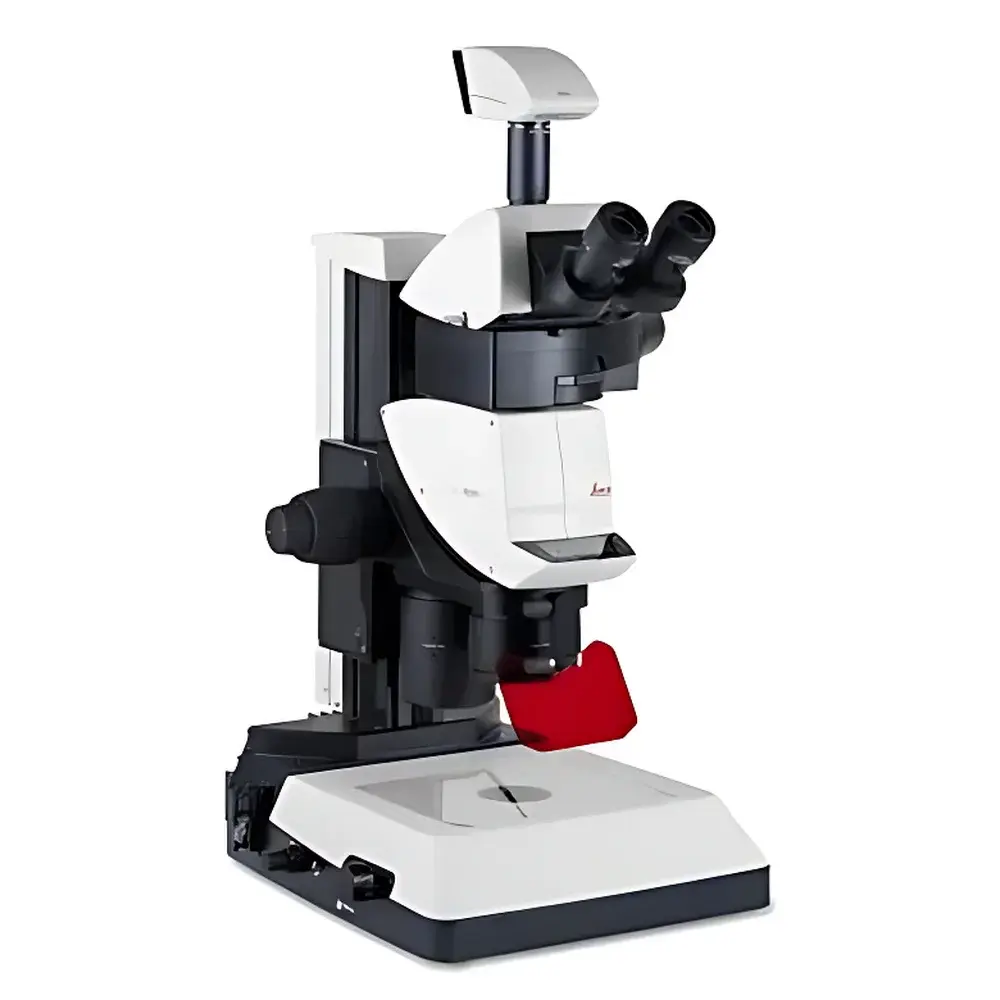
Leica TL4000 RCI Transmitted Light Base
| Brand | Leica |
|---|---|
| Origin | Germany |
| Model | TL4000 RCI |
| Illumination Technology | Rottermann Contrast (localized differential interference contrast via oblique transmitted lighting) |
| Interface | Dual USB 2.0 for brightness control and device communication |
| Mirror Options | Adjustable planar and concave reflectors for dynamic positive/negative relief contrast |
| Stage Integration | Slide-on mechanical stage compatible with transmitted-light focusing |
| Color Temperature Management | Constant Color Intensity Control (CCIC) — intensity adjustment without white balance recalibration |
| Vibration Damping | Integrated elastomeric anti-vibration feet |
| Remote Operation | Software-controllable illumination, automated image acquisition, and time-lapse sequencing |
| Compliance | Designed for integration into Leica Z6 APO, M205 FA, and other modular stereo microscope systems per DIN EN ISO 9001 manufacturing standards |
Overview
The Leica TL4000 RCI Transmitted Light Base is a precision-engineered illumination module designed exclusively for high-resolution stereo microscopy applications requiring enhanced structural contrast in transparent or semi-transparent specimens. Unlike conventional Köhler or brightfield transmitted light bases, the TL4000 RCI implements Rottermann Contrast—a proprietary localized oblique illumination technique that exploits minute refractive index gradients within unstained, label-free samples to generate topographic-like contrast. This principle operates on the physical basis of differential light path deviation at phase boundaries, producing optically rendered “relief” effects—either positive (hill-like) or negative (valley-like)—without introducing artifacts associated with staining or polarized optics. The system is fully compatible with Leica’s modular stereo microscope platforms, including the Z6 APO and M205 FA, and serves as a critical component in quality control workflows for microelectronics inspection, pharmaceutical tablet coating analysis, polymer morphology assessment, and developmental biology imaging where non-invasive, real-time contrast modulation is essential.
Key Features
- Rottermann Contrast Illumination: Delivers adjustable, directional transmitted light that accentuates subtle surface and subsurface features through controlled angular incidence—enabling visualization of otherwise invisible refractive discontinuities in glass, hydrogels, thin films, and biological tissues.
- Dual USB 2.0 Interface: Provides direct digital control of LED intensity and enables synchronization with Leica Application Suite (LAS X) for hardware-triggered acquisition, exposure ramping, and illumination profiling during time-lapse experiments.
- Dynamic Relief Contrast Switching: Interchangeable planar and concave reflectors allow rapid, tool-free switching between positive and negative contrast modes—facilitating immediate comparative evaluation of identical sample regions under opposing optical interpretations.
- Slide-on Mechanical Stage Integration: Engineered to support Leica’s motorized or manual XY stages with integrated focus coupling, ensuring stable, parfocal alignment when transitioning between reflected and transmitted light observation paths.
- Constant Color Intensity Control (CCIC): Maintains fixed correlated color temperature (~5700 K) across the full intensity range (1–100%), eliminating the need for repeated white balance calibration during quantitative imaging or multi-channel documentation.
- Vibration-Isolated Platform: Features elastomer-based damping feet compliant with ISO 25316:2015 guidelines for vibration-sensitive optical instrumentation—reducing transmission of floor-borne mechanical noise below 15 Hz and preserving resolution at magnifications up to 200×.
Sample Compatibility & Compliance
The TL4000 RCI supports a broad range of transmission-compatible specimens, including but not limited to: histological sections (unstained frozen or paraffin-embedded), live zebrafish embryos, microfluidic devices, semiconductor wafers, coated optical filters, and layered composite materials. Its illumination geometry avoids thermal loading and phototoxicity, making it suitable for extended-duration live-cell observation under GLP-compliant documentation protocols. The unit complies with IEC 61000-6-3 (EMC emission limits) and IEC 61000-6-2 (immunity to electrostatic discharge and RF fields), and its construction adheres to RoHS 2011/65/EU directives. When operated within Leica’s validated software environment (LAS X v3.7+), audit trails, user access logs, and electronic signatures meet FDA 21 CFR Part 11 requirements for regulated laboratories.
Software & Data Management
Native integration with Leica Application Suite (LAS X) enables full parametric control—including intensity ramping, timed illumination pulses, and synchronized shutter triggering—via scriptable Python APIs. Image metadata (illumination mode, reflector type, intensity value, timestamp) is embedded directly into TIFF and JPEG2000 files using EXIF and DICOM-SR schemas. LAS X also supports automated contrast optimization workflows: users can define region-of-interest (ROI)-based illumination profiles and store them as reusable presets. All configuration changes are logged with ISO/IEC 17025-aligned traceability, including operator ID, timestamp, and parameter delta values—ensuring full compliance with analytical method validation frameworks.
Applications
- Microelectronics: Inspection of solder joint integrity, underfill voids, and wafer-level packaging defects under variable relief contrast.
- Pharmaceutical QA/QC: Assessment of tablet film-coating uniformity, blister-pack seal integrity, and lyophilized cake structure without destructive sampling.
- Materials Science: Characterization of phase separation in polymer blends, interfacial adhesion in laminates, and crack propagation in transparent ceramics.
- Developmental Biology: Time-lapse imaging of gastrulation dynamics in avian and amphibian embryos using label-free contrast modulation.
- Forensic Document Analysis: Differentiation of ink layer sequence, paper fiber orientation, and erased/altered entries in questioned documents.
FAQ
Is the TL4000 RCI compatible with non-Leica stereo microscopes?
No—the TL4000 RCI requires mechanical and electrical interface alignment specific to Leica’s modular base architecture; adapter solutions are not supported by Leica Microsystems.
Does Rottermann Contrast replace phase contrast or DIC?
It complements—but does not substitute—phase contrast or differential interference contrast; Rottermann Contrast operates exclusively in transmitted-light stereo configurations and lacks the wavefront-shearing capability of true DIC systems.
Can CCIC be disabled for custom white balance workflows?
Yes—CCIC is software-toggled in LAS X; disabling it allows manual RGB gain adjustment while retaining all other illumination controls.
What is the expected lifetime of the integrated LED array?
Rated for ≥20,000 hours at nominal output, with luminous flux degradation <15% over rated life per IES LM-80 testing protocols.
Is firmware update capability available via USB?
Yes—firmware updates are delivered through Leica’s official Service Portal and installed via USB-connected LAS X workstation.