
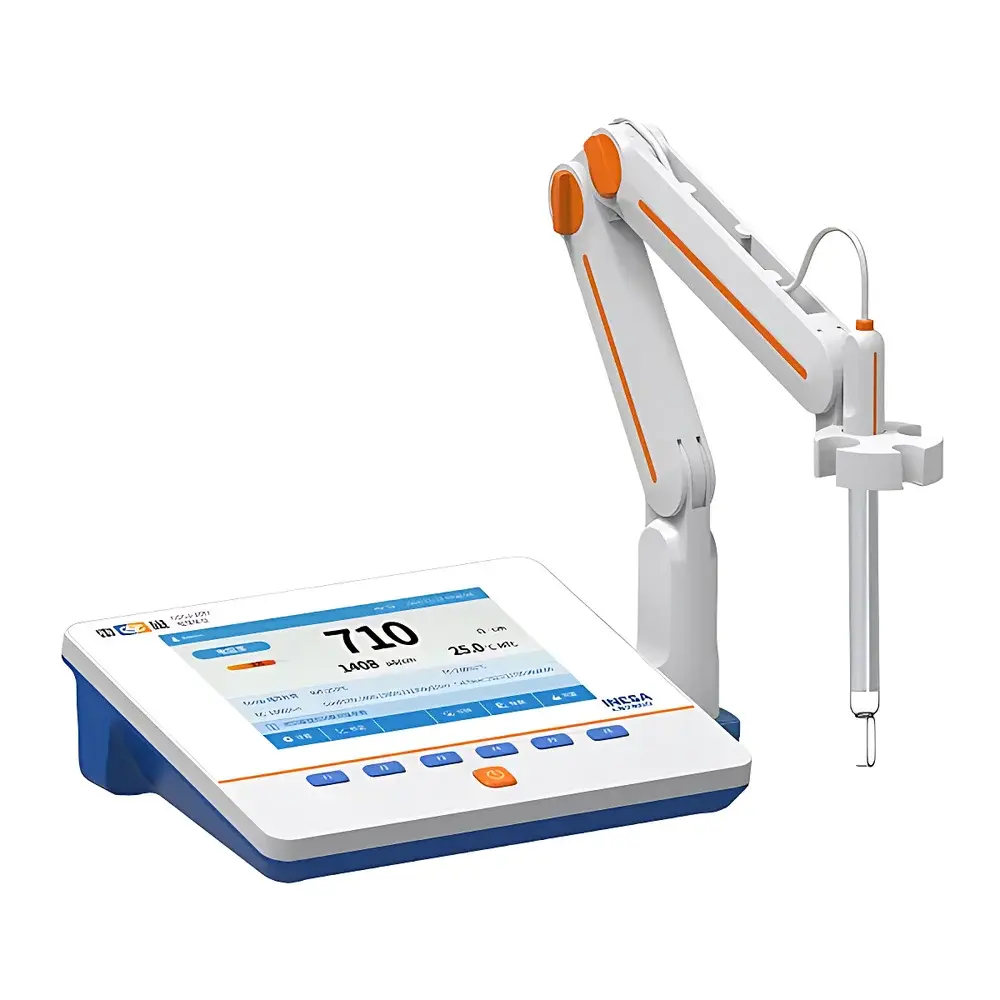
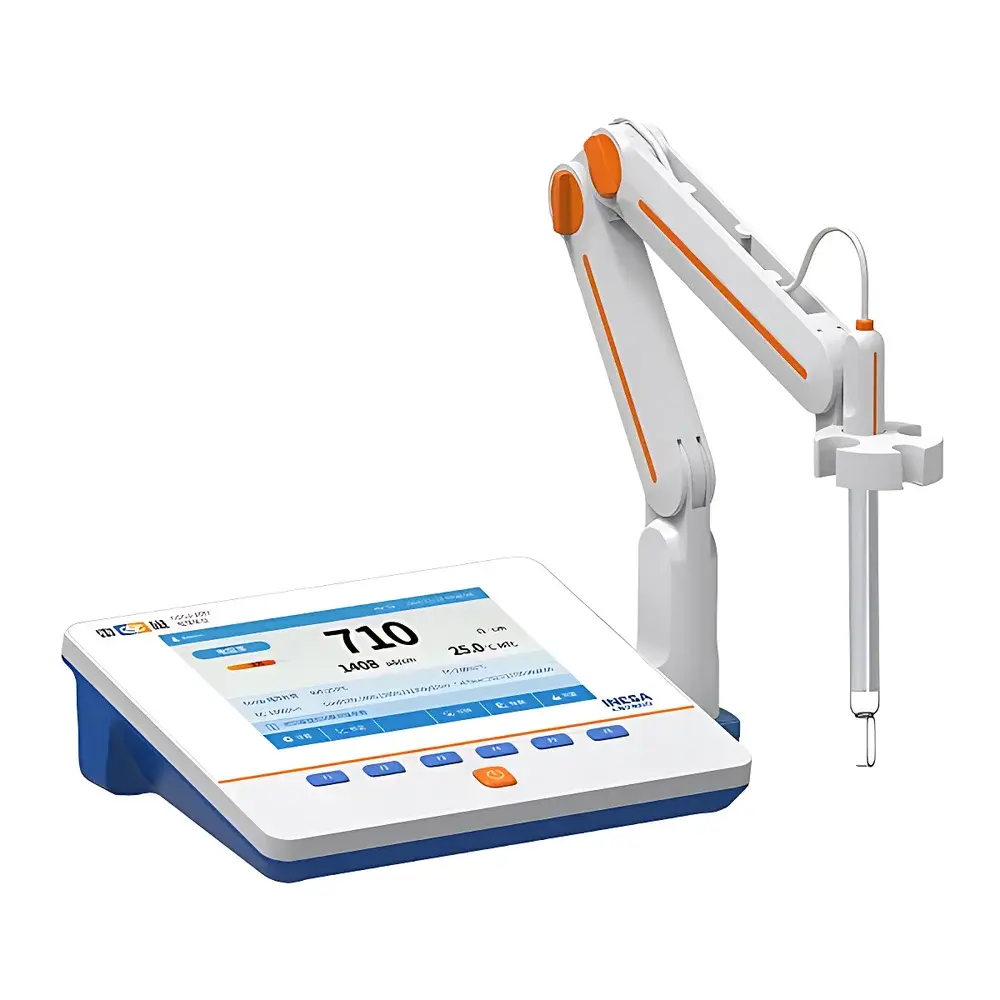
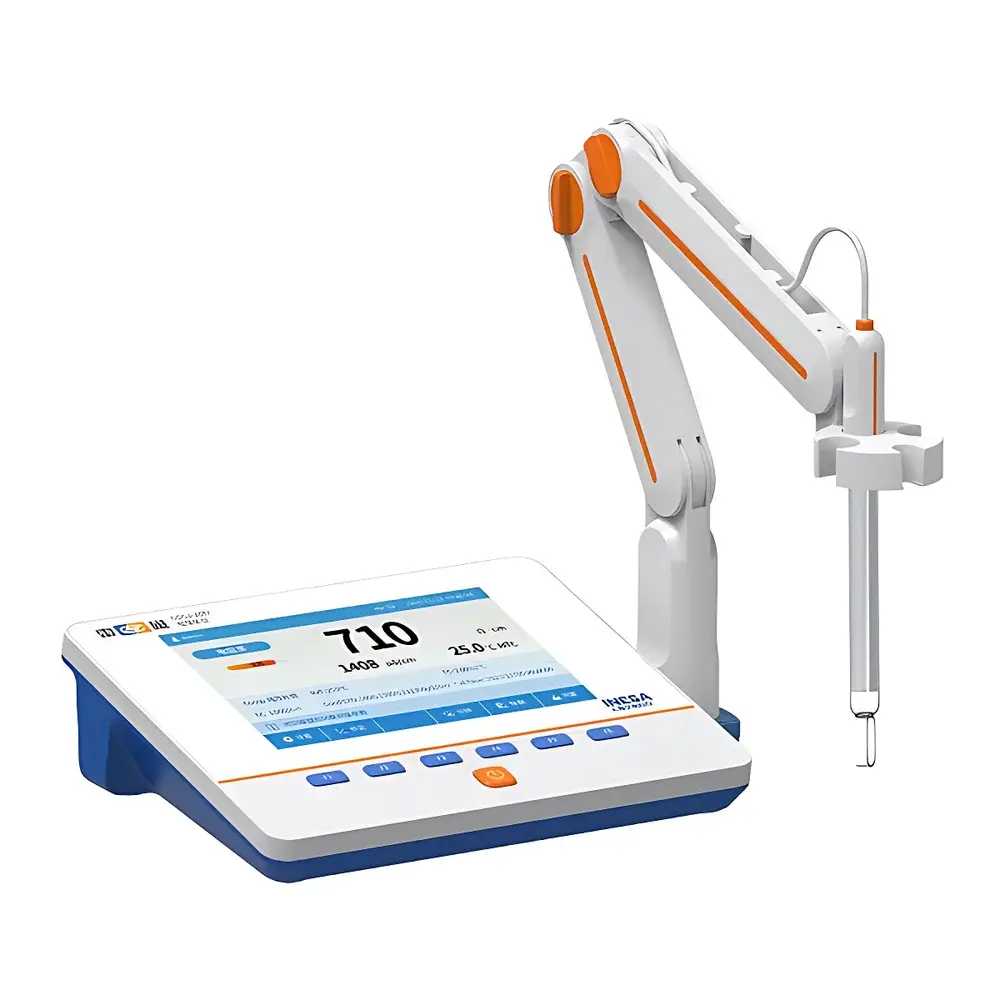
Leichi DDS-307A Benchtop Conductivity Meter
| Brand | Leichi |
|---|---|
| Origin | Shanghai, China |
| Instrument Type | Benchtop Conductivity Meter |
| Measurement Principle | Two-electrode AC conductivity measurement with frequency auto-switching |
| Conductivity Range | 0.000 µS/cm to 200.0 mS/cm |
| TDS Range | 0.000 mg/L to 100.0 g/L |
| Temperature Range | −5.0 °C to 110.0 °C |
| Display | 6-inch high-resolution LCD |
| Protection Rating | IP54 |
| Calibration | Single-point calibration with auto-recognition of four standard solutions (146.5 µS/cm, 1408 µS/cm, 12.85 mS/cm, 111.3 mS/cm) |
| Temperature Compensation | Automatic and manual modes |
| Data Storage | 50 measurement sets with recall and deletion |
| Compliance | JB/T 9366–2017, GB/T 11007–2008, JJG 376–2007, HJ 1396–2024 |
Overview
The Leichi DDS-307A is a precision benchtop conductivity meter engineered for routine and quality-critical conductivity, TDS, and temperature measurements in academic, environmental, pharmaceutical, and industrial laboratory environments. It operates on the two-electrode alternating current (AC) conductivity principle—minimizing polarization effects and electrode fouling—while incorporating automatic frequency switching to maintain measurement stability across wide conductivity ranges. Designed for reproducible electrochemical analysis under controlled conditions, the DDS-307A delivers traceable, stable readings from ultrapure water (0.000 µS/cm) to concentrated brines (200.0 mS/cm), with integrated temperature sensing (−5.0 to 110.0 °C) enabling accurate thermal compensation per ISO 7888 and ASTM D1125 guidelines.
Key Features
- 6-inch high-resolution LCD display with intuitive key-based navigation and backlight support for low-light lab conditions
- IP54-rated enclosure ensuring resistance to dust ingress and incidental water splashes during daily operation
- Auto-detection and recognition of four certified conductivity standards (146.5 µS/cm, 1408 µS/cm, 12.85 mS/cm, and 111.3 mS/cm), streamlining single-point calibration workflows
- Intelligent endpoint detection algorithm supporting both continuous reading mode and equilibrium-based stabilized output
- Automatic temperature compensation (ATC) using built-in NTC thermistor; manual compensation also available for non-standard probe configurations
- Power management system featuring programmable auto-shutdown and power-loss data retention to preserve calibration and last-measurement states
- Integrated electrode holder and dust cover included as standard accessories—optimized for workspace organization and sensor protection
Sample Compatibility & Compliance
The DDS-307A accommodates aqueous samples across diverse matrices—including deionized water, process streams, wastewater effluents, nutrient solutions, and buffer systems—provided sample conductivity falls within its validated range and no aggressive solvents or suspended solids exceed electrode tolerance. Its design conforms to national metrological verification regulations (JJG 376–2007) and laboratory instrument standards (JB/T 9366–2017, GB/T 11007–2008). For environmental compliance testing, it satisfies methodology requirements specified in HJ 1396–2024 for water temperature determination via sensor-based methods. While not inherently 21 CFR Part 11 compliant, audit-ready usage is achievable through documented SOPs, user access control (via physical key lockout), and manual logbook correlation with stored datasets.
Software & Data Management
Data handling is performed locally via internal flash memory supporting up to 50 complete measurement records—each timestamped and annotated with conductivity, TDS, temperature, and calibration status. Users may review, export (via manual transcription), or delete entries directly from the front panel interface. No proprietary software or USB connectivity is provided; however, the instrument’s structured data format enables straightforward integration into LIMS or ELN platforms via manual entry or barcode-assisted logging. All calibration events—including date, standard used, slope, and offset—are retained alongside measurement history to support GLP-aligned recordkeeping and internal QA audits.
Applications
- Quality control of purified water (PW) and water-for-injection (WFI) in pharmaceutical manufacturing per USP
- Monitoring conductivity drift in reverse osmosis (RO) and deionization (DI) systems for semiconductor and biotech cleanrooms
- Environmental field screening and lab-based validation of surface water, groundwater, and wastewater per EPA Method 120.1 and ISO 7888
- TDS estimation in agricultural irrigation water and hydroponic nutrient solutions
- Educational labs requiring robust, entry-level instrumentation for electrochemistry fundamentals and calibration practice
- Validation of thermal equilibration in stability chambers and incubators via concurrent temperature-conductivity correlation
FAQ
What types of electrodes are compatible with the DDS-307A?
The instrument ships with a standard K=1.0 composite conductivity electrode. It supports interchangeable two-electrode cells with BNC or DIN connectors rated for K-factors between 0.1 and 10.0 cm⁻¹.
Does the DDS-307A support GLP-compliant data traceability?
While it lacks electronic signature or audit-trail features required for full GLP compliance, its timestamped storage, calibration logging, and physical record retention enable alignment with GLP principles when paired with procedural documentation and analyst training records.
Can the DDS-307A measure resistivity directly?
No—it calculates and displays conductivity and derived TDS only. Resistivity values must be manually computed as the reciprocal of conductivity (ρ = 1/σ), with appropriate unit conversion.
Is temperature measurement independently validated?
Yes—the integrated temperature sensor is factory-calibrated against NIST-traceable references and verified per GB/T 11007–2008 thermal response testing protocols.
How often should the conductivity electrode be recalibrated?
Recalibration is recommended before each analytical session or after exposure to high-solids or viscous samples; daily verification using a mid-range standard is advised for regulated QC environments.





