
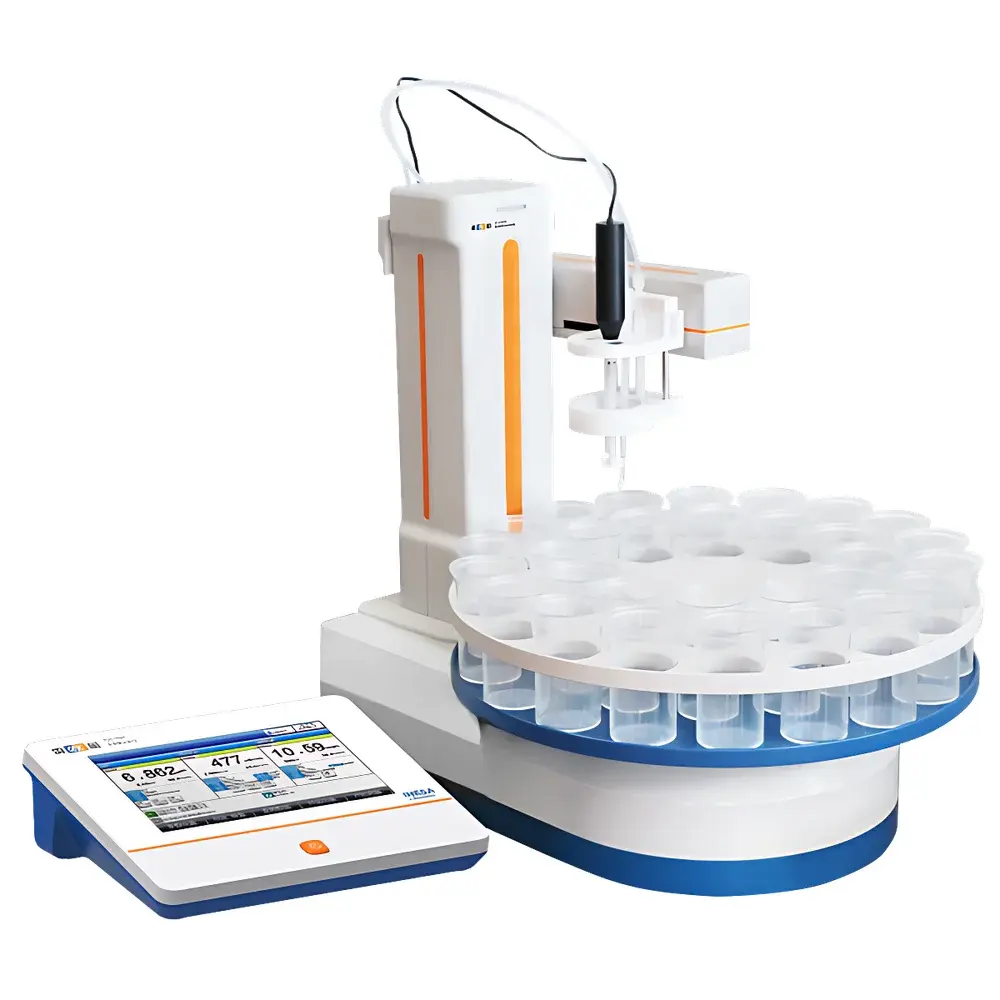
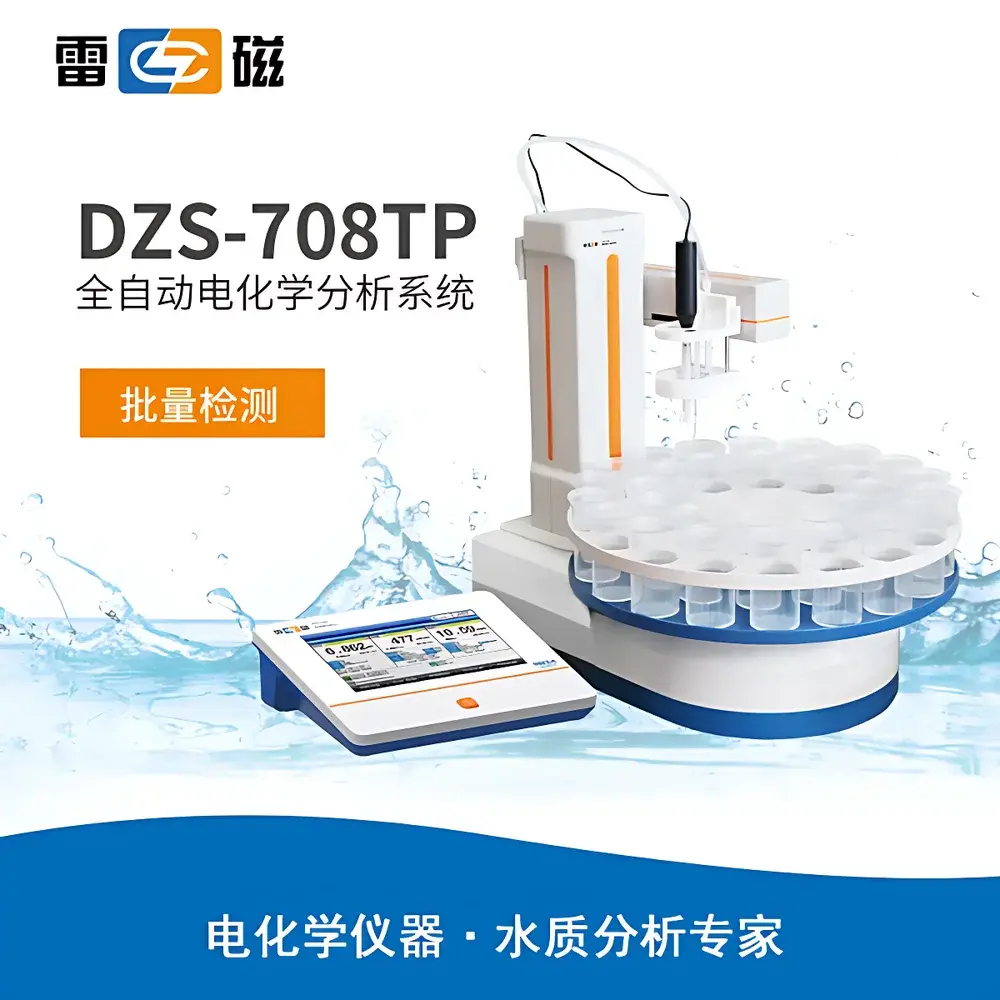
Leichi DZS-708TP Automated Electrochemical Water Quality Analyzer
| Brand | Leichi |
|---|---|
| Origin | Shanghai, China |
| Manufacturer Type | Original Equipment Manufacturer (OEM) |
| Product Category | Domestic |
| Model | DZS-708TP Automated Electrochemical Water Quality Analyzer |
| Instrument Type | Laboratory Water Quality Analyzer |
| Measurable Parameters | pH, Conductivity, Dissolved Oxygen (DO), Ion Concentration (pX), ORP, TDS, Salinity, Resistivity, Ash Content (White Sugar & HFCS), Temperature |
Overview
The Leichi DZS-708TP Automated Electrochemical Water Quality Analyzer is an integrated benchtop system engineered for high-throughput, multi-parameter electrochemical analysis in environmental monitoring, municipal water treatment, food & beverage quality control, and regulatory compliance laboratories. It implements standardized potentiometric (pH/pX), conductimetric (conductivity/resistivity/TDS/salinity), and amperometric (dissolved oxygen) measurement principles in accordance with ISO 5667-3, ASTM D1293, ASTM D5391, ISO 5814, and USP . The system features a modular three-sensor architecture—pH/pX, conductivity, and DO—each equipped with digital electrode interfaces supporting automatic recognition, real-time diagnostics, and temperature-compensated signal processing. Designed for GLP/GMP-aligned workflows, the DZS-708TP delivers traceable, auditable measurements across aqueous matrices ranging from ultrapure water to high-ionic-strength wastewater and sugar solutions.
Key Features
- Triple-measurement-unit integration: Simultaneous or sequential acquisition of pH/pX (±0.002 pH/pX), conductivity (±0.5% FS), and dissolved oxygen (±0.10 mg/L at ≤20 mg/L), all referenced to NIST-traceable standards.
- Intelligent endpoint detection: Adaptive algorithms support auto-read, timed-read, interval-read, and manual-read modes; automatic endpoint stabilization verified per ISO 11277 for pH and ASTM D888 for DO.
- Comprehensive electrode management: Onboard diagnostics include impedance monitoring, slope verification, asymmetry potential assessment, and calibration history logging with timestamped alerts for overdue or out-of-spec calibrations.
- Automated sample handling: Compatible with optional robotic autosamplers supporting 18–30 position trays (50–200 mL vials); includes programmable rinse cycles (jet spray + magnetic stirrer wash) and positional mapping for unattended batch analysis.
- Robust environmental protection: IP54-rated enclosure ensures operational reliability in humid or dust-prone lab environments; power-fail recovery and scheduled auto-shutdown minimize energy use and data loss.
- Firmware extensibility: Field-upgradable firmware enables method customization, new ion calibration protocols, and future regulatory alignment (e.g., EPA Method 365.4 updates).
Sample Compatibility & Compliance
The DZS-708TP is validated for use with natural waters (surface, groundwater, seawater), treated effluents, potable water, process streams, white sugar solutions (per GB/T 10498), and high-fructose corn syrup (HFCS) ash determinations. All electrochemical modules comply with IEC 61000-4 immunity standards and meet CE marking requirements for laboratory instrumentation. Data integrity conforms to FDA 21 CFR Part 11 through role-based user authentication (three-tier access), electronic signature support, immutable audit trails, and full operation logging—including calibration events, electrode swaps, and method modifications. Instrument validation documentation supports IQ/OQ protocols required under ISO/IEC 17025-accredited testing labs.
Software & Data Management
Embedded Linux-based OS provides intuitive touchscreen navigation with context-aware prompts and multilingual UI (English, Spanish, French, Chinese). Measurement data are stored locally in encrypted SQLite databases (≥1000 complete test records), each containing raw sensor outputs, metadata (operator ID, location, ambient conditions), and full calibration logs. Export options include CSV (tabular), PDF (formatted reports), and XML (LIMS-integrated). USB host port enables direct U-disk import/export of methods and results; RS-232 supports legacy thermal printers (customizable templates); RJ45 Ethernet and Wi-Fi (802.11n) enable secure TLS-encrypted upload to cloud platforms compliant with GDPR and HIPAA-compliant storage architectures. Optional Leichi LabLink PC software offers advanced statistical analysis (ANOVA, trend charts, control charts per ISO 7870) and automated report generation.
Applications
- Regulatory compliance testing for drinking water (EPA 180.1, ISO 10523, ISO 7888)
- Wastewater discharge monitoring (BOD/COD correlation via DO kinetics, salinity correction per ISO 15839)
- Pharmaceutical water systems (PW, WFI): conductivity mapping per USP , TOC surrogate via resistivity
- Food industry: Ash content quantification in sucrose and HFCS per AOAC 992.02 and GB/T 10498
- Academic research: Multi-ion speciation studies (e.g., F⁻, NO₃⁻, NH₄⁺) using pX mode with ISE cross-sensitivity compensation
- Calibration lab services: Reference standard verification using dual-standard bracketing and uncertainty propagation per GUM (JCGM 100:2008)
FAQ
Does the DZS-708TP support ASTM D1293-compliant pH measurement in natural waters?
Yes—the instrument applies automatic temperature compensation (ATC) and ionic strength correction algorithms aligned with ASTM D1293 Annex A1 for field-representative pH reporting.
Can the system validate electrode performance before each batch run?
Yes—electrode diagnostic routines assess slope (% theoretical), zero offset, and membrane resistance prior to measurement initiation; results are logged and configurable alarm thresholds trigger operator review.
Is the dissolved oxygen module certified for Winkler method equivalence?
While not a replacement for titrimetric Winkler, the Clark-type DO sensor meets ISO 5814 performance criteria for routine monitoring, with documented bias ≤ ±0.2 mg/L vs. iodometric reference in freshwater matrices.
How does the system ensure data integrity during network transmission?
All wireless/Ethernet data transfers employ TLS 1.2 encryption; server-side validation enforces checksum matching and session token binding to prevent man-in-the-middle tampering.
What calibration standards are required for regulatory submissions?
NIST-traceable buffers (pH 4.01, 7.00, 10.01), KCl conductivity standards (84 μS/cm, 1413 μS/cm, 12.88 mS/cm), and BOD-free air-saturated water (for DO) are recommended per ISO/IEC 17025 Clause 6.6.







