
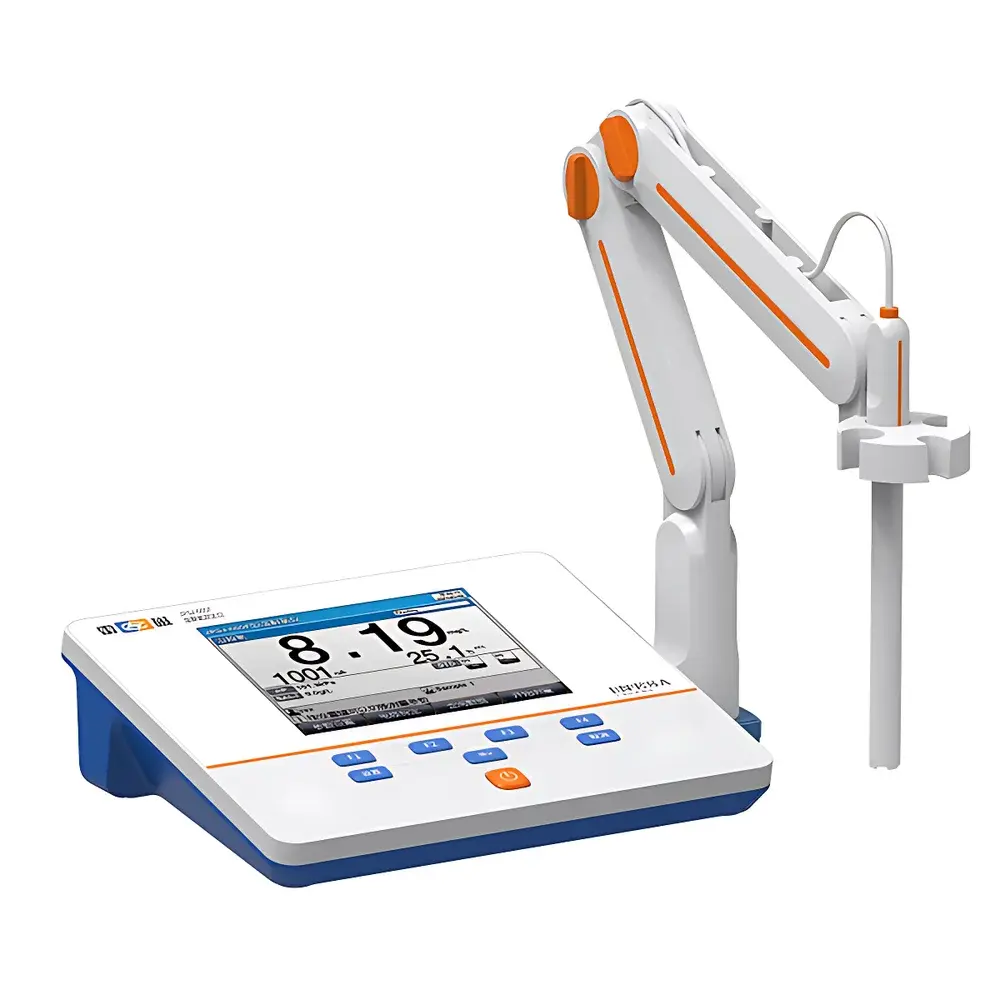
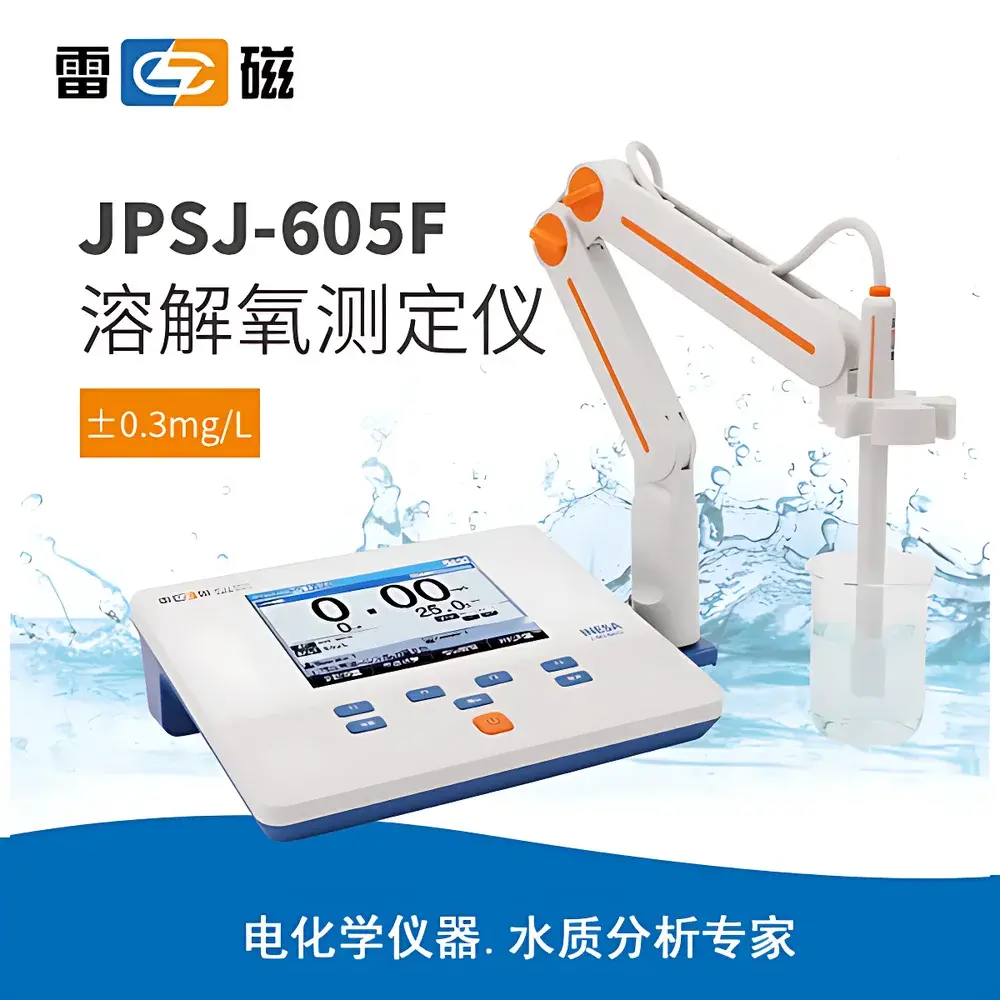
Leichi JPSJ-605F Dissolved Oxygen Meter
| Brand | Leichi |
|---|---|
| Origin | Shanghai, China |
| Manufacturer Type | Direct Manufacturer |
| Regional Classification | Domestic (China) |
| Model | JPSJ-605F |
| Instrument Type | Benchtop Laboratory Meter |
| Measurement Principle | Polarographic Electrochemical Probe |
| DO Range | (0.00–50.00) mg/L |
| Accuracy | ±0.30 mg/L (≤20.00 mg/L) |
| Repeatability | 0.15 mg/L |
| Detection Limit | 0.01 mg/L |
| Temperature Range | (−10.0 to 135.0) °C |
| Temp. Accuracy | ±0.3 °C (0.0–60.0 °C) |
| Response Time | ≤45 s (90% response at 20.0 °C) |
| Saturation Range | (0.0–600.0) % |
| Salt Compensation Error | ±2.0% saturation |
| IP Rating | IP54 |
| Interface | RS-232, USB |
| Data Storage | 500 sets |
| Power Supply | AC 100–240 V input / DC 9 V output |
| Dimensions | 242 × 195 × 68 mm |
| Weight | 0.9 kg |
Overview
The Leichi JPSJ-605F Dissolved Oxygen Meter is a benchtop laboratory instrument engineered for precise, reproducible measurement of dissolved oxygen (DO) concentration, saturation percentage, and temperature in aqueous samples. It operates on the polarographic electrochemical principle—utilizing a Clark-type membrane-covered sensor with a gold cathode and silver/silver chloride anode immersed in an electrolyte solution. Oxygen diffuses through a selective gas-permeable membrane and undergoes reduction at the cathode, generating a current linearly proportional to the partial pressure of oxygen in the sample. This signal is converted to concentration (mg/L) and saturation (%) using built-in algorithms that apply automatic temperature compensation (ATC), atmospheric pressure correction (kPa, mmHg, or atm), and user-adjustable salinity compensation. Designed for routine water quality analysis in environmental monitoring labs, wastewater treatment facilities, aquaculture research, and academic teaching laboratories, the JPSJ-605F meets core functional requirements for GLP-compliant data integrity and method traceability.
Key Features
- High-resolution color LCD display with intuitive icon-based navigation and dual-unit support (°C/°F)
- Intelligent endpoint detection with multiple reading modes: auto-read, timed-read, interval-read, and manual-read
- Comprehensive auto-compensation: temperature (−10.0 to 135.0 °C), atmospheric pressure (user-selectable units), and salinity (manual entry)
- Calibration flexibility: automated zero-oxygen and full-scale (air-saturated) calibration routines; supports one- or two-point calibration protocols
- Rugged industrial design rated IP54 for dust resistance and limited water splashing protection—suitable for shared lab environments
- Firmware upgradability via USB connection, enabling future feature enhancements and protocol alignment with evolving regulatory expectations
- Integrated power management: auto-shutdown, power-loss recovery, and factory reset capability
Sample Compatibility & Compliance
The JPSJ-605F is validated for use with freshwater, seawater, wastewater effluents, biological media, and process water across municipal, industrial, and research applications. Its polarographic probe design ensures stable performance in moderately turbid or low-conductivity samples where optical (luminescence-based) sensors may exhibit drift. While not certified to ISO 5814 or ASTM D888 under factory validation, the instrument’s operational parameters—including ±0.30 mg/L accuracy (≤20 mg/L), ≤45 s response time at 20 °C, and 0.01 mg/L detection limit—are consistent with typical specifications for Class II laboratory-grade DO meters used in environmental compliance screening per EPA Method 360.5 and ISO 5815-1. The device supports GLP data governance through timestamped storage of calibration records, measurement history, and operator IDs (when paired with compatible PC software), fulfilling foundational audit-trail requirements for regulated laboratories.
Software & Data Management
The meter stores up to 500 complete measurement records—including DO (mg/L and % sat), temperature, date/time stamp, calibration status, and user-defined sample ID. Data can be reviewed locally in tabular or trend-curve format, filtered by date range or parameter, and selectively deleted. Export is enabled via RS-232 serial interface (compatible with standard ESC/P or PCL printers for direct hardcopy output) or USB port using Leichi’s proprietary communication software for Windows OS. The software facilitates CSV export, batch printing, and structured archiving compliant with internal QA documentation standards. All stored entries include metadata required for GLP traceability: calibration dates, electrode lot numbers (manually entered), ambient pressure values, and salinity inputs—ensuring full method reconstruction during internal or external audits.
Applications
- Environmental field labs conducting surface water and groundwater DO profiling per national monitoring programs
- Wastewater treatment plants performing aeration basin optimization and effluent compliance verification
- Aquaculture facilities monitoring dissolved oxygen thresholds for species-specific health management
- University teaching labs demonstrating fundamental principles of aquatic chemistry and sensor electrochemistry
- Pharmaceutical water system qualification (PW, WFI) where DO serves as a secondary indicator of system integrity
- Research studies involving bioreactor oxygen transfer rate (OTR) estimation and respiration kinetics
FAQ
What calibration standards are required for routine operation?
A zero-oxygen solution (e.g., sodium sulfite saturated solution) and an air-saturated water standard (temperature- and pressure-equilibrated) are recommended for two-point calibration. Single-point air calibration is acceptable for routine checks if zero drift is confirmed negligible.
Can the instrument compensate for variable salinity in estuarine or brackish water samples?
Yes—users manually enter salinity (ppt or ‰) prior to measurement; the firmware applies a standardized correction factor derived from the APHA-standardized oxygen solubility model.
Is the polarographic probe replaceable, and what is its typical service life?
The included JPSJ-605F polarographic DO probe is field-replaceable; membrane and electrolyte require renewal every 3–6 months depending on usage frequency and sample matrix. Cathode cleaning and membrane replacement kits are available separately.
Does the device meet FDA 21 CFR Part 11 requirements for electronic records?
Out-of-the-box, it does not provide electronic signatures or role-based access control; however, when integrated with validated third-party LIMS or ELN systems via RS-232/USB, raw data export enables compliant archival under Part 11 Annex 11 frameworks.
What maintenance procedures ensure long-term measurement stability?
Regular membrane inspection, electrolyte level verification, cathode polishing (using supplied abrasive pad), and periodic verification against NIST-traceable DO standards are essential. Storage in moistened protective cap prevents membrane drying.
Related Products







