
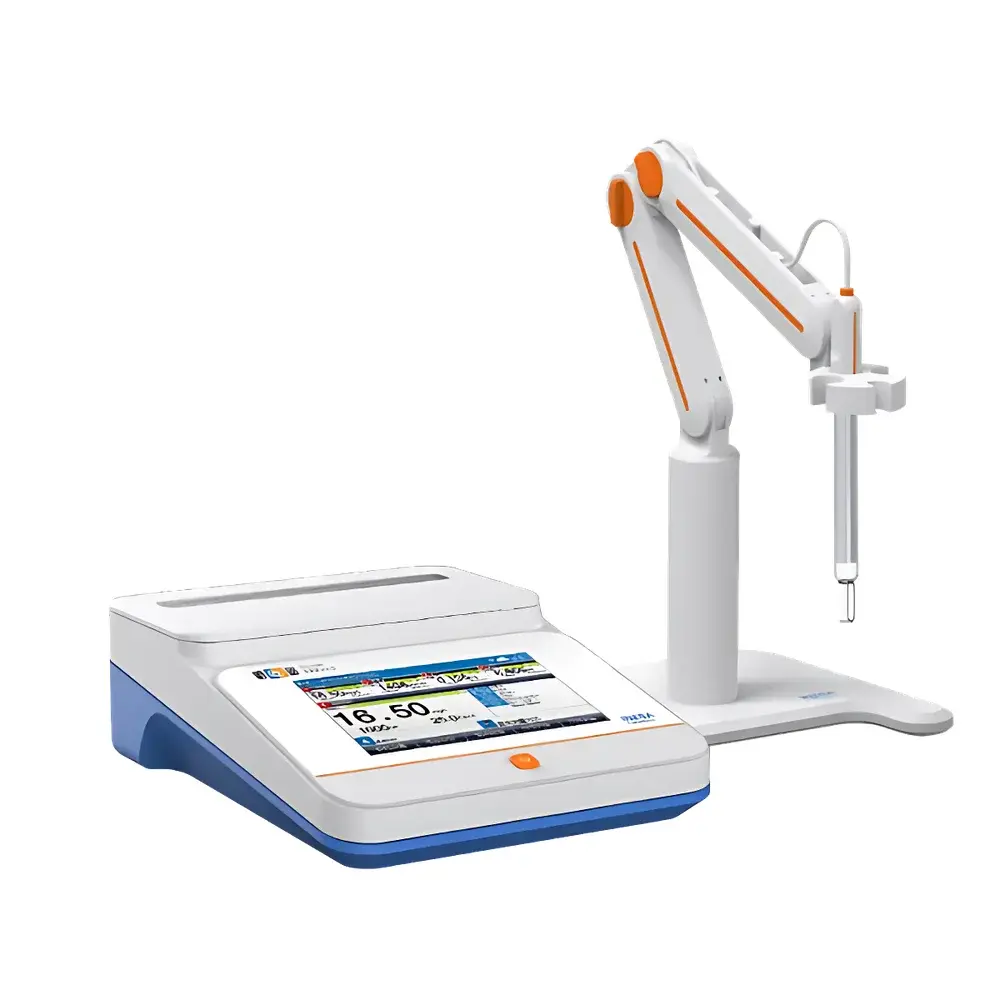
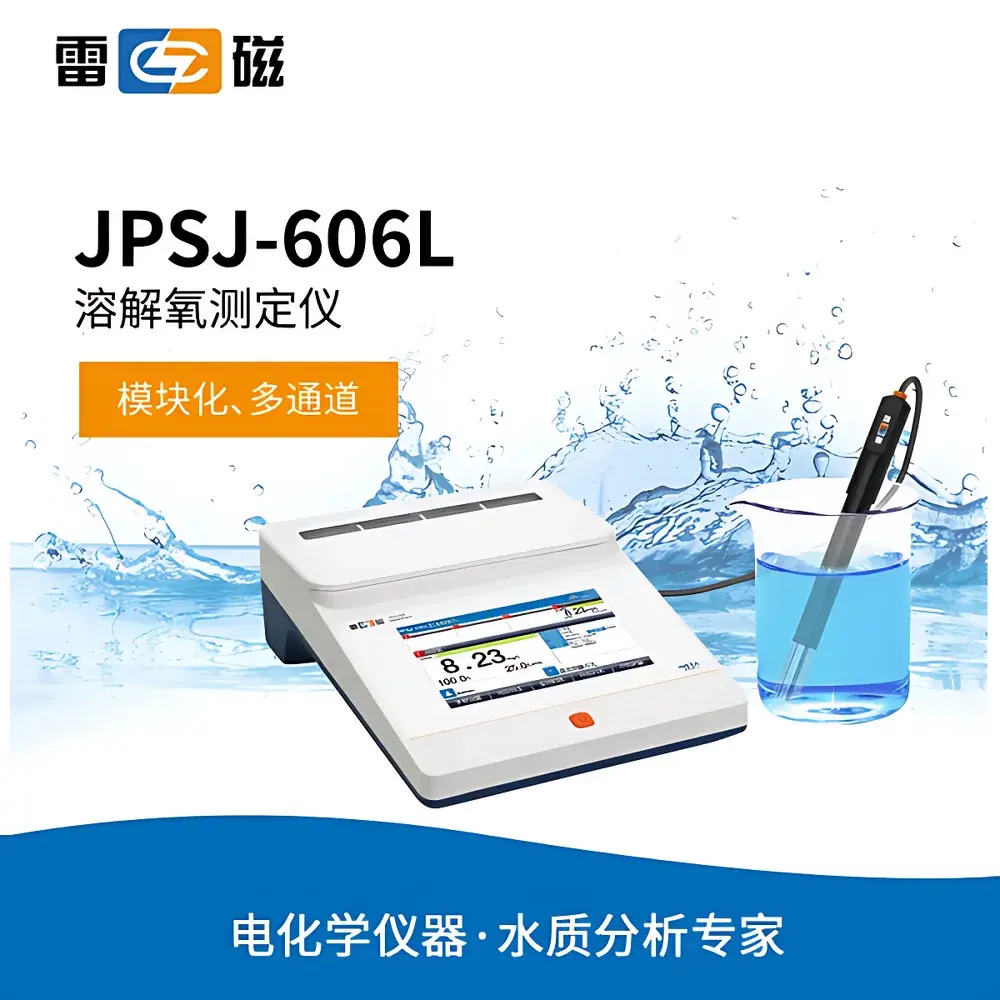
Leichi JPSJ-606L Dissolved Oxygen Meter
| Brand | Leichi |
|---|---|
| Origin | Shanghai, China |
| Manufacturer Type | Direct Manufacturer |
| Regional Origin | Domestic (China) |
| Model | JPSJ-606L |
| Instrument Type | Benchtop Laboratory Meter |
| Measurement Principle | Electrochemical Polarographic Probe |
| DO Range (Instrument Electronics) | 0.00–90.00 mg/L |
| DO Range (with Standard Probe) | 0.00–50.00 mg/L |
| Accuracy (DO) | ±0.10 mg/L (electronic unit) |
| Repeatability | ≤0.15 mg/L |
| Detection Limit | 0.00 ± 0.10 mg/L |
| DO Saturation Range | 0.0–600.0 % |
| DO Saturation Resolution | 0.1 % |
| DO Saturation Accuracy | ±2.0 % |
| Temperature Range | −5.0–130.0 °C |
| Temperature Resolution | 0.1 °C |
| Temperature Accuracy | ±0.1 °C |
| Atmospheric Pressure Compensation | 60.0–110.0 kPa |
| Salinity Compensation | 0.0–50.0 g/L |
| Power Supply | 24 VDC, 3 A (via external adapter: 100–240 VAC input) |
| Dimensions (W×D×H) | 280 × 280 × 130 mm |
| Weight | 2.5 kg |
Overview
The Leichi JPSJ-606L Dissolved Oxygen Meter is a benchtop laboratory instrument engineered for high-precision measurement of dissolved oxygen (DO) concentration, saturation percentage, and temperature in aqueous samples. It operates on the polarographic electrochemical principle—utilizing a Clark-type membrane-covered amperometric sensor that generates a current proportional to the partial pressure of molecular oxygen diffusing across a gas-permeable membrane. This method ensures stable baseline response, low drift, and compatibility with a broad range of water matrices including freshwater, seawater, wastewater, and biological culture media. Designed for routine quality control, environmental monitoring, and research applications, the JPSJ-606L integrates real-time atmospheric pressure and salinity compensation algorithms to correct for physical solubility variations—critical for regulatory compliance and inter-laboratory comparability.
Key Features
- Intelligent endpoint detection: Supports multiple reading modes—auto-read (stability-based), timed-read, fixed-interval read, and manual read—to accommodate varying sample kinetics and operator workflow preferences.
- Comprehensive environmental compensation: Automatic temperature sensing (−5.0 to 130.0 °C) coupled with user-configurable barometric pressure (60.0–110.0 kPa) and salinity (0.0–50.0 g/L) inputs ensures accurate DO conversion from partial pressure to mass concentration (mg/L) per ISO 5814 and ASTM D888 standards.
- Streamlined calibration protocol: Dual-point zero-oxygen (sodium sulfite) and full-scale (air-saturated or water-saturated air) calibration routines with audible/visual prompts; automatic electrode health diagnostics and calibration due-date reminders.
- Modular connectivity: RS-232 and USB ports enable direct connection to PCs for real-time data logging, remote configuration, and firmware updates; compatible with optional automated samplers for unattended calibration and batch analysis sequences.
- Rugged benchtop architecture: Compact footprint (280 × 280 × 130 mm), robust ABS housing, and 2.5 kg mass ensure stability during extended operation and resistance to ambient vibration in shared lab environments.
Sample Compatibility & Compliance
The JPSJ-606L is validated for use with natural waters, effluents, drinking water, aquaculture systems, bioreactor broths, and pharmaceutical process streams. Its polarographic probe design tolerates moderate turbidity and suspended solids without clogging, though particulate-rich samples require filtration prior to measurement to prevent membrane fouling. The instrument conforms to Good Laboratory Practice (GLP) requirements through mandatory audit-trail functionality—including timestamped calibration records, user ID tagging, method versioning, and electrode usage logs. All stored data retain full traceability per FDA 21 CFR Part 11 guidelines when used with compliant PC software and electronic signatures. It supports method validation protocols aligned with ISO 5814:2012 (water quality — determination of dissolved oxygen — electrochemical probe method) and USP for dissolution testing environments.
Software & Data Management
The embedded operating system enables storage of up to 1,000 complete measurement sets—including DO concentration (mg/L), saturation (%), temperature (°C), pressure (kPa), salinity (g/L), calibration history, and operator ID. Data export is supported via USB flash drive (FAT32 formatted) or direct serial transmission to Windows-based platforms using Leichi’s proprietary LDataSuite software—capable of statistical summarization (mean, SD, RSD), trend charting, outlier detection, and PDF report generation. User management supports three-tier access control (Administrator, Technician, Viewer), while method templates allow pre-programming of compensation parameters, alarm thresholds, and auto-save intervals. All modifications to configuration or stored data are logged with immutable timestamps and user attribution.
Applications
- Environmental laboratories conducting EPA Method 360.1 and ISO 5814-compliant surface water and groundwater DO profiling.
- Wastewater treatment plants performing aeration basin optimization, nitrification/denitrification monitoring, and BOD incubation support.
- Pharmaceutical and biotechnology QC labs verifying dissolved oxygen levels in cell culture media, buffer preparation, and lyophilization cycle development.
- Academic research groups studying aquatic ecosystem respiration, sediment oxygen demand (SOD), and hypolimnetic oxygen depletion dynamics.
- Fisheries and aquaculture facilities maintaining optimal DO setpoints across recirculating aquaculture systems (RAS) and hatchery tanks.
FAQ
What calibration standards are required for daily operation?
Zero-oxygen solution (e.g., saturated sodium sulfite) and air-saturated water (or certified air-saturated standard at known temperature/pressure/salinity) are required for two-point calibration. Calibration frequency depends on usage intensity and regulatory requirements—typically before each analytical session or every 8 hours of continuous operation.
Can the JPSJ-606L measure DO in high-salinity seawater (≥35 g/L)?
Yes—the instrument supports salinity compensation up to 50.0 g/L and includes built-in seawater DO solubility tables derived from Garcia & Gordon (1992) and UNESCO equations, ensuring accuracy across marine, estuarine, and brackish conditions.
Is the polarographic probe interchangeable with other Leichi DO meters?
The JPSJ-606L uses the standardized Leichi DO-606 series polarographic sensor interface; compatible probes include DO-606A (general-purpose), DO-606S (low-flow/stagnant water), and DO-606T (high-temperature variant up to 50 °C). Probe replacement requires recalibration but no hardware modification.
Does the meter support GLP-compliant electronic signatures?
While the instrument itself records user IDs and timestamps, full 21 CFR Part 11 compliance—including electronic signatures and audit trail encryption—requires integration with Leichi’s validated LDataSuite software running on a controlled Windows environment with domain authentication and role-based permissions.
How often should the electrolyte and membrane be replaced?
Under typical laboratory use (≤4 hrs/day), the KCl-based electrolyte should be refreshed every 2–4 weeks, and the Teflon membrane replaced monthly. Frequency increases under high-DO, high-temperature, or abrasive matrix conditions—monitoring current stability and response time (>90% in <30 s) serves as operational indicators.
Related Products







