
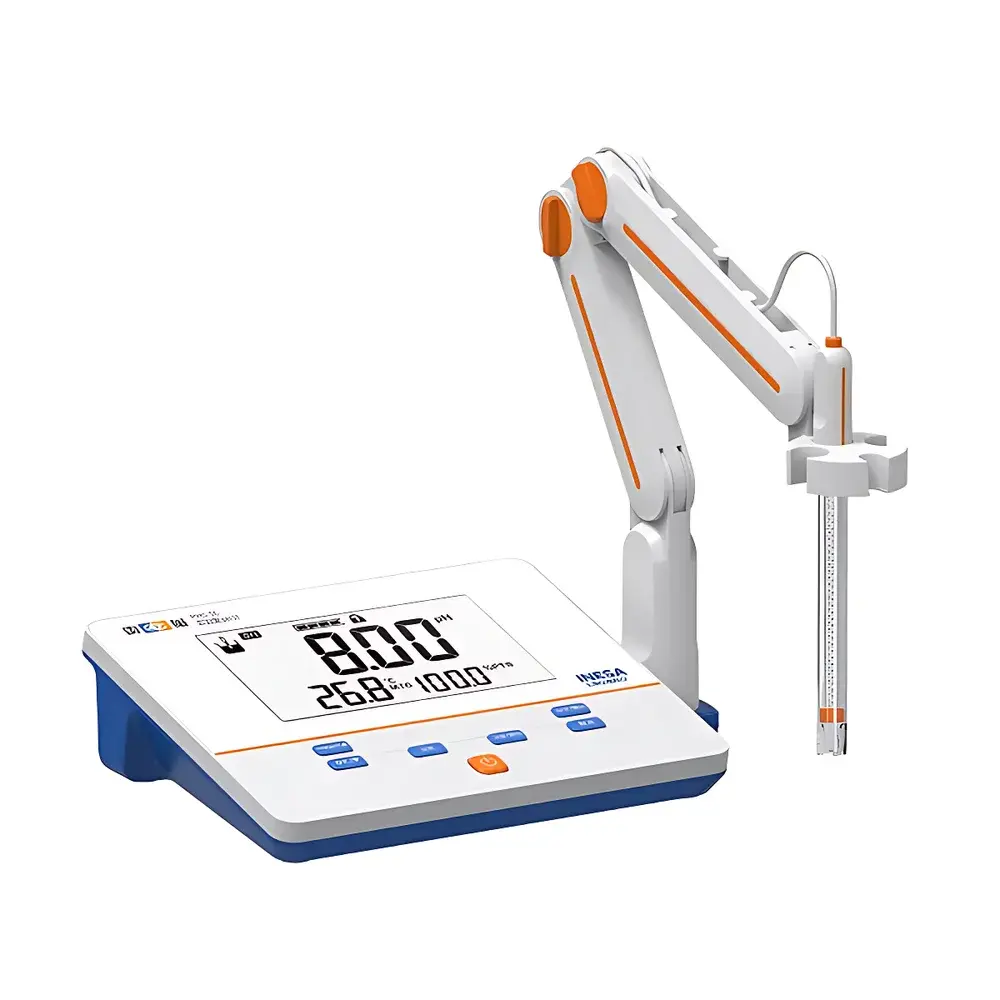
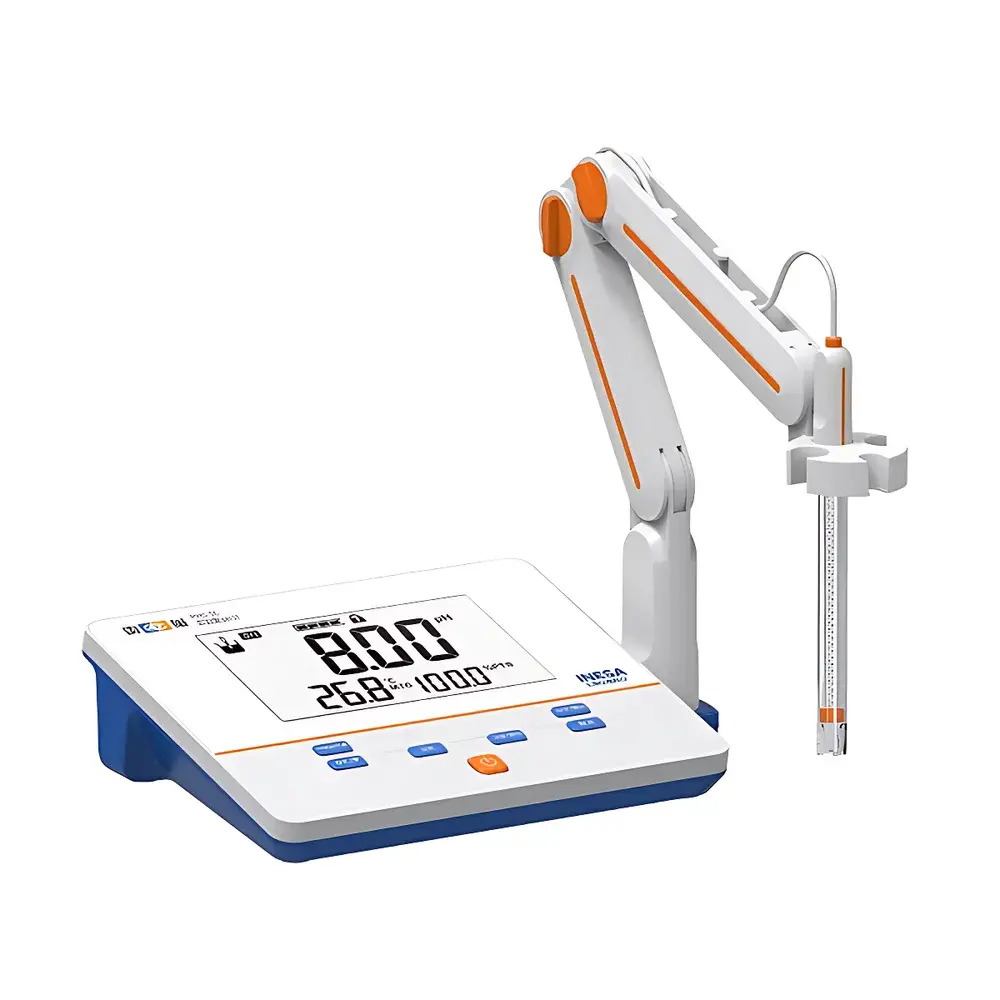
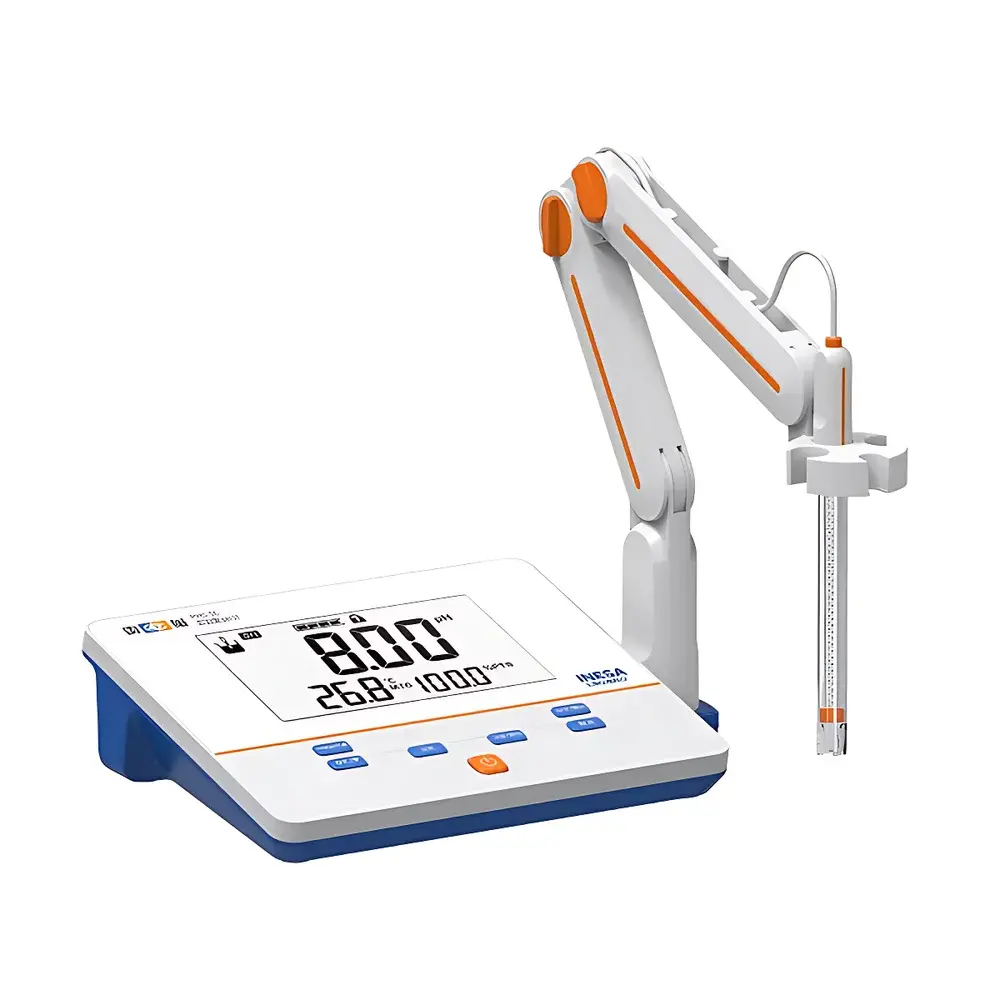
Leichi PHS-3E Benchtop pH Meter
| Brand | Leichi |
|---|---|
| Origin | Shanghai, China |
| Instrument Type | Benchtop |
| Parameter Type | Dual-parameter (pH + temperature) |
| Measurement Range | −2.00 to 18.00 pH |
| Resolution | 0.01 pH |
| Accuracy | ±0.01 pH |
| Calibration Points | 1–3 point automatic calibration |
| Buffer Recognition | Auto-identifies five standard GB buffers (1.68, 4.00, 6.86, 9.18, 12.46 pH) and supports custom buffer entry |
| Temperature Compensation | Automatic and manual modes |
| Data Storage | 50 measurement sets with recall and deletion |
| Display | 6-inch HD LCD |
| Protection Rating | IP54 |
| Compliance | GB/T 11165–2005, JJG 119–2018, HJ 1396–2024 |
Overview
The Leichi PHS-3E is a precision benchtop pH meter engineered for routine and quality-controlled pH measurement in academic laboratories, environmental monitoring stations, water treatment facilities, and industrial QC environments. It operates on the potentiometric principle—measuring the electromotive force (EMF) generated across a glass pH electrode relative to a stable reference electrode—and converts this voltage into a pH value using the Nernst equation. Designed for stability and repeatability under variable ambient conditions, the PHS-3E integrates dual-parameter functionality (pH and temperature), enabling real-time temperature-compensated readings without external probes or manual correction. Its measurement range of −2.00 to 18.00 pH accommodates highly acidic, neutral, and strongly alkaline samples—including aggressive cleaning solutions, electroplating baths, and caustic soda effluents—while maintaining ±0.01 pH accuracy per JJG 119–2018 verification requirements.
Key Features
- 6-inch high-definition LCD display with backlight for clear readability under varied lighting conditions and at viewing angles up to 60°
- Intelligent endpoint detection algorithm that automatically identifies signal stabilization—supporting both continuous reading mode for dynamic processes and equilibrium reading mode for static sample analysis
- IP54-rated enclosure provides protection against dust ingress and low-pressure water splashes, suitable for general lab environments with moderate humidity and occasional spills
- Dual-mode temperature compensation: auto-compensation via integrated Pt1000 sensor (built into the supplied tri-combination electrode) or manual input for non-temperature-probe configurations
- One-touch system management functions including auto power-off (configurable delay), power-loss data retention, and factory reset—ensuring operational continuity and traceability during extended use cycles
- Ergonomic keypad layout with tactile feedback and dedicated function keys for calibration, storage, and review—minimizing operator error in high-throughput settings
Sample Compatibility & Compliance
The PHS-3E is validated for aqueous and mildly conductive non-aqueous solutions typical in environmental, pharmaceutical, and food testing workflows. It supports direct immersion of the included tri-combination pH electrode (with integrated reference junction and temperature sensor) into liquid samples ≥5 mL volume. The instrument complies with national metrological verification regulations JJG 119–2018 and technical standards GB/T 11165–2005 for laboratory pH meters, ensuring conformance with China’s mandatory accuracy, linearity, and repeatability criteria. For regulatory reporting contexts, its data handling protocol aligns with GLP documentation expectations—each stored record includes timestamp, measured pH, temperature, electrode status flag, and calibration history ID. While not FDA 21 CFR Part 11–certified out-of-the-box, audit-ready data export (via optional RS232 interface) supports integration into validated LIMS or ELN systems meeting GMP/GxP requirements.
Software & Data Management
The PHS-3E features embedded firmware with local data management capability: up to 50 complete measurement records are retained in non-volatile memory, each containing pH value, temperature, date/time stamp, and calibration identifier. Users may navigate, review, and selectively delete entries directly from the front panel—no PC connection required. All stored data adhere to ISO/IEC 17025–recommended traceability principles: no record can be overwritten; deletion triggers an immutable log entry. Optional serial communication (RS232) enables raw data transfer to third-party software for statistical process control (SPC), trend analysis, or automated report generation. Firmware updates are performed via USB-to-serial adapter (not included), with version history and checksum validation ensuring integrity.
Applications
- Environmental water quality assessment per HJ 1396–2024, including surface water, groundwater, and wastewater effluent monitoring
- Pharmaceutical excipient and buffer solution verification in pre-formulation labs
- Food and beverage processing control—e.g., dairy fermentation tracking, fruit juice acidity profiling, and brine pH adjustment
- Chemical manufacturing QC for acid/base titrant standardization and reaction endpoint confirmation
- Academic teaching labs requiring robust, entry-level instrumentation compliant with national curriculum standards
FAQ
Does the PHS-3E support calibration with non-standard buffer solutions?
Yes—it recognizes five predefined GB buffers and allows manual entry of custom buffer values with user-defined pH and temperature coefficients.
Is the tri-combination electrode included with the instrument?
Yes—the standard configuration includes one E-201F tri-combination pH electrode, electrode holder, dust cover, and five packets of lyophilized GB buffer powders (1.68, 4.00, 6.86, 9.18, and 12.46 pH).
Can measurement data be exported to a computer?
Data export is supported via optional RS232 interface; no built-in USB or Bluetooth connectivity is provided in the base model.
What is the expected service life of the included pH electrode?
Under normal usage (≤4 hours/day, proper storage in 3 M KCl solution), the E-201F electrode typically maintains specification performance for 12–18 months before recalibration frequency increases significantly.
Does the instrument meet international standards such as ISO 17025 or ASTM E70?
While not certified to ISO/IEC 17025, the PHS-3E meets the metrological performance criteria outlined in ASTM E70–22 (Standard Test Method for pH of Aqueous Solutions) when operated within specified environmental conditions and calibrated per manufacturer instructions.





