
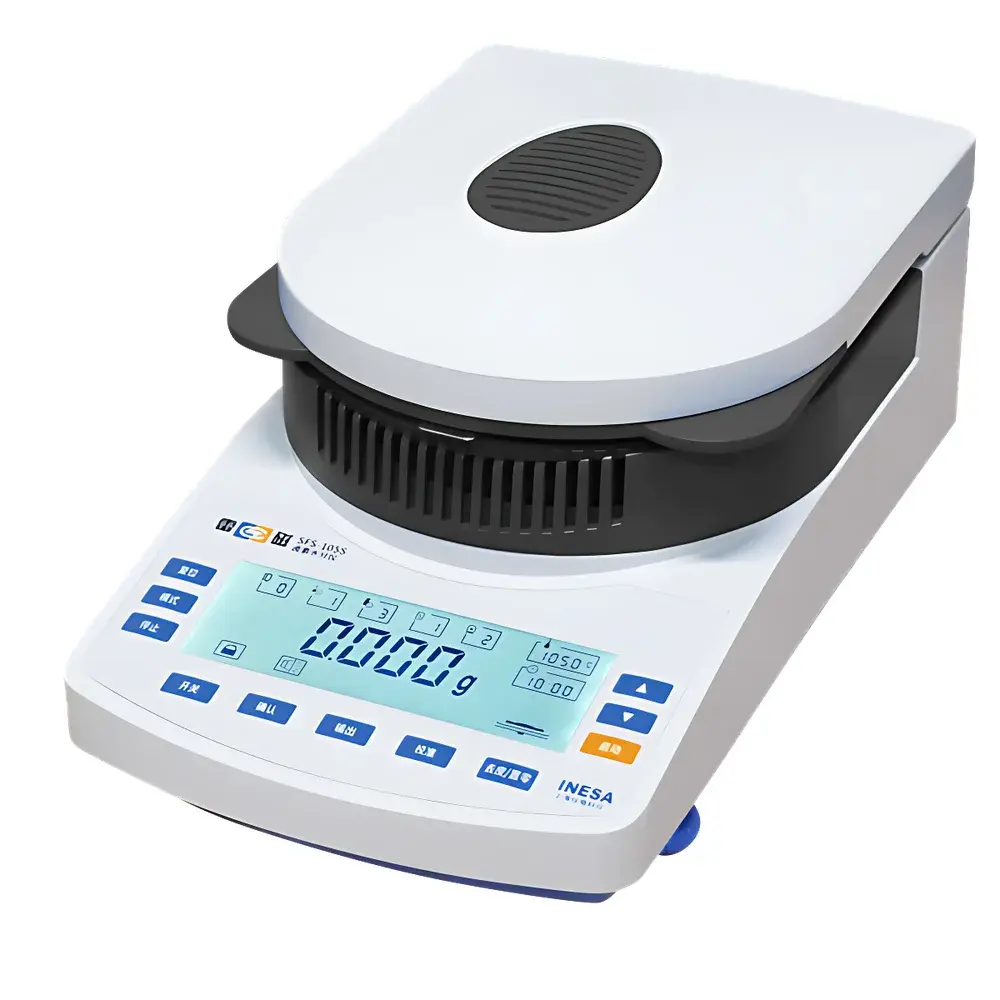
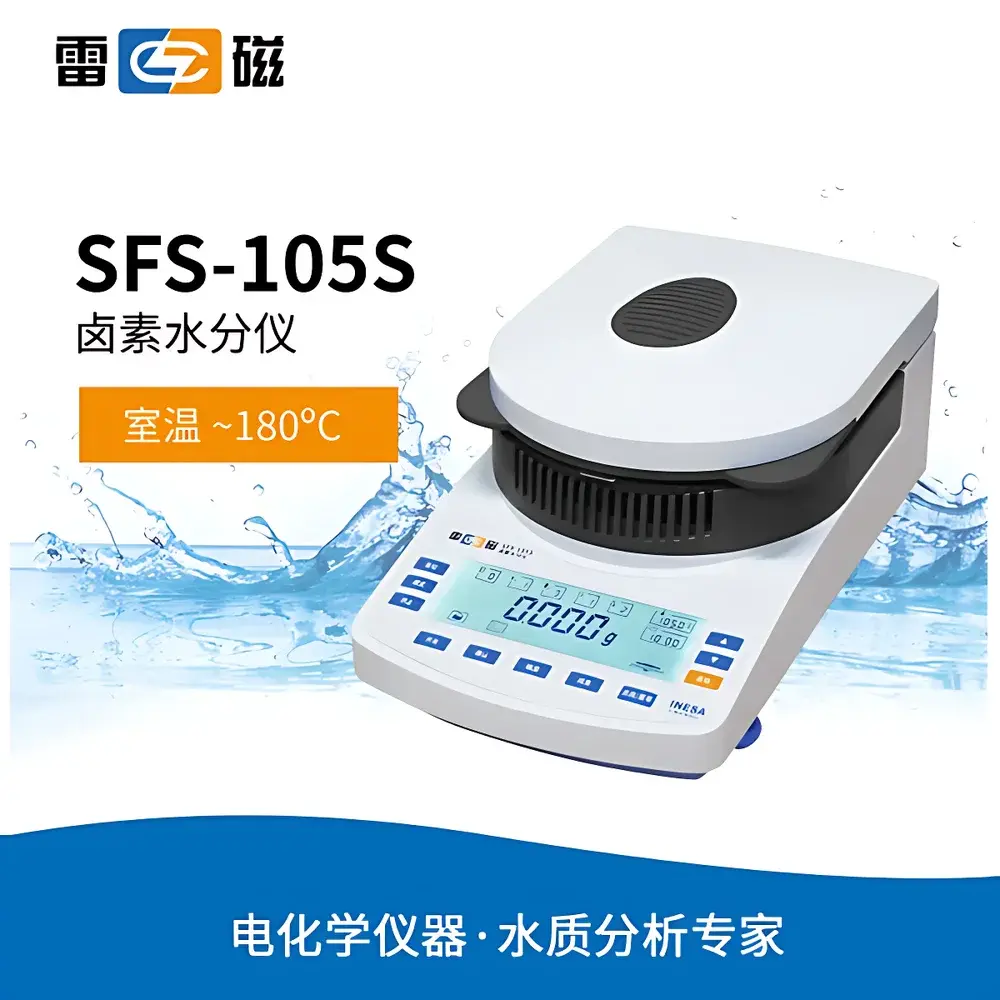
Leichi SFS-105S Halogen Moisture Analyzer
| Brand | Leichi |
|---|---|
| Origin | Shanghai, China |
| Manufacturer Type | Direct Manufacturer |
| Product Origin | Domestic (China) |
| Model | SFS-105S Halogen Moisture Analyzer |
| Price Range | USD 420 – 700 |
| Display | High-resolution LCD |
| Heating Source | Circular halogen lamp |
| Max. Heating Temperature | 180 °C |
| Weighing Range | 0.2 g to 110 g |
| Readability (mass) | 5 mg |
| Legal Metrology Class | II |
| Moisture Readability | 0.02 % |
| Minimum Sample Mass | 1 g |
| Heating Chamber Material | Heat-resistant polymer housing |
| Pan Diameter | 90 mm |
| Temperature Control | Adjustable in 1 °C increments |
| Drying Modes | Standard, Rapid |
| Endpoint Detection | Auto, Manual, Semi-auto |
| Displayed Parameters | Moisture %, Dry Matter %, ATRO Dry Basis %, ATRO Wet Basis % |
| Real-time Data | Current temperature, elapsed time, dynamic moisture loss curve |
| Interface | RS-232 for thermal printer |
| Power Supply | 220 V ±10 %, 50/60 Hz |
| Dimensions (W×D×H) | 310 × 180 × 157 mm |
| Net Weight | 2.6 kg |
Overview
The Leichi SFS-105S Halogen Moisture Analyzer is a precision benchtop instrument engineered for rapid, gravimetric determination of moisture content in solid and semi-solid materials using the loss-on-drying (LOD) principle. It employs a high-efficiency circular halogen lamp as its heating source, delivering uniform thermal radiation across the sample surface—minimizing thermal gradients and ensuring reproducible drying kinetics. Unlike infrared or convection ovens, halogen heating enables faster energy transfer with precise, programmable temperature control from ambient up to 180 °C in 1 °C increments. The integrated analytical balance—calibrated to Class II metrological accuracy per OIML R76—provides mass resolution of 5 mg over a 0.2–110 g weighing range, enabling reliable quantification of moisture loss down to 0.02 % (w/w). Designed for routine quality control laboratories in food, pharmaceuticals, chemicals, and agriculture, the SFS-105S supports method development, batch release testing, and stability monitoring under GLP-compliant workflows.
Key Features
- High-contrast LCD interface with intuitive navigation and real-time graphical feedback of moisture loss trends
- Circular halogen heating system optimized for homogeneous thermal distribution and reduced drying time versus conventional heaters
- Multi-mode endpoint detection: fully automatic (based on mass stabilization criteria), manual (user-defined time), and semi-automatic (user-triggered stop after defined delta-mass)
- Configurable drying protocols—including Standard and Rapid modes—with independent setting of target temperature (room temp to 180 °C) and maximum duration (0–90 min)
- Four standardized reporting formats: moisture % (w/w), dry matter %, ATRO dry basis %, and ATRO wet basis %—aligned with ISO 665:2022 and AOAC 952.07 conventions
- Integrated safety interlocks: audible/visual alerts for lid open during heating, overtemperature conditions, and low-sample-mass (<1 g) warnings
- RS-232 serial port compliant with ESC/POS protocol for direct connection to standard thermal printers—enabling auditable hard-copy output without PC dependency
Sample Compatibility & Compliance
The SFS-105S accommodates diverse sample types including powders (e.g., lactose, starch), granules (APIs, excipients), pastes (dairy concentrates), and thin-film solids (coated tablets, dried films), provided minimum mass requirements (≥1 g) are met and samples remain thermally stable below 180 °C. Its polymer-based heating chamber ensures electrical insulation and resistance to incidental chemical exposure during routine cleaning. While not certified to IEC 61000-6-3 for EMC or UL 61010-1 for safety out-of-the-box, the instrument conforms to national metrological verification standards JJG 1085-2013 (Moisture Analyzers) and supports traceable calibration via external weights. For regulated environments, users may implement documented SOPs covering daily performance checks, periodic recalibration, and audit-ready print logs—consistent with FDA 21 CFR Part 11 data integrity expectations when paired with timestamped printer output.
Software & Data Management
The SFS-105S operates autonomously without proprietary software; all configuration, measurement execution, and result display occur locally via the embedded firmware. Measurement records—including start/end timestamps, setpoints, real-time mass/temperature values, and final calculated percentages—are retained in non-volatile memory for up to 100 recent tests. RS-232 output delivers ASCII-formatted reports containing operator ID (if entered), sample ID, method name, weight data, and statistical summaries—facilitating import into LIMS or Excel for trend analysis. No cloud connectivity, remote access, or electronic signature capability is included; data governance remains under direct user control, aligning with risk-based approaches to computerized system validation (CSV) per Annex 11 and GAMP 5 guidelines.
Applications
- Pharmaceutical QC: Moisture verification of active pharmaceutical ingredients (APIs), excipients, and finished dosage forms per USP <921>
- Food & Beverage: Routine testing of flour, coffee beans, spices, dairy powders, and pet food for shelf-life prediction and HACCP compliance
- Agricultural Labs: Grain moisture assessment per ISO 4879 and ASTM D4442 for storage and trade specifications
- Chemical Manufacturing: Solvent residue quantification in polymers, catalysts, and pigments
- Research Settings: Method optimization for novel drying profiles, comparative LOD studies against Karl Fischer titration
FAQ
What is the recommended calibration frequency for the SFS-105S?
Calibration should be performed at least daily using certified test weights (e.g., 10 g and 100 g class M2), prior to first use and after any physical relocation or temperature fluctuation exceeding ±5 °C.
Can the SFS-105S be used for volatile organic compound (VOC) analysis?
No—it measures total volatile loss, not compound-specific volatiles. For VOC identification and quantification, gas chromatography (GC) or headspace-GC/MS is required.
Is the halogen lamp replaceable by the end user?
Yes; the lamp is a field-serviceable component with standardized socket interface and manufacturer-provided replacement part number (SFS-LAMP-01).
Does the instrument support GLP-compliant audit trails?
While it lacks electronic audit trail functionality, printed RS-232 reports include immutable timestamps and operator input fields—sufficient for paper-based GLP documentation when managed within a controlled record retention system.
What maintenance is required beyond lamp replacement?
Regular cleaning of the pan and chamber interior with lint-free cloth and isopropyl alcohol; inspection of pan leveling and door seal integrity every 200 operating hours.




