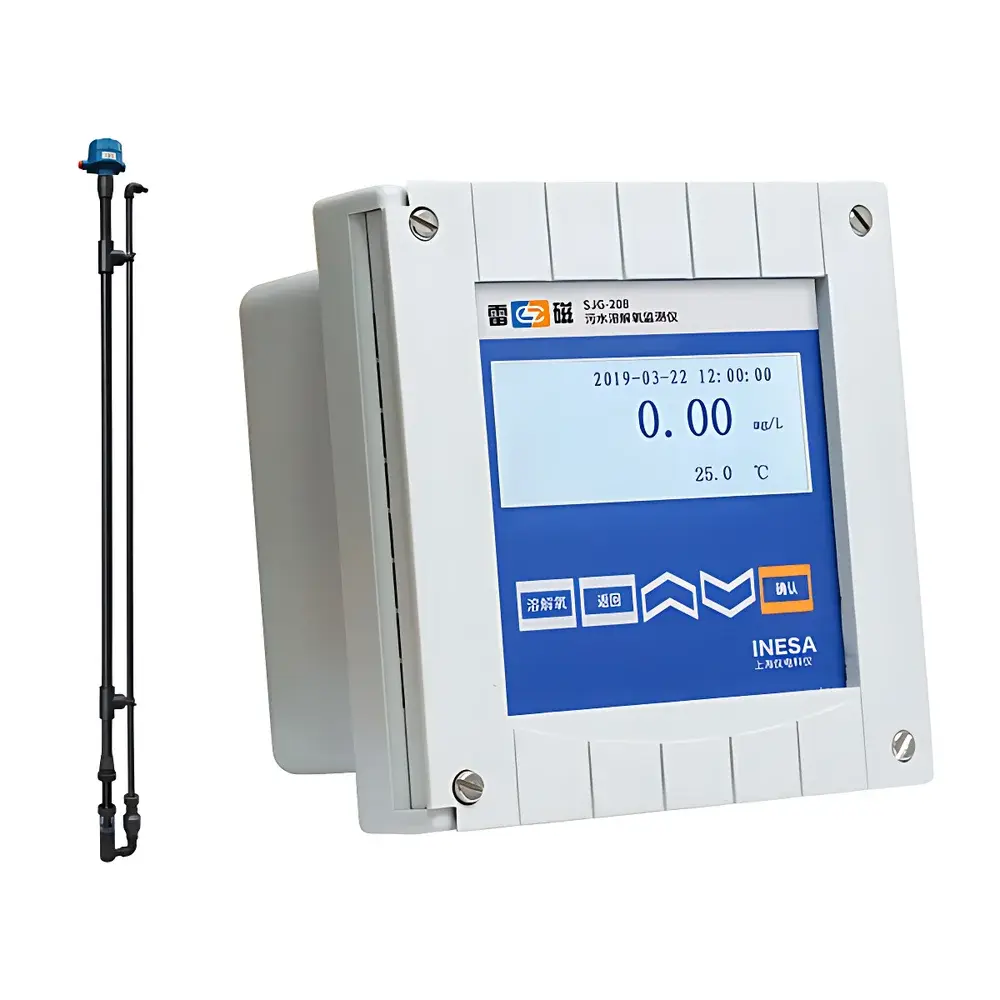
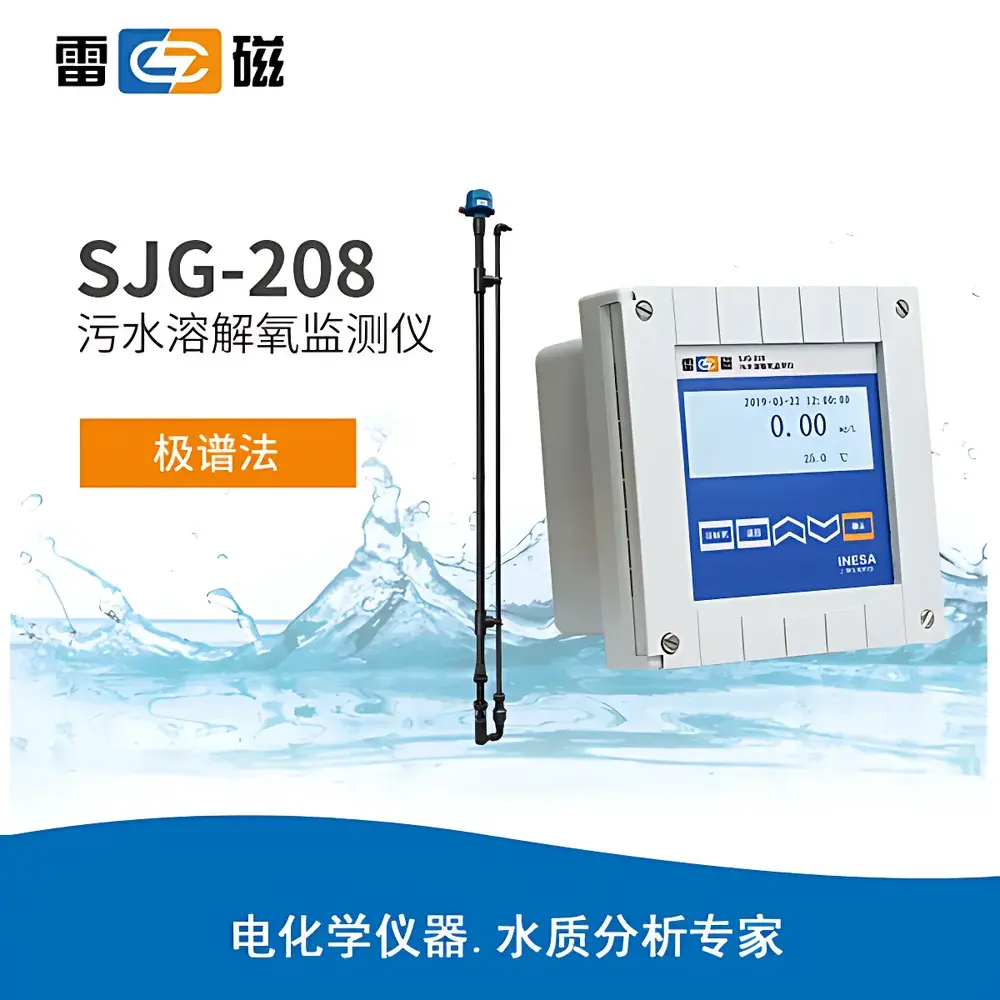
Leichi SJG-208 Online Dissolved Oxygen Analyzer
| Brand | Leichi |
|---|---|
| Origin | Shanghai, China |
| Manufacturer Type | Direct Manufacturer |
| Product Origin | Domestic (China) |
| Model | SJG-208 |
| Price Range | USD 700 – 1,400 (FOB Shanghai) |
| Resolution | 0.01 mg/L, 0.1 % saturation, 0.1 °C |
| Measurement Range | (0.0–20.0) mg/L DO, (0.0–200.0) % saturation, (−10.0–120.0) °C |
| Repeatability | ≤ 0.20 mg/L |
| Stability | ±0.20 mg/L / 24 h |
| Temperature Compensation Range | (−10.0–120.0) °C |
| Communication Interface | RS-232 or RS-485 (user-selectable) |
| Dimensions | 144 × 144 × 160 mm |
| Weight | 2.5 kg |
Overview
The Leichi SJG-208 Online Dissolved Oxygen Analyzer is an industrial-grade electrochemical sensor system engineered for continuous, real-time monitoring of dissolved oxygen (DO) concentration and saturation in aqueous process streams. It employs a polarographic (Clark-type) membrane-covered amperometric sensor principle—where molecular oxygen diffuses through a gas-permeable membrane and undergoes reduction at a cathode, generating a current linearly proportional to the partial pressure of O2. This analog signal is digitized and processed by an embedded microcontroller unit (MCU) with dedicated firmware for temperature compensation, atmospheric pressure correction, and calibration validation. Designed specifically for demanding municipal and industrial water applications, the SJG-208 delivers stable, traceable measurements under variable flow, pressure, and temperature conditions—meeting operational requirements for biological treatment control in activated sludge systems, intake monitoring at drinking water facilities, and environmental compliance reporting.
Key Features
- High-contrast dot-matrix LCD display showing simultaneous real-time readings of DO concentration (mg/L), DO saturation (%), and process temperature (°C)
- Integrated microprocessor-based electronics ensuring precise digital signal conditioning, linearization, and multi-point calibration management
- Support for both zero-oxygen (anaerobic) and full-saturation (air-saturated water) calibration protocols; manual barometric pressure input and automatic temperature compensation (ATC) across −10.0 to 120.0 °C
- Onboard data logging capability storing up to 400 timestamped measurement records with retrieval via serial interface
- Dual-stage alarm functionality with programmable upper/lower limits and relay-driven actuation for process interlocks or pump control
- Four configurable SPDT relays supporting automated probe cleaning cycles, dosing control, or fault signaling per IEC 61000-4 immunity standards
- Isolated 4–20 mA analog output with fully adjustable span (e.g., 0–10 mg/L mapped to 4–20 mA); supports HART-compatible configuration via handheld communicator
- RS-232 or RS-485 Modbus RTU communication port (user-selectable during setup), enabling integration into SCADA, DCS, or PLC-based supervisory systems
- IP65-rated polycarbonate enclosure suitable for wall-mount or panel installation in humid, chemically aggressive environments typical of wastewater lift stations and oxidation ditches
Sample Compatibility & Compliance
The SJG-208 is validated for use in non-corrosive, low-turbidity aqueous media with suspended solids < 50 mg/L and chloride concentrations < 5,000 mg/L. It complies with CE marking directives (2014/30/EU EMC, 2014/35/EU LVD) and meets functional safety requirements aligned with IEC 61508 SIL 1 for basic process monitoring tasks. While not certified to ISO 5814 or ASTM D888 for laboratory-grade accuracy, its performance specifications satisfy routine operational needs defined in EPA Method 360.1 and EN 25814 for online DO surveillance in secondary wastewater treatment. Calibration traceability is maintained through documented two-point verification using standardized zero-O2 solution (sodium sulfite) and air-saturated water at known temperature and barometric pressure.
Software & Data Management
No proprietary PC software is required for basic operation; configuration, calibration, and data export are performed via ASCII command protocol over serial interface using standard terminal emulators (e.g., PuTTY, Tera Term). The device supports Modbus RTU register mapping for seamless read/write access to all operational parameters—including setpoints, relay states, logged values, and sensor diagnostics (e.g., membrane integrity flag, electrode polarization status). All configuration changes are stored in non-volatile memory with battery-backed retention. Audit trails are not natively supported; however, external SCADA historians may log timestamps and parameter changes in accordance with GLP/GMP-aligned data integrity practices when deployed with validated Modbus gateways.
Applications
- Real-time DO control in aerobic bioreactors and aeration basins of municipal wastewater treatment plants (WWTPs)
- Intake monitoring at surface water sources feeding potable water treatment facilities
- Process optimization in aquaculture recirculating aquaculture systems (RAS) and fish hatcheries
- Environmental compliance tracking for discharge permits (e.g., NPDES) requiring continuous DO reporting
- Industrial cooling tower and boiler feedwater monitoring where oxygen corrosion risk assessment is critical
- Research and pilot-scale studies involving aerobic biodegradation kinetics and nitrification/denitrification profiling
FAQ
What calibration standards are recommended for field verification?
Zero-oxygen solution prepared from sodium sulfite (Na2SO3) and air-saturated deionized water at ambient temperature and local barometric pressure.
Can the SJG-208 be used in seawater or high-salinity effluents?
Not recommended without factory-installed salinity compensation firmware and specialized electrolyte formulation; standard units are optimized for freshwater and low-conductivity secondary effluents.
Does the analyzer support automatic pressure compensation?
No—barometric pressure must be manually entered during calibration; no integrated barometer is included.
Is the 4–20 mA output intrinsically safe?
No—the output is non-isolated from internal power supply; external galvanic isolators are required for hazardous area installations (Zone 2 / Class I Div 2).
What is the expected service life of the DO sensor membrane and electrolyte?
Typical replacement interval is 6–12 months under continuous operation; depends on fouling rate, temperature exposure, and mechanical abrasion from suspended solids.
Related Products