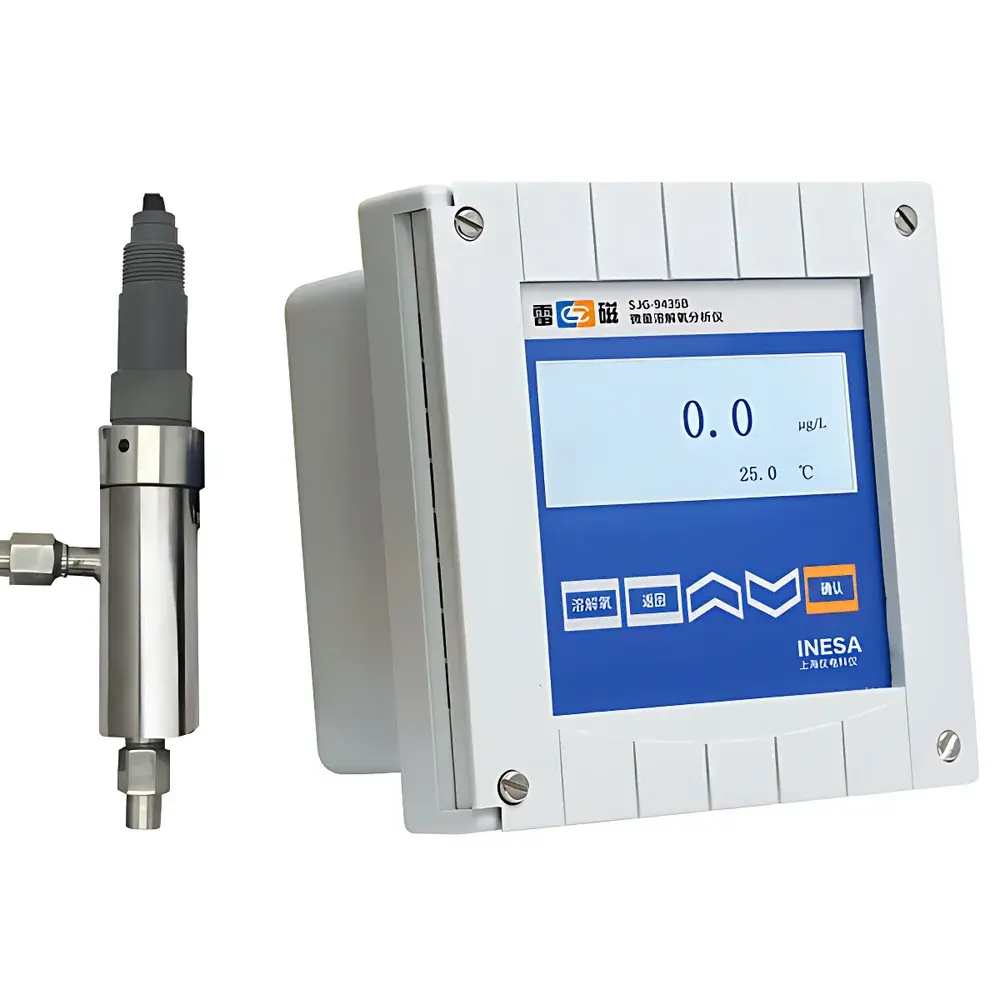
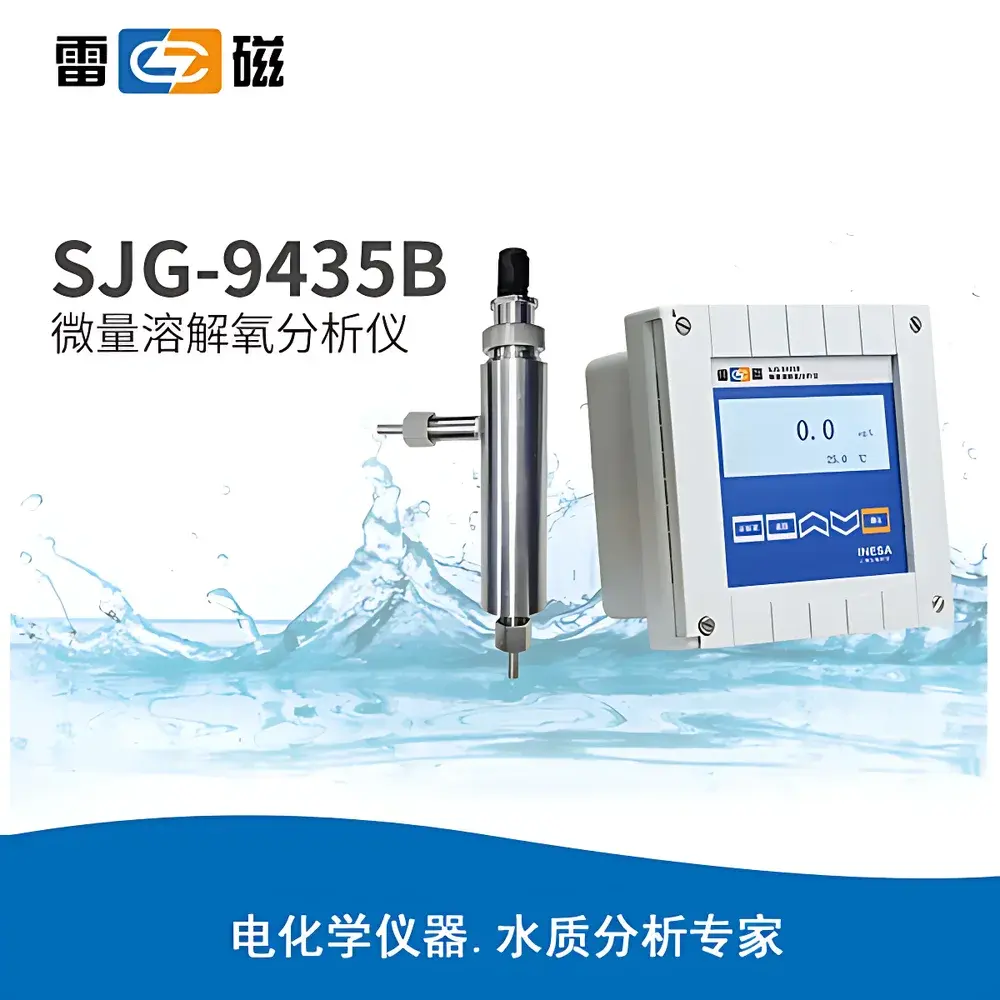
Leichi SJG-9435B Online Microgram-Level Dissolved Oxygen Analyzer
| Brand | Leichi |
|---|---|
| Origin | Shanghai, China |
| Manufacturer Type | Direct Manufacturer |
| Regional Classification | Domestic (China) |
| Model | SJG-9435B |
| Price Range | USD 1,400–4,200 (FOB Shanghai) |
| Resolution | 0.1 µg/L |
| Measurement Ranges | (0–19.9) µg/L, (20–199) µg/L, (0.20–20.00) mg/L |
| Repeatability | ±3% FS |
| Stability | ±2% FS / 24 h |
| Temperature Compensation Range | (−10.0 to 120.0) °C |
| Communication Interface | RS-232 |
| Dimensions | 160 × 160 × 110 mm |
| Weight | 2 kg |
Overview
The Leichi SJG-9435B Online Microgram-Level Dissolved Oxygen Analyzer is an industrial-grade electrochemical sensor system engineered for continuous, high-sensitivity monitoring of dissolved oxygen (DO) in ultra-pure water streams—specifically targeting boiler feedwater, turbine condensate, and nuclear power plant secondary loop applications where oxygen concentrations must be maintained below 20 µg/L to mitigate flow-accelerated corrosion (FAC) and stress corrosion cracking (SCC). It employs a polarographic membrane-covered Clark-type electrode with temperature-compensated amperometric detection, delivering stable, low-drift measurements across wide thermal gradients. Unlike optical (luminescence-based) DO sensors, the SJG-9435B’s electrochemical architecture provides proven long-term reliability in low-conductivity, low-oxygen environments typical of high-pressure steam cycles—without requiring frequent recalibration or consumable replacement of optical films.
Key Features
- Triple-range measurement capability: (0–19.9) µg/L, (20–199) µg/L, and (0.20–20.00) mg/L—automatically selected or manually configured to optimize resolution at trace-level thresholds.
- High-resolution display: Dot-matrix LCD simultaneously shows real-time DO concentration and process temperature with 0.1 µg/L resolution in the sub-20 µg/L range—critical for compliance with ASME PTC 19.11 and EPRI guidelines for feedwater oxygen control.
- Integrated temperature compensation: Automatic compensation across −10.0 to 120.0 °C using built-in Pt1000 RTD; electronic unit temperature compensation error ≤ ±0.3% FS/°C ensures accuracy under dynamic thermal transients.
- Isolated 4–20 mA analog output: Fully configurable upper/lower limits (0–200 µg/L range), supporting integration into DCS/PLC systems without external signal conditioners.
- RS-232 serial interface: Enables direct connection to local HMI terminals or centralized SCADA logging systems for periodic data retrieval and configuration backup.
- Robust enclosure: IP65-rated front panel and housing—certified for installation in humid, chemically aggressive utility corridors and turbine halls per IEC 60529.
- Fail-safe operation: Built-in power-loss memory retains calibration and alarm settings; programmable high/low DO alarms with relay dry-contact outputs support automatic shutdown interlocks per IEC 61511 SIL-1 requirements.
Sample Compatibility & Compliance
The SJG-9435B is validated for use in deionized water, demineralized water, and condensate with conductivity < 1 µS/cm and pH 5.5–9.0. It meets essential performance criteria referenced in ASTM D867 (Standard Test Method for Dissolved Oxygen in Water), ISO 5814 (Electrochemical probe method), and USP (Oxygen Determination in Purified Water and Water for Injection). While not FDA 21 CFR Part 11–compliant out-of-the-box (lacking audit trail and electronic signature functionality), its analog and serial outputs are compatible with validated third-party data acquisition systems operating under GMP/GLP environments. Calibration traceability aligns with NIST-traceable zero-oxygen (nitrogen-sparged) and full-scale (air-saturated water at known temperature/pressure) standards.
Software & Data Management
The analyzer operates autonomously without embedded firmware-based data storage. Configuration, calibration, and alarm thresholds are managed locally via front-panel keypad navigation. RS-232 communication supports ASCII command protocol (e.g., “READ_DO”, “SET_ALM_HI”) for integration with custom LabVIEW, Python, or WinCC scripts. For regulatory environments requiring data integrity, users typically deploy it alongside time-stamped historian servers that log 4–20 mA output signals—enabling retrospective trend analysis of oxygen excursions aligned with maintenance logs and turbine startup/shutdown events.
Applications
- Real-time monitoring of boiler feedwater deaerator outlet and economizer inlet in fossil and combined-cycle power plants.
- Continuous surveillance of condensate polishing system effluent to verify resin bed integrity and prevent oxygen ingress.
- Monitoring steam condensate return lines in pharmaceutical clean steam systems (per ISPE CPG on Pure Steam).
- Supporting hydrogen-water chemistry control programs in pressurized water reactors (PWRs) and boiling water reactors (BWRs).
- Verification of nitrogen blanketing effectiveness in high-purity water storage tanks and distribution loops.
FAQ
What is the recommended calibration frequency for the SJG-9435B in continuous boiler feedwater service?
For critical FAC mitigation applications, zero-oxygen (N₂-sparged) and span (air-saturated water) calibrations are advised every 7 days—or after any maintenance event affecting sample flow, temperature, or pressure.
Does the instrument support pressure compensation?
No—pressure compensation is manual only via operator-entered barometric pressure value; it does not integrate with external pressure transmitters.
Can the 4–20 mA output be scaled to non-linear DO ranges?
No—the analog output is linear across the selected measurement range only; non-linear scaling requires external signal processors.
Is the sensor replaceable as a field-serviceable module?
Yes—the polarographic electrode assembly is a user-replaceable cartridge with factory pre-calibration; replacement interval is typically 6–12 months depending on water quality and flow velocity.
What is the 90% response time at 25°C, and how does it vary with temperature?
T₉₀ = 2 minutes at 25°C; response slows to ~4 minutes at 5°C and accelerates to ~90 seconds at 80°C due to diffusion kinetics—temperature compensation corrects for equilibrium current drift, not kinetic lag.
Related Products