
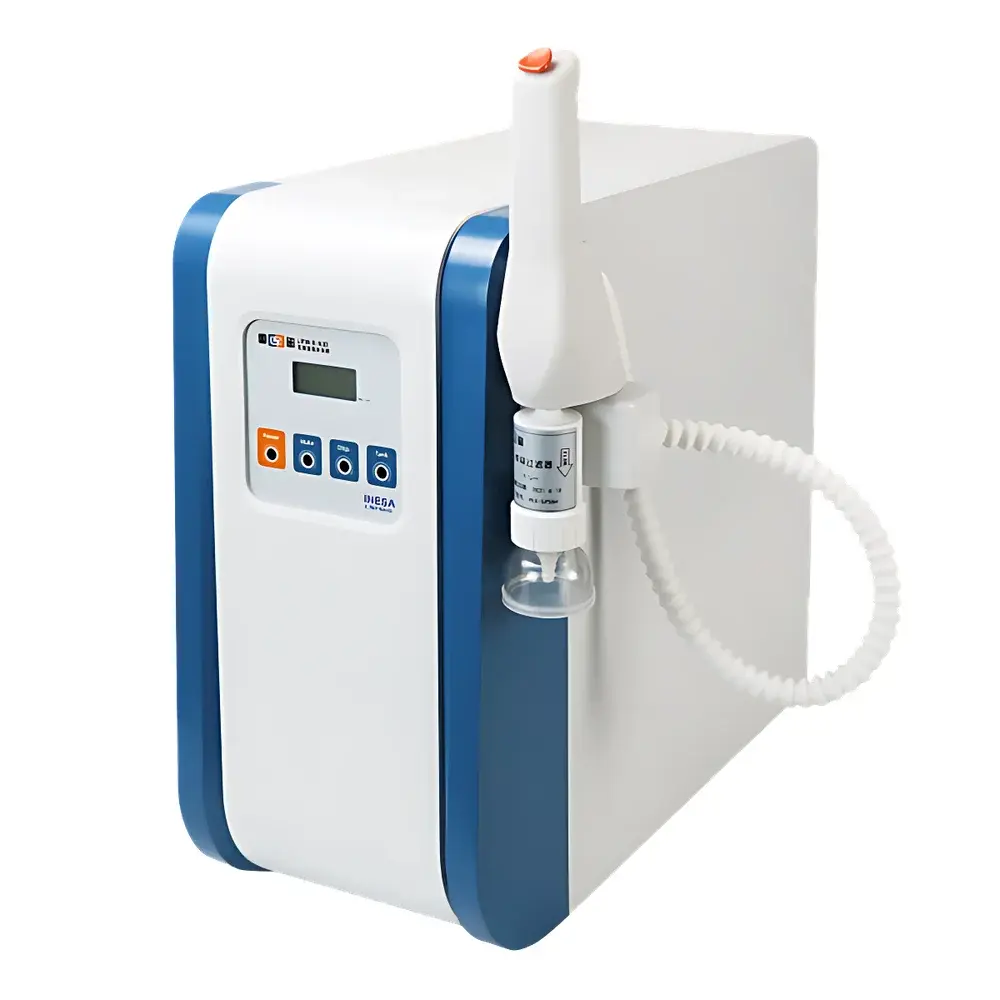
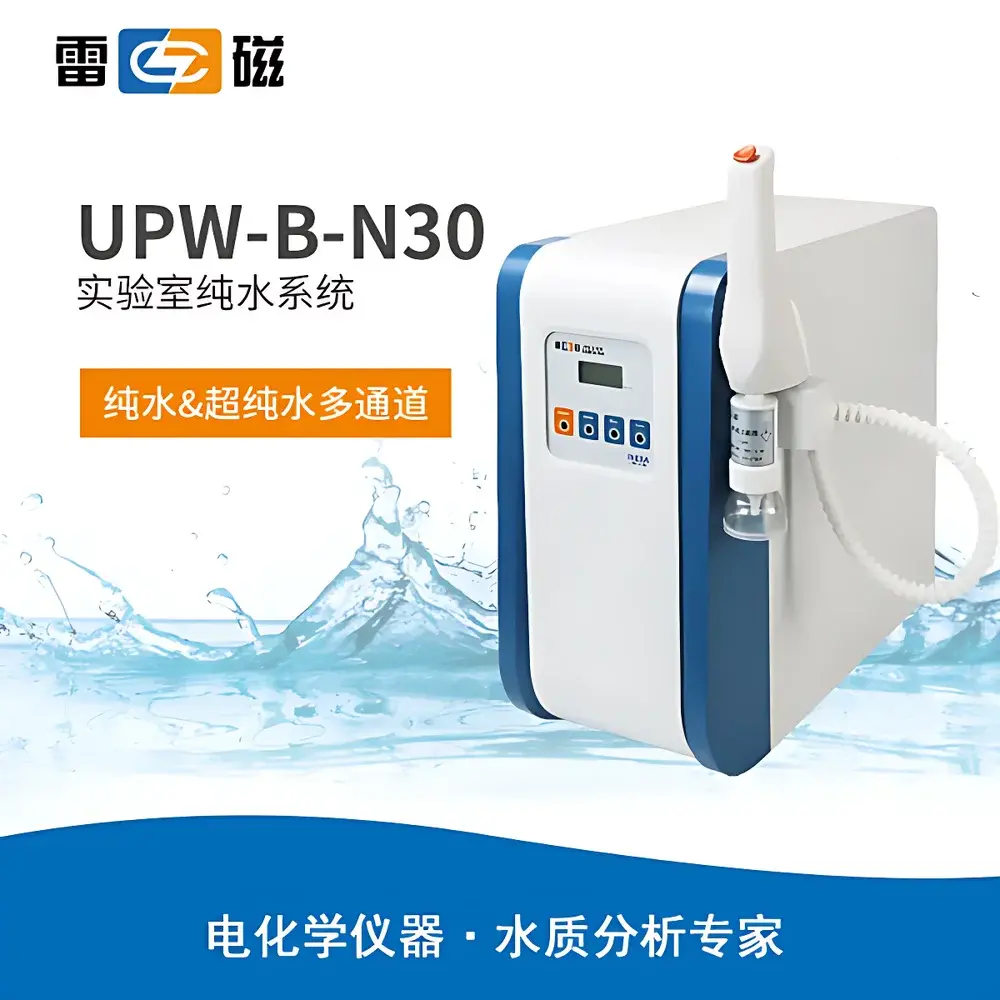
Leichi UPW-B-N30 Ultra Pure Water System
| Brand | Leichi |
|---|---|
| Origin | Shanghai, China |
| Manufacturer Type | Direct Manufacturer |
| Regional Classification | Domestic (China) |
| Model | UPW-B-N30 |
| Price Range | USD 1,400 – 2,100 (FOB Shanghai) |
| Purified Water Grade | ASTM Type I Reagent Water |
| Resistivity | ≥18.2 MΩ·cm at 25 °C |
| Production Rate | 30 L/h |
| Feed Water Conductivity | <400 µS/cm |
| Feed Temperature | 5–40 °C |
| Feed Pressure | 0.1–0.4 MPa |
| RO Salt Rejection | >95% |
| Bacterial Reduction | >99% |
| TOC | ≤30 ppb |
| Particulate Count | <1 particle/mL @ ≥0.22 µm |
| Microbial Limit | ≤1 CFU/mL |
| Flow Rate (Ultrapure) | 1–1.5 L/min |
| Display | LCD with real-time resistivity, temperature-compensated conductivity, system status, and tank level indicators |
Overview
The Leichi UPW-B-N30 Ultra Pure Water System is an integrated, modular laboratory water purification platform engineered to deliver ASTM Type I reagent-grade ultrapure water continuously for critical analytical applications—including HPLC, LC-MS, ICP-MS, cell culture, molecular biology, and trace elemental analysis. It employs a sequential multi-stage purification architecture: pre-treatment (sediment + activated carbon + softening), dual-stage reverse osmosis (RO), electrodeionization (EDI) or mixed-bed ion exchange (depending on configuration), ultrafiltration (UF), and final 0.22 µm microfiltration. The system’s resistivity monitoring is temperature-compensated to 25 °C per ASTM D1193 and ISO 3696, ensuring metrological traceability of the ≥18.2 MΩ·cm specification—a benchmark for low ionic contamination in high-sensitivity workflows.
Key Features
- Modular, tool-free cartridge design with quick-connect fluidic interfaces—enabling rapid replacement of pre-filters, RO membranes, and ultrapure polishing columns without system depressurization or technician certification.
- Narrow-footprint chassis (≤300 mm depth) optimized for space-constrained benchtop environments; independent ergonomic dispensing arm allows flexible placement up to 1.5 m from main unit via reinforced PE tubing.
- Dual-output configuration: simultaneous dedicated ports for Type III purified water (RO permeate, <5 µS/cm) and Type I ultrapure water (≥18.2 MΩ·cm), each with flow-controlled valves and non-return check mechanisms.
- Intelligent LCD interface displaying real-time resistivity (with automatic temperature compensation), feed/production flow rates, cumulative volume dispensed, consumables remaining life (%), and fault diagnostics (e.g., low pressure, high TOC, membrane fouling index).
- Integrated 15 L pressurized stainless steel storage tank with integrated UV lamp (254 nm) and 0.22 µm vent filter to suppress microbial regrowth; level sensors trigger auto-replenishment and alarm at <10% capacity.
- Double-length service-life cartridges—pre-filter and mixed-bed columns rated for ≥6,000 L throughput under typical municipal feed conditions—reduce annual maintenance frequency by up to 40% versus conventional systems.
Sample Compatibility & Compliance
The UPW-B-N30 is validated for compatibility with deionized, softened, or municipally treated tap water meeting ASTM D1193 feed specifications (conductivity <400 µS/cm, turbidity <1 NTU, chlorine <3 ppm). Its output complies with key international standards for laboratory water quality: ASTM Type I (D1193-20), ISO 3696:1987 Class 1, CLSI EP22-A2 for ultrapure water validation, and USP Purified Water and Water for Injection (WFI) preparatory requirements. All wetted materials—including PVDF housings, PEEK manifolds, and EPDM gaskets—are USP Class VI compliant and extractables-tested per ISO 10993-12. The system supports GLP/GMP documentation workflows via optional audit-trail-enabled firmware (compliant with FDA 21 CFR Part 11 Annex 11 principles).
Software & Data Management
While the base UPW-B-N30 operates via embedded microcontroller logic without external PC dependency, optional firmware upgrade enables USB-C data export (CSV format) of time-stamped resistivity logs, usage history, and alarm events. All sensor outputs—including resistivity, temperature, pressure, and flow—are sampled at 2 Hz and internally averaged over 30-second windows to minimize noise artifacts. Calibration protocols follow NIST-traceable reference standards (e.g., KCl solutions at 25 °C); calibration certificates are generated per run and stored in non-volatile memory. Remote monitoring integration (via Modbus RTU over RS-485) is available for centralized facility management systems.
Applications
This system serves as a primary ultrapure water source for analytical instrumentation requiring minimal background interference: mobile phase preparation for UHPLC and gradient HPLC systems; diluent formulation in ICP-OES and ICP-MS; buffer and reagent preparation for ELISA, qPCR, and CRISPR-based assays; rinsing of quartz cuvettes and optical components; and media supplementation in sterile mammalian cell culture. Its low TOC (<30 ppb) and sub-ppb metal leaching profile make it suitable for electrochemical studies and nanoparticle synthesis where organic or ionic contaminants would compromise nucleation kinetics.
FAQ
What feed water quality is required for stable operation?
Municipal tap water with conductivity <400 µS/cm, free chlorine <3 ppm, and sediment load <1 NTU is recommended. Optional pretreatment modules (e.g., dual-cartridge sediment + carbon) are advised for high-hardness or high-chlorine sources.
Does the system meet ISO 3696 Class 1 specifications?
Yes—the UPW-B-N30 consistently delivers water meeting ISO 3696:1987 Class 1 criteria (resistivity ≥18.2 MΩ·cm, TOC ≤50 ppb, bacteria ≤1 CFU/mL, particles ≤1/mL at ≥0.22 µm) when operated within specified environmental and maintenance parameters.
Can the system be validated for GMP environments?
With optional IQ/OQ documentation packages and Part 11-compliant firmware, the UPW-B-N30 supports installation qualification (IQ), operational qualification (OQ), and routine performance verification per EU GMP Annex 15 and WHO TRS 970 guidelines.
How often must consumables be replaced?
Under typical lab use (8 h/day, 200 L/week), pre-filters last ~6 months, RO membranes ~24 months, and ultrapure polishing columns ~12 months—subject to feed water quality and usage intensity. The LCD displays real-time remaining service life based on flow-weighted consumption algorithms.
Is remote monitoring supported out-of-the-box?
Standard configuration includes local LCD only. RS-485 Modbus RTU interface is available as a factory-installed option for integration into building management or LIMS platforms.



