
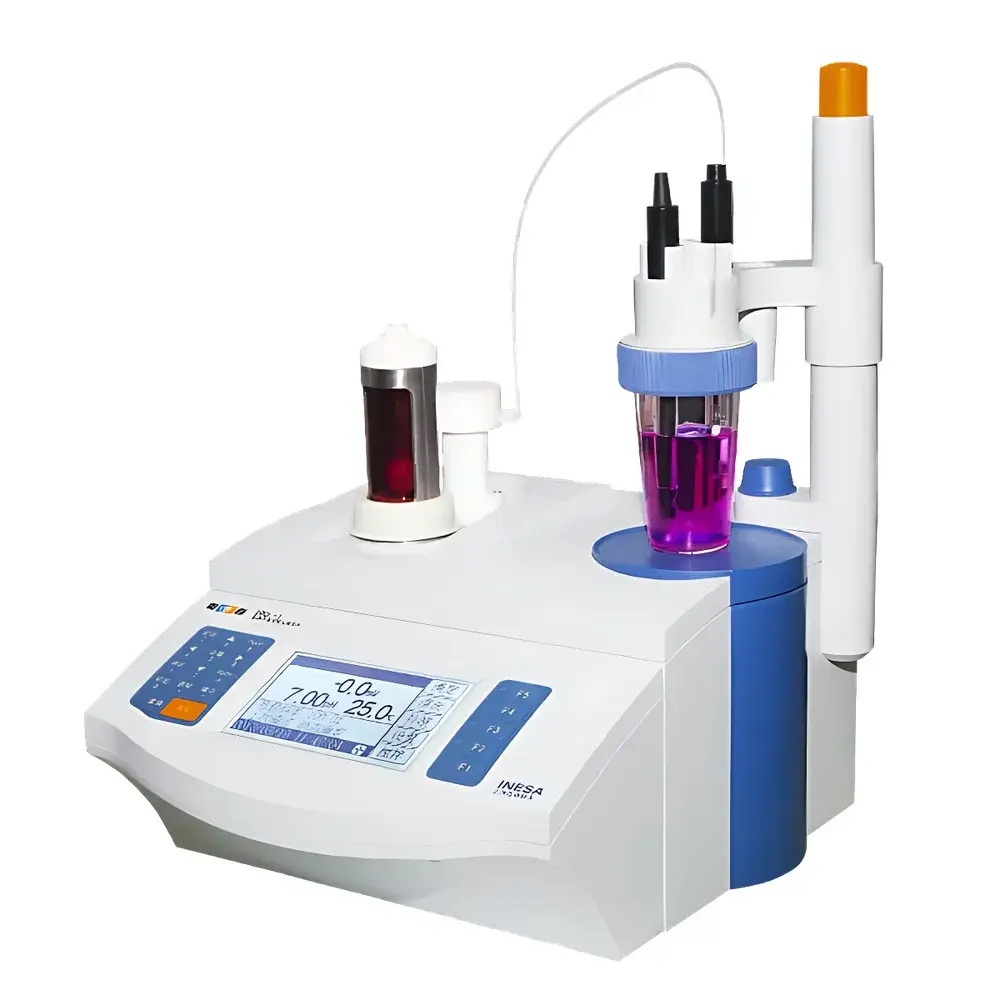
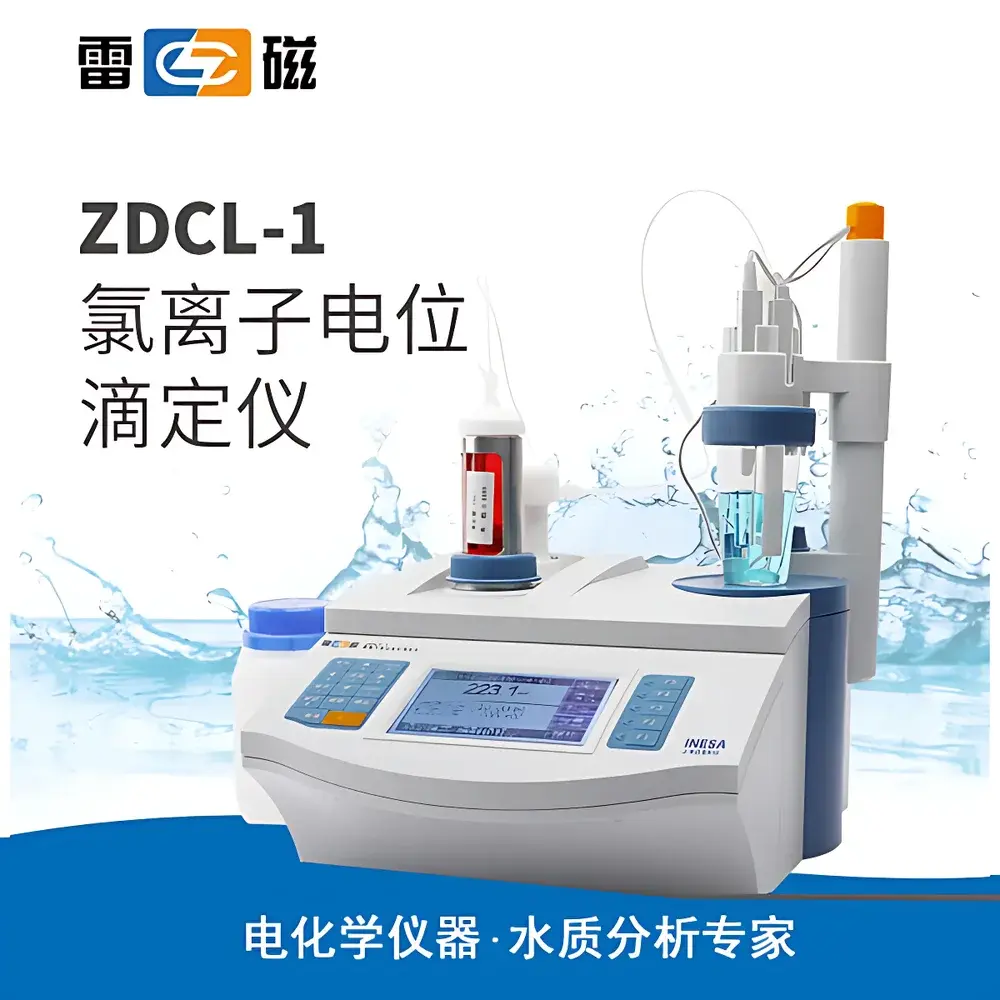
Leichi ZDCL-1 Chloride Ion Automatic Potentiometric Titrator
| Brand | Leichi |
|---|---|
| Origin | Shanghai, China |
| Manufacturer Type | Direct Manufacturer |
| Regional Classification | Domestic (China) |
| Model | ZDCL-1 |
| Instrument Category | General-Purpose Potentiometric Titrator |
| Application Scope | Dedicated for Chloride Ion Analysis |
| Measurement Range | (−1800.0 to +1800.0) mV |
| Meter Accuracy | ±0.20% of full scale |
| Meter Resolution | 0.1 mV |
| Titration Accuracy | (±0.3 mV ±1 digit) over 3 h |
| Titration Resolution | 1/10000 |
| Titration Repeatability | 0.20% |
| Burette Error | ±0.025 mL (10 mL burette), ±0.035 mL (20 mL burette) |
| Electronic Unit Basic Error | ±0.05% FS |
| Stability | ±0.3 mV / 3 h |
| Operating Environment | 0–40 °C, ≤85% RH |
| Dimensions & Weight | 340 × 400 × 400 mm, ~10 kg |
| Power Supply | AC (220 ± 22) V, (50 ± 1) Hz |
Overview
The Leichi ZDCL-1 Chloride Ion Automatic Potentiometric Titrator is a dedicated electrochemical analytical instrument engineered for precise and reproducible quantification of chloride ion (Cl⁻) concentration in solid and liquid matrices—particularly in cement, concrete admixtures, construction materials, and related industrial quality control samples. It operates on the principle of potentiometric titration, where the potential difference between a silver/silver chloride (Ag/AgCl) indicator electrode and a reference electrode is monitored continuously during titration with standardized silver nitrate (AgNO₃) solution. The endpoint is determined by the inflection point of the first derivative of the potential curve (dE/dV), ensuring high sensitivity and minimal operator bias. Designed in strict alignment with Chinese national standards GB/T 176–2017 *Chemical Analysis of Cement* and GB/T 8077–2012 *Test Methods for Uniformity of Concrete Admixtures*, the ZDCL-1 delivers metrologically traceable results suitable for regulatory reporting, inter-laboratory comparison, and routine QC/QA workflows in accredited testing laboratories.
Key Features
- Integrated potentiometric measurement module with wide-range voltage detection (−1800.0 to +1800.0 mV) and high-resolution readout (0.1 mV), enabling robust signal acquisition even under low-ionic-strength or high-background conductivity conditions.
- Dual-burette support (10 mL and 20 mL volumetric glass burettes) calibrated to ISO 385 tolerances; volumetric accuracy meets ±0.025 mL (10 mL) and ±0.035 mL (20 mL) specifications per ISO 8655–3.
- Real-time graphical display via dot-matrix LCD: simultaneous visualization of titration curve (E vs. V), first-derivative plot (dE/dV), method parameters, and endpoint confirmation—no external software required for basic operation.
- Multi-mode operational firmware supporting chloride determination, AgNO₃ standard solution calibration, and blank volume correction—eliminating manual calculation steps and reducing procedural error.
- RS232 serial interface compliant with EIA/TIA-232-F standard, enabling bidirectional communication with Windows-based titration software for automated data logging, curve fitting, audit trail generation, and report export (CSV, PDF).
- Onboard memory stores up to 200 complete titration result sets and one full-resolution titration curve per session, with timestamped metadata (date/time, operator ID, sample ID, method name) satisfying GLP documentation requirements.
Sample Compatibility & Compliance
The ZDCL-1 is validated for use with aqueous extracts from cementitious materials, concrete admixtures, soil leachates, and industrial process waters. Sample preparation follows standardized dissolution protocols outlined in GB/T 176–2017 (e.g., hot water extraction under reflux) and GB/T 8077–2012 (e.g., acid digestion followed by dilution). Electrode compatibility includes standard double-junction Ag/AgCl titration electrodes and refillable calomel reference electrodes. All measurement procedures are fully compatible with Good Laboratory Practice (GLP) frameworks, including mandatory data integrity controls: electronic signature support (via optional PC software), user-access levels, and immutable audit trails. While not pre-certified for FDA 21 CFR Part 11, its data export architecture and metadata tagging support validation for regulated environments upon site-specific qualification.
Software & Data Management
The included Windows-compatible titration software provides comprehensive instrument control, real-time remote monitoring, and post-acquisition analysis. Functions include automatic endpoint detection using tangent, second-derivative, or Gran’s plot methods; customizable report templates with embedded calibration records; and batch export of raw potential/volume data for third-party statistical analysis (e.g., JMP, Minitab). All stored results retain full traceability: each entry logs instrument serial number, firmware version, electrode calibration history, environmental conditions (temperature/humidity), and user authentication status. Data deletion requires administrator-level credentials and generates an auditable log entry—ensuring compliance with ISO/IEC 17025 clause 7.5.2 on record retention and integrity.
Applications
- Quantitative determination of soluble chloride content in Portland cement, blended cements, and supplementary cementitious materials (SCMs) per ASTM C114 and GB/T 176–2017.
- Chloride ion assessment in concrete admixtures—including water reducers, retarders, and air-entraining agents—to verify conformance with GB/T 8077–2012 limits (<0.02% mass fraction for non-steel-reinforced applications).
- Quality assurance testing in precast concrete manufacturing facilities and ready-mix plants, supporting durability evaluation against chloride-induced reinforcement corrosion.
- Research applications in civil engineering laboratories studying chloride diffusion coefficients, binding capacity, and pore solution chemistry in hydrated cement pastes.
- Environmental testing of construction waste leachates and recycled aggregate wash water for chloride discharge compliance.
FAQ
What electrode types are recommended for optimal chloride titration performance?
Silver/silver chloride (Ag/AgCl) combination electrodes with ceramic junctions and low-resistance fill solutions (e.g., 3 mol/L KCl) are recommended. Double-junction configurations minimize contamination from sample matrix ions.
Can the ZDCL-1 be used for other anions beyond chloride?
No—the instrument firmware and default calibration routines are optimized exclusively for chloride determination using AgNO₃ titrant. It does not support bromide, iodide, or cyanide titrations without hardware modification and method revalidation.
Is the RS232 interface compatible with modern 64-bit Windows systems?
Yes—driver support is provided for Windows 10 and Windows 11 (64-bit) via signed USB-to-serial adapters or native COM port connections. Virtual COM port emulation is supported through standard FTDI or Prolific chipsets.
How is measurement uncertainty estimated for chloride results?
Uncertainty propagation accounts for burette volumetric error (±0.025 mL), electrode potential drift (±0.3 mV/3 h), AgNO₃ standard concentration uncertainty (typically ±0.1% if certified), and sample mass weighing error (±0.1 mg)—calculated per GUM (JCGM 100:2008) principles.
Does the instrument support automatic electrode calibration?
No—electrode calibration is performed manually using two standard solutions (e.g., 10⁻³ M and 10⁻¹ M KCl), with slope and offset verification displayed on-screen. Calibration data is stored with timestamp but not auto-applied to subsequent runs.




