
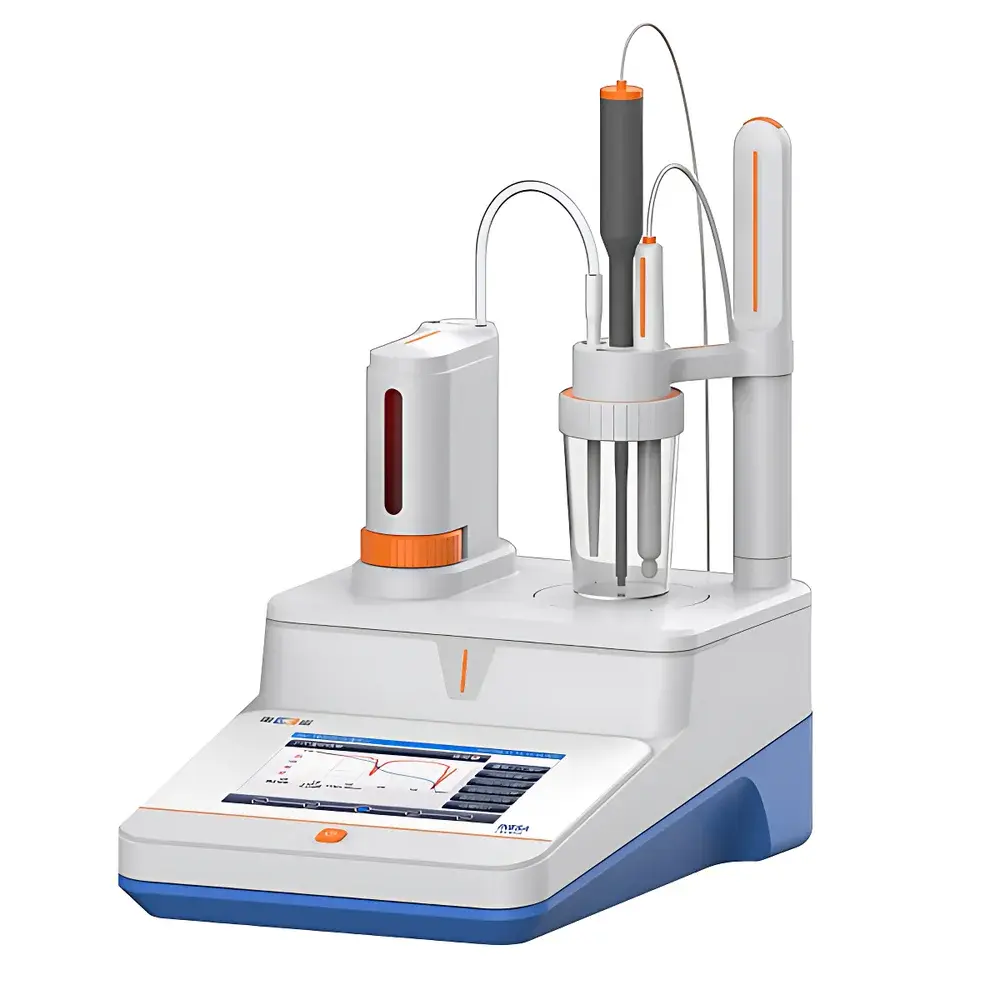
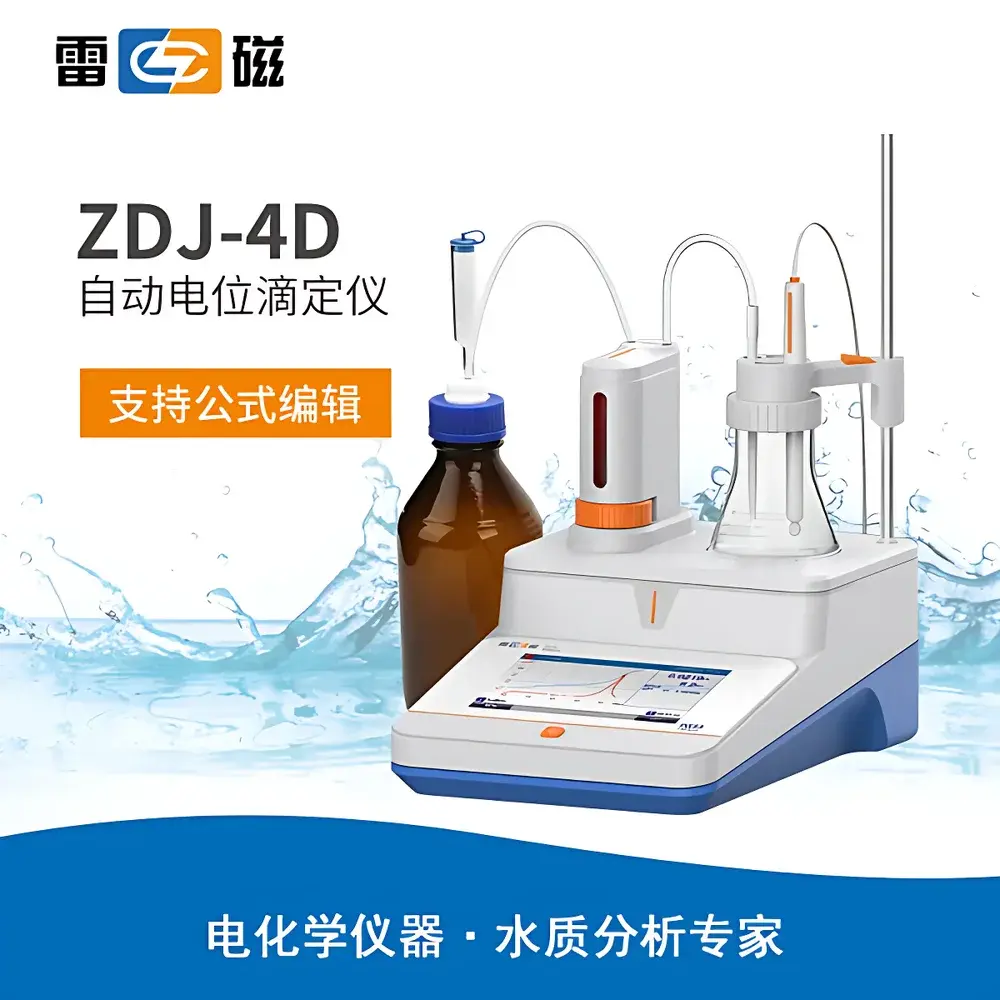
Leichi ZDJ-4D Automatic Potentiometric Titrator
| Brand | Leichi |
|---|---|
| Origin | Shanghai, China |
| Manufacturer Type | Direct Manufacturer |
| Regional Classification | Domestic (China) |
| Model | ZDJ-4D |
| Instrument Category | General-Purpose Potentiometric Titrator |
| Application Scope | Universal |
| Measurement Range | mV: −2000.0 to +2000.0 mV |
| pH | −5.000 to 20.000 |
| Potentiometric Resolution | 0.01 mV |
| Titration Volume Resolution | 1/20000 |
Overview
The Leichi ZDJ-4D Automatic Potentiometric Titrator is a precision-engineered electrochemical analysis system designed for high-reproducibility potentiometric titrations in quality control, research, and regulatory-compliant laboratories. Based on the principle of monitoring potential change (E) across a redox-sensitive indicator electrode versus a stable reference electrode, the instrument detects inflection points in the titration curve—enabling accurate endpoint determination for acid-base, redox, precipitation, complexometric, and non-aqueous titrations. Its modular architecture integrates a microprocessor-controlled burette drive, low-drift potentiometric measurement circuitry, and thermally compensated electrode interface—all calibrated to meet ISO/IEC 17025 traceability requirements. The system is purpose-built for environments requiring routine compliance with GLP, GMP, and pharmacopeial methods (e.g., USP , EP 2.2.20), where data integrity, audit readiness, and method reproducibility are non-negotiable.
Key Features
- 7-inch capacitive color touchscreen with intuitive navigation interface supporting both English and Chinese language modes
- Integrated valve-burette assembly enabling rapid, tool-free replacement of 10 mL or 20 mL burettes—minimizing cross-contamination and calibration drift
- Chemically resistant fluid path constructed from PTFE, ETFE, and sapphire components—validated for use with concentrated acids, perchloric acid, and organic solvents (e.g., glacial acetic acid, DMF)
- Dual-stirring support: top-mounted magnetic stirrer and bottom-mounted mechanical stirrer for heterogeneous sample homogenization
- Six operational titration modes: dynamic titration (incremental addition with real-time slope evaluation), fixed-volume titration, preset-endpoint titration, constant-pH titration (for buffer capacity studies), blank titration, and manual override mode
- Comprehensive method library supporting acid–base (aqueous & non-aqueous), redox (e.g., Ce⁴⁺/Fe²⁺, I₂/ascorbic acid), argentometric (Cl⁻, Br⁻), and complexometric (EDTA–Ca²⁺/Mg²⁺) titrations
- Multi-titrant management: up to seven independent reagent channels with individual concentration tracking, expiry logging, and usage history
- Advanced electrode calibration: automated recognition of GB, DIN, and NIST pH standard buffers; up to 3-point pH calibration with residual error reporting
Sample Compatibility & Compliance
The ZDJ-4D accommodates liquid, semi-solid, and suspended samples within temperature ranges of −5.0 °C to 110.0 °C (with optional Pt100 temperature probe). Its electrode input complies with DIN 19262 and ASTM D1129 standards for reference junction compatibility and liquid junction potential stability. All data acquisition—including raw mV/pH readings, derivative curves (dE/dV), and calculated results—is timestamped, user-attributed, and stored with immutable metadata (operator ID, method name, environmental conditions). The system satisfies core elements of FDA 21 CFR Part 11 when configured with optional GMP software: electronic signatures, role-based access control (8 configurable user profiles), audit trail with event-type classification (e.g., “method edit”, “result deletion”), and automatic backup to external USB storage. Data export formats include CSV, PDF, and XML for LIMS integration.
Software & Data Management
Onboard firmware supports local storage of ≥1000 complete titration records—including method parameters, raw sensor outputs, first- and second-derivative plots, and final quantitative results with uncertainty estimates. Data retrieval includes chronological filtering, keyword search (by sample ID or operator), statistical summary (mean, RSD, confidence intervals), and comparative overlay of multiple titration curves. USB 2.0 and RS-232 interfaces enable direct connection to thermal printers, USB flash drives (FAT32 formatted), and Leichi’s PC-based TitraLink™ software—enabling remote method deployment, batch report generation, and automated validation protocol execution (IQ/OQ/PQ templates included). Firmware updates are delivered via signed binary packages with SHA-256 hash verification.
Applications
- Pharmaceutical QC: assay of active pharmaceutical ingredients (APIs) per USP monographs (e.g., aspirin hydrolysis, chlorpheniramine maleate titration)
- Food & Beverage: total acidity (TA) in wines and juices, chloride content in dairy products, peroxide value in edible oils
- Environmental Testing: alkalinity and hardness profiling in wastewater per APHA Standard Methods 2320B and 2340C
- Materials Science: determination of free fatty acids in biodiesel (ASTM D664), residual catalyst metals in polymer synthesis
- Academic Research: equilibrium constant derivation via Gran plot analysis, pKa determination of weak electrolytes
FAQ
What electrode types are compatible with the ZDJ-4D?
The instrument accepts all standard BNC-compatible pH, redox, ion-selective (e.g., Ag/AgCl, F⁻, Cl⁻), and combination electrodes meeting IUPAC impedance specifications (< 10¹² Ω at 1 kHz).
Does the system support automatic sample handling?
Yes—via RS-232 or TTL-level trigger interface, it synchronizes with third-party autosamplers (e.g., Metrohm 815, Hanna HI84531) for unattended multi-sample sequences.
How is measurement traceability ensured?
Each unit ships with a factory calibration certificate traceable to NIM (National Institute of Metrology, China) standards; users may perform internal verification using certified reference materials (CRMs) per ISO Guide 34.
Can custom calculation formulas be deployed?
Yes—the built-in formula editor supports arithmetic operations, conditional logic (IF/THEN), unit conversions, and embedded constants—outputting derived values (e.g., % purity, mmol/g) directly on result screens.
Is temperature compensation mandatory during titration?
Temperature compensation is optional but recommended for high-accuracy work; the system applies the Nernst equation correction factor automatically when a calibrated Pt100 probe is connected.







