
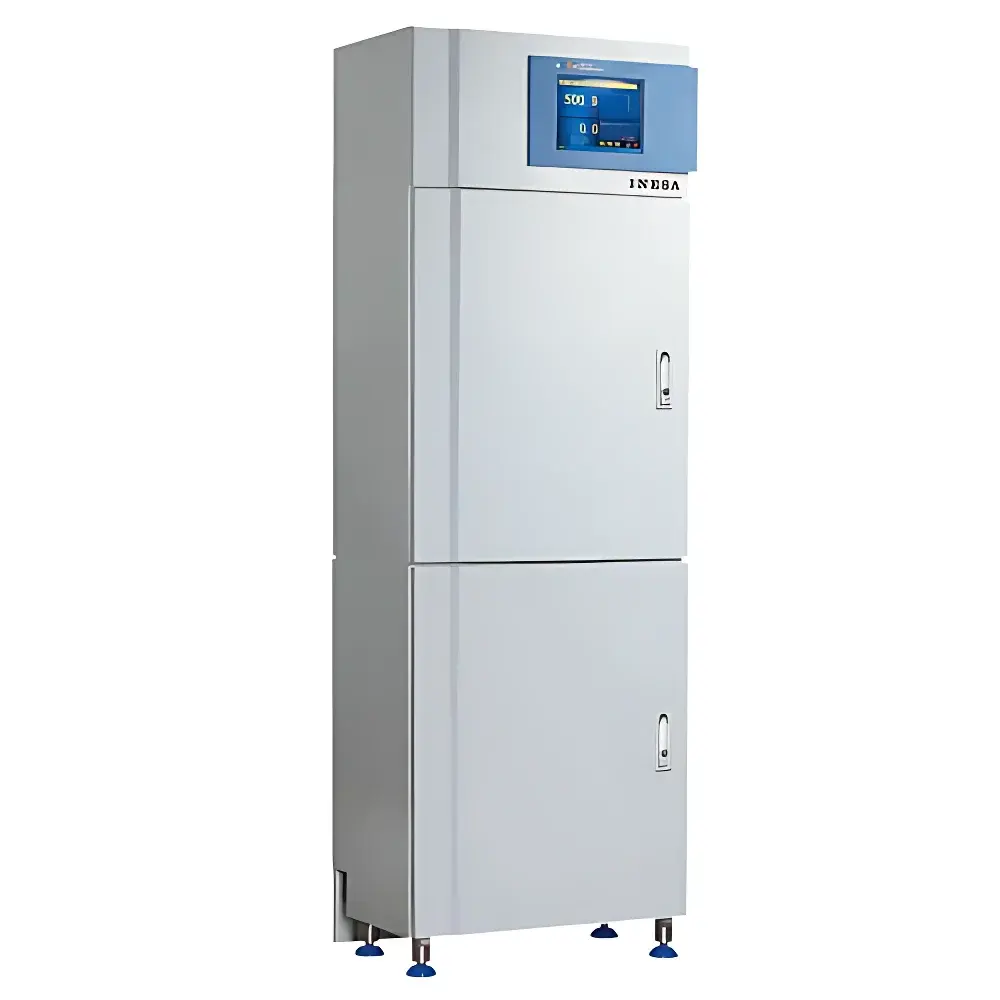
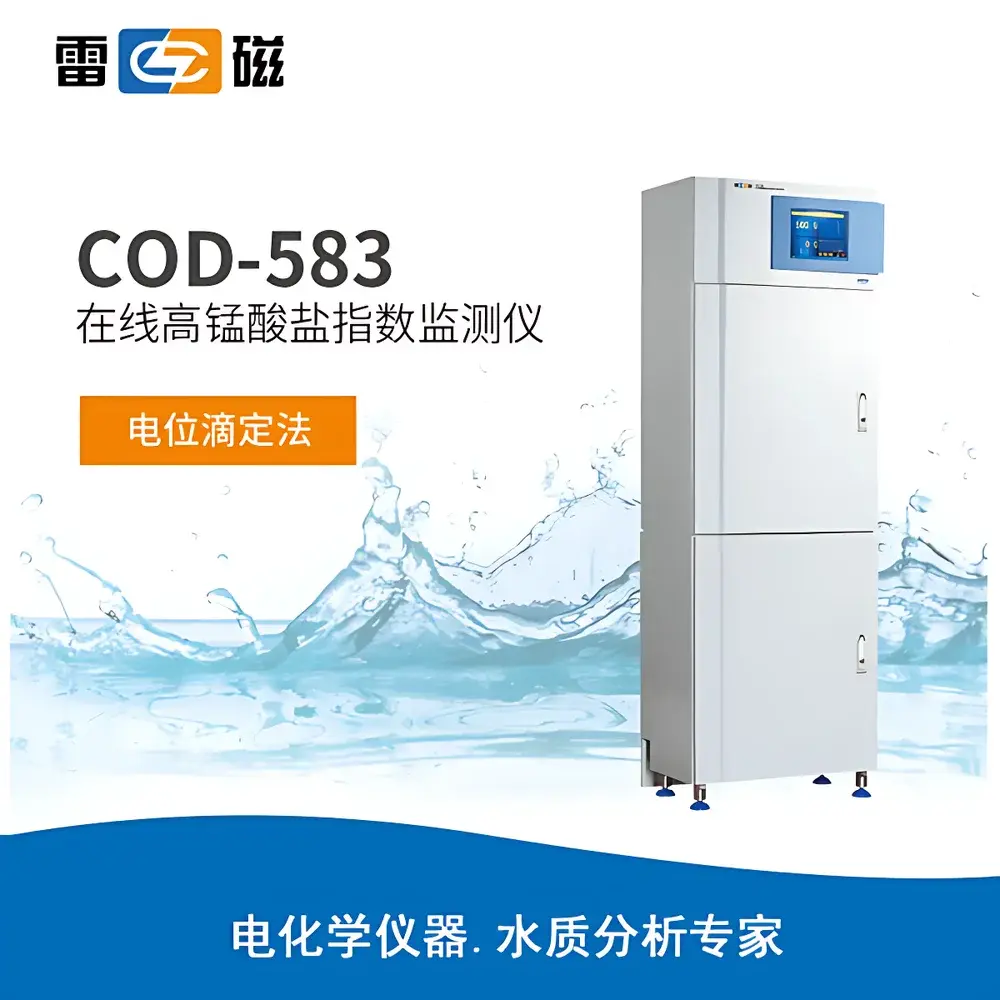
Leici COD-583 Online Permanganate Index Analyzer
| Brand | Leici |
|---|---|
| Origin | Shanghai, China |
| Manufacturer Type | Original Equipment Manufacturer (OEM) |
| Product Category | Domestic |
| Model | COD-583 |
| Pricing | USD 12,300 (FOB Shanghai) |
| Measurement Principle | Potassium Permanganate Oxidation with ORP Endpoint Detection |
| Instrument Type | Online Continuous Analyzer |
| Repeatability | ≤ ±5% RSD |
| Accuracy | ±10% of reading (as per GB/T 11892–1989) |
| Power Failure Recovery | Yes |
| Remote Connectivity | Ethernet & Modbus TCP |
| Calibration Verification | Automated Zero & Span Check |
| Fluidic Architecture | Sequential Injection with Multi-Position Rotary Valve |
| Tubing Material | FEP (fluorinated ethylene propylene), ID ≥ 1.0 mm |
| Diagnostic Capability | Embedded Self-Diagnostic Routine |
| Maintenance Interval | ≥ 30 days under standard operation |
Overview
The Leici COD-583 Online Permanganate Index Analyzer is a fully automated, continuous-monitoring instrument engineered for regulatory-compliant measurement of the permanganate index (CODMn) in surface water, wastewater influent/effluent, and source water applications. It implements the standardized potassium permanganate oxidation method—aligned with China’s national standard GB/T 11892–1989—and employs redox potential (ORP) endpoint detection to determine stoichiometric completion of oxidation. Unlike spectrophotometric or dichromate-based COD analyzers, the COD-583 targets low-to-moderate organic load matrices where permanganate index serves as a surrogate for biodegradable organic content, particularly in drinking water sources and ecological monitoring networks. Its design prioritizes long-term operational stability in unattended field deployments, minimizing manual intervention while maintaining metrological traceability to reference titrimetric procedures.
Key Features
- ORP-driven endpoint detection ensures precise termination of permanganate titration without reliance on colorimetric interference—critical for turbid or colored samples common in riverine and reservoir environments.
- Sequential injection fluidics with a corrosion-resistant multi-port rotary valve eliminates cross-contamination between samples and reagents; each sample undergoes independent volumetric metering prior to oxidation.
- High-resolution stepper motor actuation (16,000 steps per revolution) delivers titrant increments of 0.0025 mL, enabling fine-grained control over KMnO4 dosing and reducing cumulative volumetric error.
- FEP peristaltic tubing (ID ≥ 1.0 mm) provides chemical inertness toward strong oxidants and mechanical resilience against particulate-laden water—reducing clogging frequency by >40% compared to standard PVC or silicone tubing.
- Automated zero and span verification routines execute at user-defined intervals (e.g., every 6 or 12 hours), logging drift metrics to support QA/QC documentation and GLP-aligned data integrity.
- Non-volatile memory retains configuration, calibration history, and event logs during power interruption; system resumes measurement sequence automatically upon restoration without operator input.
- Embedded diagnostics monitor valve actuation timing, pump pressure profiles, ORP sensor response kinetics, and reagent depletion—generating actionable fault codes rather than generic “error” alerts.
Sample Compatibility & Compliance
The COD-583 is validated for use with raw surface water (turbidity ≤ 100 NTU), treated drinking water, municipal wastewater influent (CODMn range: 0.5–10 mg/L O2), and industrial effluents meeting Chinese Class III–V surface water quality standards. It complies with GB/T 11892–1989 methodology requirements and supports audit-ready data logging compatible with ISO/IEC 17025 laboratory quality systems. While not certified to US EPA Method 410.4 or ISO 8467, its performance characteristics align with the precision and bias expectations defined in those frameworks for low-range permanganate index determination. All firmware and calibration records adhere to ALCOA+ principles (Attributable, Legible, Contemporaneous, Original, Accurate, Complete, Consistent, Enduring, Available) for regulatory review.
Software & Data Management
The analyzer integrates a Linux-based embedded controller running Leici’s proprietary L-DAQ v3.2 firmware. Local HMI includes a 7-inch resistive touchscreen with real-time trend plots, alarm thresholds, and maintenance scheduling. Remote access is enabled via Ethernet using Modbus TCP (function codes 03/04/16) for integration into SCADA, DCS, or cloud-based water management platforms. Data export supports CSV and XML formats with timestamped metadata—including sample ID, temperature, ORP curve slope, titrant volume consumed, and diagnostic flags. Audit trails record all parameter changes, calibration events, and user logins with ISO 27001-aligned encryption for data-at-rest and TLS 1.2 for data-in-transit.
Applications
- Real-time monitoring of drinking water source quality in reservoirs and intake stations
- Compliance tracking for municipal wastewater treatment plant discharge permits
- Trend analysis of seasonal organic loading in rivers and lakes under national ecological monitoring programs
- Process optimization feedback in advanced oxidation or biofiltration units where permanganate index correlates with assimilable organic carbon (AOC)
- Early-warning detection of accidental organic spills in watershed protection zones
FAQ
What regulatory standards does the COD-583 comply with?
It implements GB/T 11892–1989 and supports documentation required for China’s Environmental Monitoring Technical Specifications (HJ/T 91–2002). It is not EPA- or ISO-certified but meets metrological equivalence for routine environmental surveillance.
Can the instrument operate unattended for extended periods?
Yes—designed for ≥30-day maintenance cycles under typical ambient conditions (5–40°C, non-condensing humidity); reagent reservoirs hold sufficient KMnO4, H2SO4, and Na2SO3 for 14 days at 1-sample/hour frequency.
Is remote calibration possible?
Zero and span verifications can be initiated remotely via Modbus command; however, full recalibration requires physical access for standard solution introduction and sensor validation.
How is data integrity ensured during network outages?
All measurements and events are buffered locally in redundant flash memory (≥6 months’ data capacity) and transmitted upon connection recovery with sequence-consistent timestamps.
Does the system support third-party SCADA integration?
Yes—Modbus TCP interface provides register-mapped access to all process variables, status bits, and diagnostic registers; configuration files are exportable for OPC UA gateway mapping.
Related Products







