
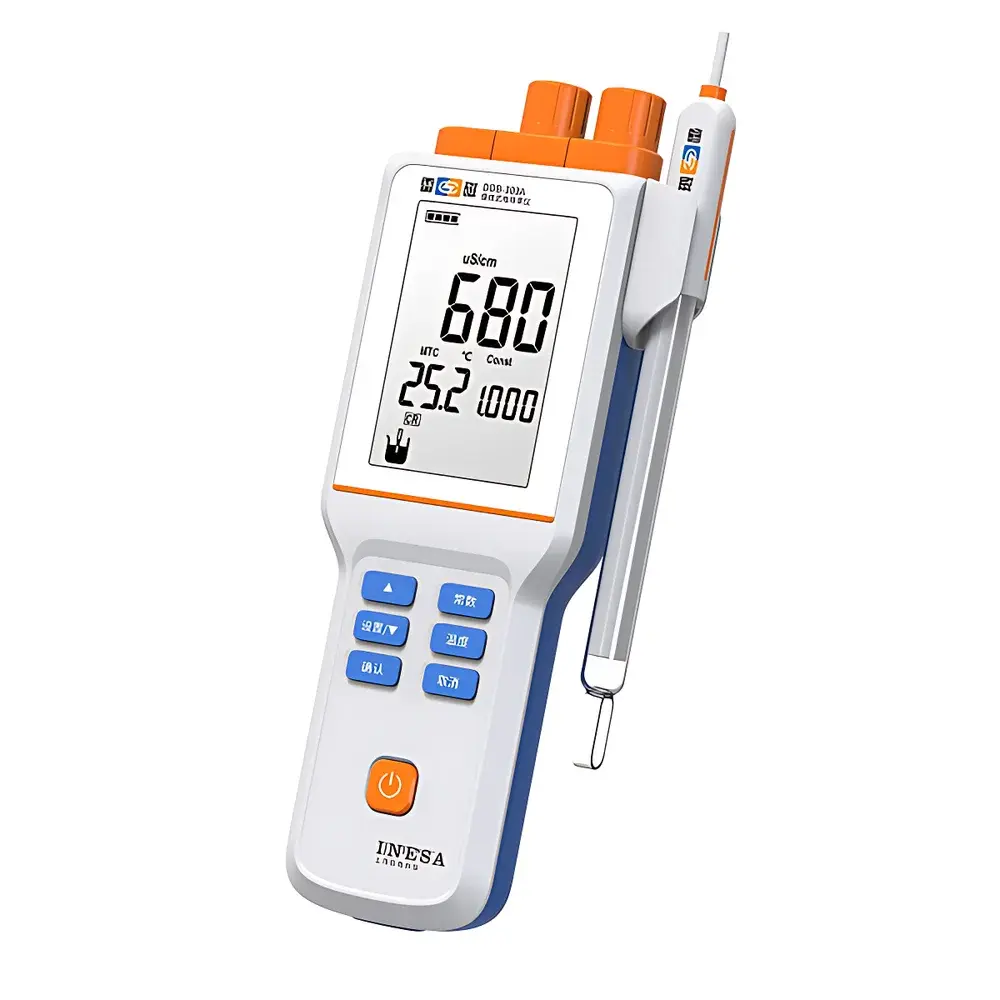
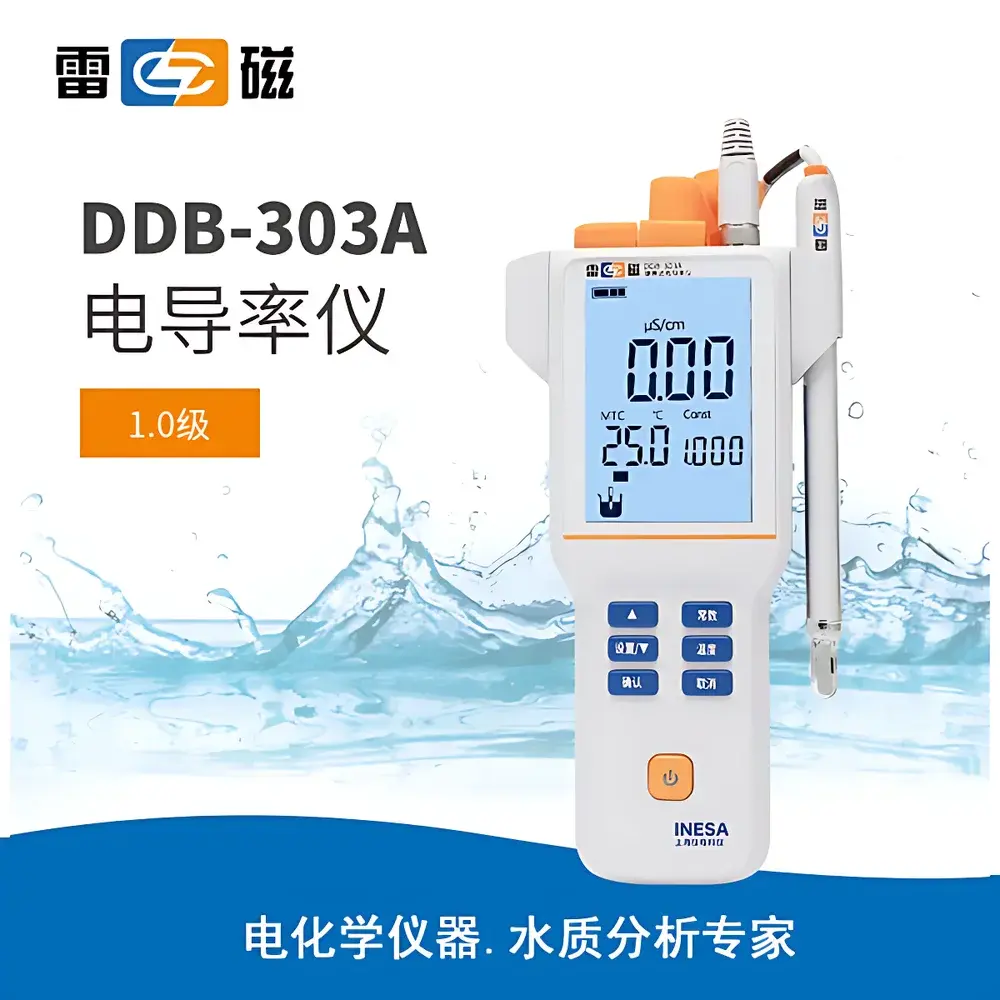
Leici DDB-303A Portable Conductivity Meter
| Brand | Leici |
|---|---|
| Origin | Shanghai, China |
| Manufacturer Type | Manufacturer |
| Product Origin | Domestic (China) |
| Model | DDB-303A |
| Price Range | USD 140–280 |
| Measured Parameter | Conductivity Only |
| Portability | Portable |
| Intended Use | Laboratory & Field |
| Conductivity Range | 0.00 μS/cm to 100 mS/cm |
| Accuracy | ±1.0% of Full Scale (FS) |
| Minimum Resolution | 0.01 μS/cm (auto-ranging) |
Overview
The Leici DDB-303A Portable Conductivity Meter is an engineered electrochemical instrument designed for reliable, field-deployable and laboratory-grade measurement of aqueous solution conductivity. Based on the principle of two-electrode AC conductometric measurement—employing a fixed-frequency alternating current to minimize polarization effects—the DDB-303A delivers stable, repeatable readings across five decades of conductivity (0.00 μS/cm to 100 mS/cm). Its architecture complies with IEC 60746-3 (Electrochemical analyzers – Part 3: Conductivity) and supports traceable calibration protocols required in quality-controlled environments. The meter is optimized for routine monitoring in environmental testing, water treatment verification, educational labs, and QC workflows where portability, battery autonomy, and IP65-rated ingress protection are operational prerequisites.
Key Features
- High-contrast LCD display with adjustable backlight for low-light or outdoor use
- Auto-ranging conductivity measurement with dynamic resolution switching (0.01 μS/cm minimum at low ranges; up to 0.1 mS/cm at high ranges)
- Manual temperature compensation (MTC) with user-input reference temperature (typically 25 °C), supporting common linear compensation coefficients (e.g., 2.0%/°C)
- Direct electrode constant entry (K = 0.1, 1.0, or 10.0 cm⁻¹) to ensure accurate conversion from conductance to conductivity
- Automatic frequency selection (1 kHz or 10 kHz) synchronized with the connected electrode’s cell constant—enabling full-range coverage using a single K = 1.0 cm⁻¹ sensor
- IP65-rated enclosure for dust resistance and protection against low-pressure water jets, suitable for humid laboratories and outdoor sampling sites
- Rechargeable lithium-ion battery (built-in, 2000 mAh typical capacity) providing ≥100 hours of continuous operation; supports USB-C charging from PCs or portable power banks
- Battery status indicator with low-voltage warning and real-time charging feedback
- Configurable auto-power-off (10/30/60 min) and factory reset function for data integrity and instrument standardization
Sample Compatibility & Compliance
The DDB-303A is validated for use with aqueous samples including drinking water, surface water, wastewater effluents, boiler feedwater, and buffer solutions. It is not intended for non-aqueous solvents, highly viscous fluids, or suspensions containing particulates >50 µm. Electrode compatibility includes standard DIN/ISO-compliant two-electrode conductivity cells (e.g., Leici E-201-C, K = 1.0 cm⁻¹). The instrument meets GB/T 23787–2009 (Chinese national standard for portable conductivity meters) and aligns with ASTM D1125–22 (Standard Test Methods for Electrical Conductivity of Water) for procedural consistency. While not 21 CFR Part 11 compliant out-of-the-box, audit-ready usage is supported via manual logbook documentation per GLP/GMP Annex 11 guidance.
Software & Data Management
The DDB-303A operates as a standalone instrument without embedded Bluetooth or cloud connectivity. Data output is limited to on-screen display and visual stability indication (“✓” icon when reading stabilizes within ±0.5% over 3 s). No internal memory or export interface is provided—measurements must be manually recorded. This design prioritizes robustness, electromagnetic immunity, and regulatory simplicity in resource-constrained or safety-critical settings. For laboratories requiring digital traceability, external logging via time-stamped photography or integration with third-party LIMS via manual entry remains standard practice.
Applications
- Field-based potable water quality screening in municipal distribution systems
- Monitoring conductivity drift in reverse osmosis (RO) and deionized (DI) water loops
- Calibration verification of inline process conductivity sensors in pharmaceutical water systems (PW, WFI)
- Student experiments in general chemistry and environmental science curricula
- Quick-check validation of cleaning efficacy (e.g., rinse water conductivity post-CIP)
- Baseline assessment of soil extract conductivity in agricultural extension services
FAQ
Does the DDB-303A support automatic temperature compensation (ATC)?
No—it provides manual temperature compensation only. Users must measure sample temperature separately and input the value to apply linear correction.
Can the meter store calibration history or measurement records?
No. It lacks non-volatile memory and does not retain calibration dates, electrode constants, or past readings.
Is the included electrode certified for traceable calibration?
The standard E-201-C electrode is factory-characterized but not supplied with NIST-traceable calibration certificate; users must perform two-point calibration using certified KCl standards (e.g., 1413 µS/cm and 12.88 mS/cm at 25 °C).
What is the operating temperature range for the instrument itself?
The electronics are rated for 5 °C to 40 °C ambient; extended operation below 5 °C may reduce battery efficiency and LCD response time.
How often should the electrode be cleaned and recalibrated?
Daily cleaning with deionized water is recommended; recalibration is required before each analytical session or after exposure to fouling matrices such as seawater or industrial effluent.





