
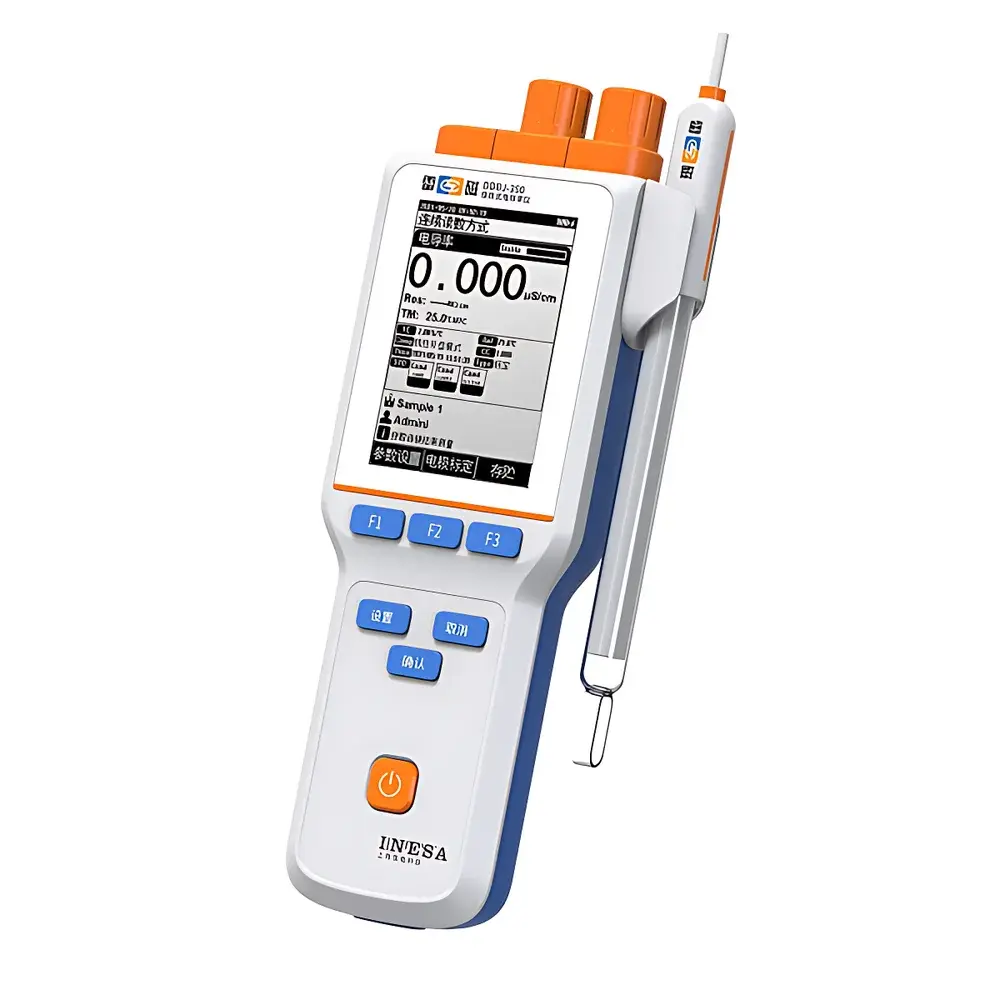
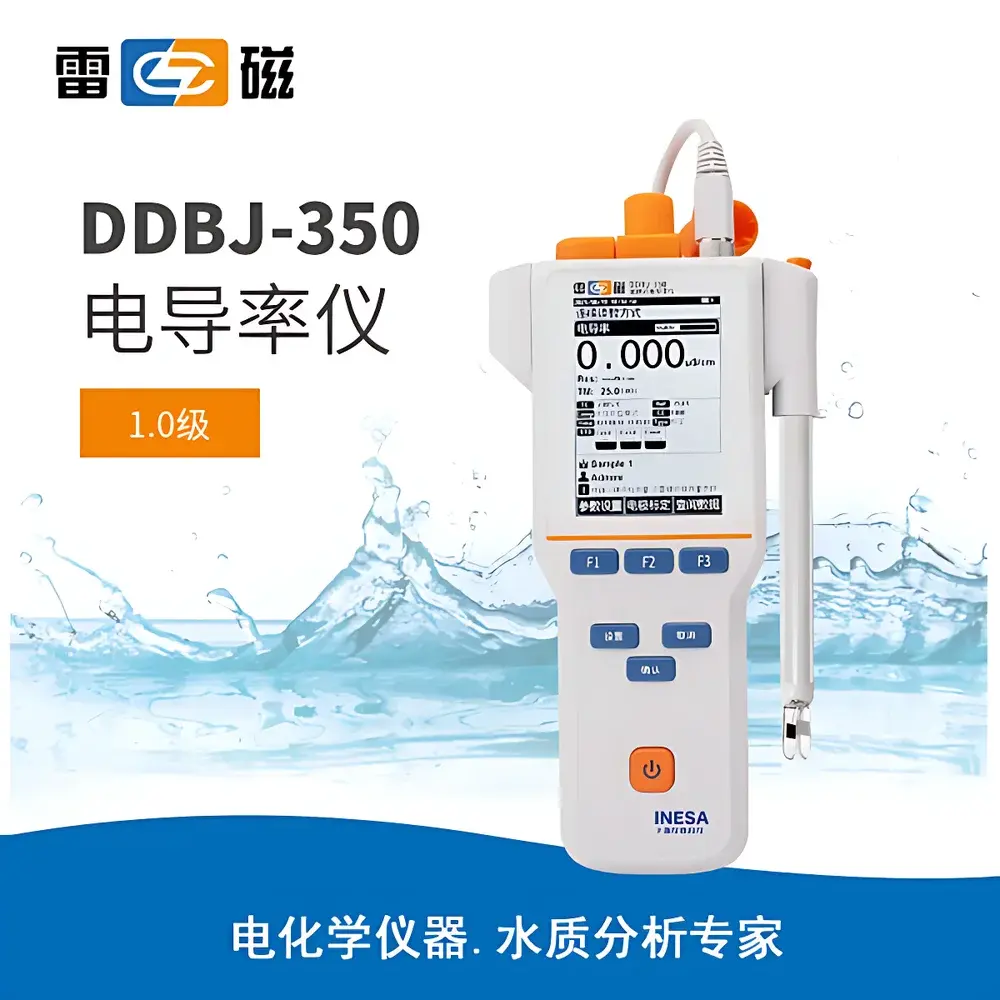
Leici DDBJ-350 Portable Conductivity Meter
| Brand | Leici |
|---|---|
| Origin | Shanghai, China |
| Manufacturer Type | Manufacturer |
| Origin Category | Domestic (China) |
| Model | DDBJ-350 |
| Price Range | USD 280–420 |
| Measured Parameters | Conductivity (single-parameter) |
| Portability | Portable |
| Intended Use | Laboratory & Field |
| Conductivity Range | 0.000 µS/cm to 500 mS/cm |
| TDS Range | 0.00 mg/L to 300 g/L |
| Resistivity Range | 5.00 Ω·cm to 20.00 MΩ·cm |
| Salinity Range | 0.00–8.00 % |
| Temperature Range | −5.0 to 110.0 °C (23.0–230.0 °F) |
| Accuracy | ±1.0 % FS (conductivity, TDS, resistivity), ±0.2 % FS (salinity), ±0.2 °C (temperature) |
| Minimum Resolution | 0.001 µS/cm (conductivity, auto-ranging) |
Overview
The Leici DDBJ-350 Portable Conductivity Meter is a field-deployable, laboratory-grade electrochemical instrument engineered for precise, traceable measurement of aqueous solution conductivity, resistivity, total dissolved solids (TDS), salinity, and temperature. It operates on the principle of two-electrode AC conductometric measurement—applying a low-frequency alternating current across a pair of stainless-steel or graphite electrodes to minimize polarization effects and electrode fouling. The meter employs automatic frequency switching (typically 30 Hz to 1 kHz) to optimize signal-to-noise ratio across its full 6-decade conductivity span—from ultrapure water (sub-µS/cm) to highly concentrated brines (500 mS/cm). Its design conforms to IEC 60746-3 (Electrochemical methods of analysis – Part 3: Conductometry) and supports reference temperature correction per ISO 7888 (Water quality – Determination of electrical conductivity), enabling standardized reporting at either 20 °C or 25 °C. Built for continuity in regulated environments, it meets GLP data integrity requirements through audit-trail-capable storage and time-stamped event logging.
Key Features
- High-resolution 3.5-inch LCD with adjustable backlight for operation under variable ambient lighting conditions
- IP65-rated enclosure—dust-tight and protected against low-pressure water jets—enabling reliable use in humid labs, outdoor sampling sites, and industrial process areas
- Intelligent endpoint detection with multiple read modes: auto-hold, timed reading (1–120 s), interval logging (1–999 min), and manual capture
- Auto-recognition of four standard GB/T 6682–2008 conductivity reference solutions (e.g., 1413 µS/cm, 12.88 mS/cm), supporting 1–3-point calibration with real-time electrode constant validation
- Multi-mode temperature compensation: non-compensated, linear (α = 2.0 %/°C default), or pure-water-specific (non-linear, per ISO 7888 Annex B)
- Automatic cell constant adaptation—compatible with electrodes of k = 0.01, 0.1, and 1.0 cm⁻¹—ensuring optimal resolution across all ranges without manual range switching
- Integrated rechargeable Li-ion battery (≥12 h typical runtime), USB-C charging interface, and dual-status LED indicators for battery level and charging state
Sample Compatibility & Compliance
The DDBJ-350 is validated for routine analysis of potable water, wastewater, boiler feedwater, cooling tower fluids, hydroponic nutrient solutions, and pharmaceutical rinse waters. Its wide dynamic range accommodates both low-conductivity ultrapure water (e.g., ASTM D1193 Type I, resistivity ≥18.2 MΩ·cm at 25 °C) and high-salinity seawater analogues (up to 8.00 % NaCl w/w). All measurements comply with GLP documentation standards: each stored record includes sample ID, operator ID, timestamp, calibration history, electrode ID (if encoded), temperature, and raw sensor output. The device supports 21 CFR Part 11–compliant data export via Leici’s certified PC software (LCS-Link v3.x), including electronic signatures, audit trails, and immutable file generation (.csv or .lcs binary format).
Software & Data Management
Data management is implemented through a dual-path architecture: local storage (500 datasets per parameter type) and external transfer. Internal memory retains full measurement metadata—including calibration coefficients, temperature compensation mode, and cell constant—indexed by unique session ID. Export occurs via USB 2.0 (mass-storage mode) or RS-232 serial interface (with optional IEEE-488-compatible printer driver). LCS-Link software provides trend visualization (time-series plots, scatter matrices), statistical summary (mean, SD, RSD), outlier flagging, and batch export to LIMS-compatible formats. All exported files include embedded CRC-32 checksums and digital signature verification to satisfy ISO/IEC 17025 Clause 7.7 traceability requirements.
Applications
- Environmental monitoring: EPA Method 120.1 compliance checks for surface water conductivity and TDS
- Pharmaceutical QC: USP purified water and water-for-injection (WFI) resistivity verification
- Food & beverage: salt content estimation in brines, sauces, and dairy processing streams
- Power generation: continuous monitoring of condensate purity in steam-cycle systems
- Educational laboratories: student experiments on electrolyte dissociation, ion mobility, and temperature dependence of conductivity
- Field-based hydrogeology: rapid screening of groundwater mineralization and aquifer salinization trends
FAQ
What calibration standards are supported?
Four GB/T 6682–2008 reference solutions (84 µS/cm, 1413 µS/cm, 12.88 mS/cm, and 111.8 mS/cm) are auto-recognized; custom standards may be entered manually with user-defined conductivity values.
Is temperature compensation mandatory?
No—compensation mode is fully configurable: off, linear (adjustable α coefficient), or pure-water nonlinear model per ISO 7888.
Can the meter be used with non-Leici electrodes?
Yes, provided the electrode has a standard BNC connector and specified cell constant (k = 0.01, 0.1, or 1.0 cm⁻¹); manual constant entry is required for third-party probes.
How is data integrity ensured during power loss?
The device implements EEPROM-based non-volatile storage with write-cycling protection and automatic save-on-interrupt; all active measurements are preserved during battery depletion.
Does it support regulatory audit trails?
Yes—each calibration and measurement event is logged with UTC timestamp, operator code (user-definable), firmware version, and cryptographic hash; logs are exportable in tamper-evident format.





