
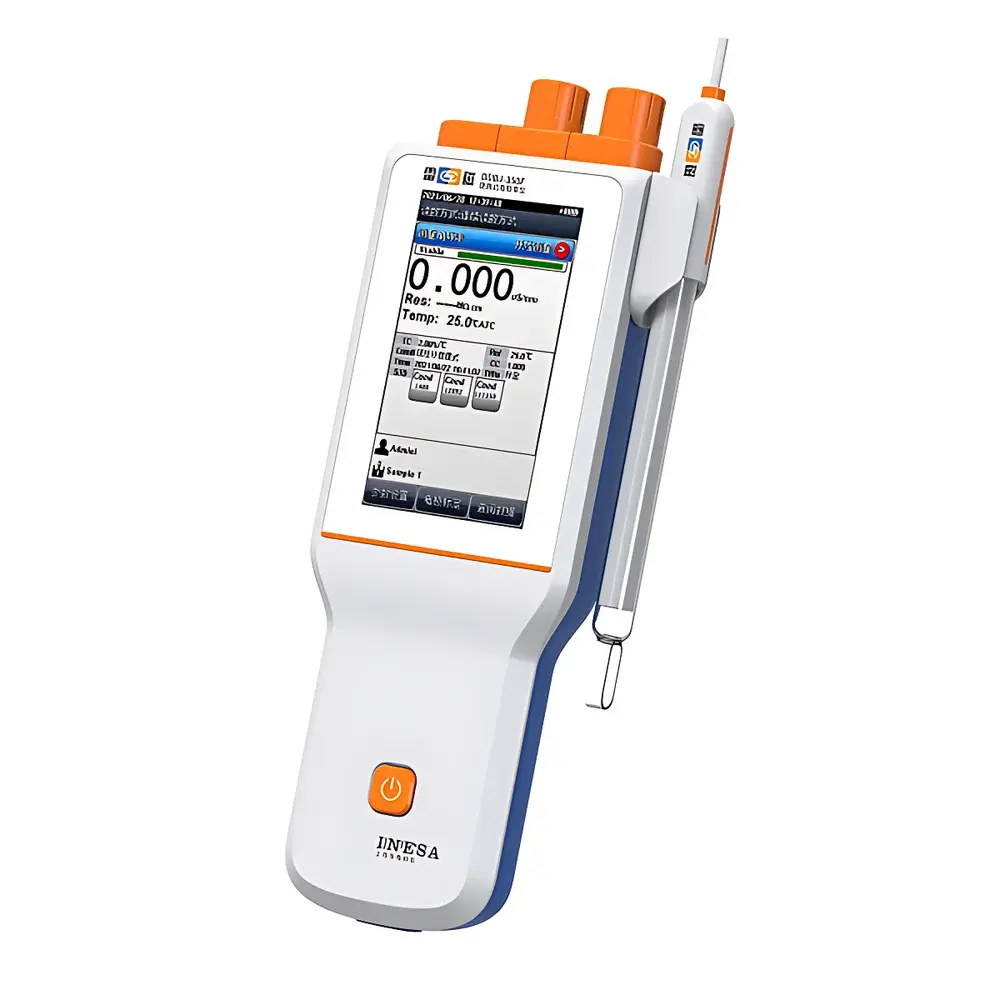
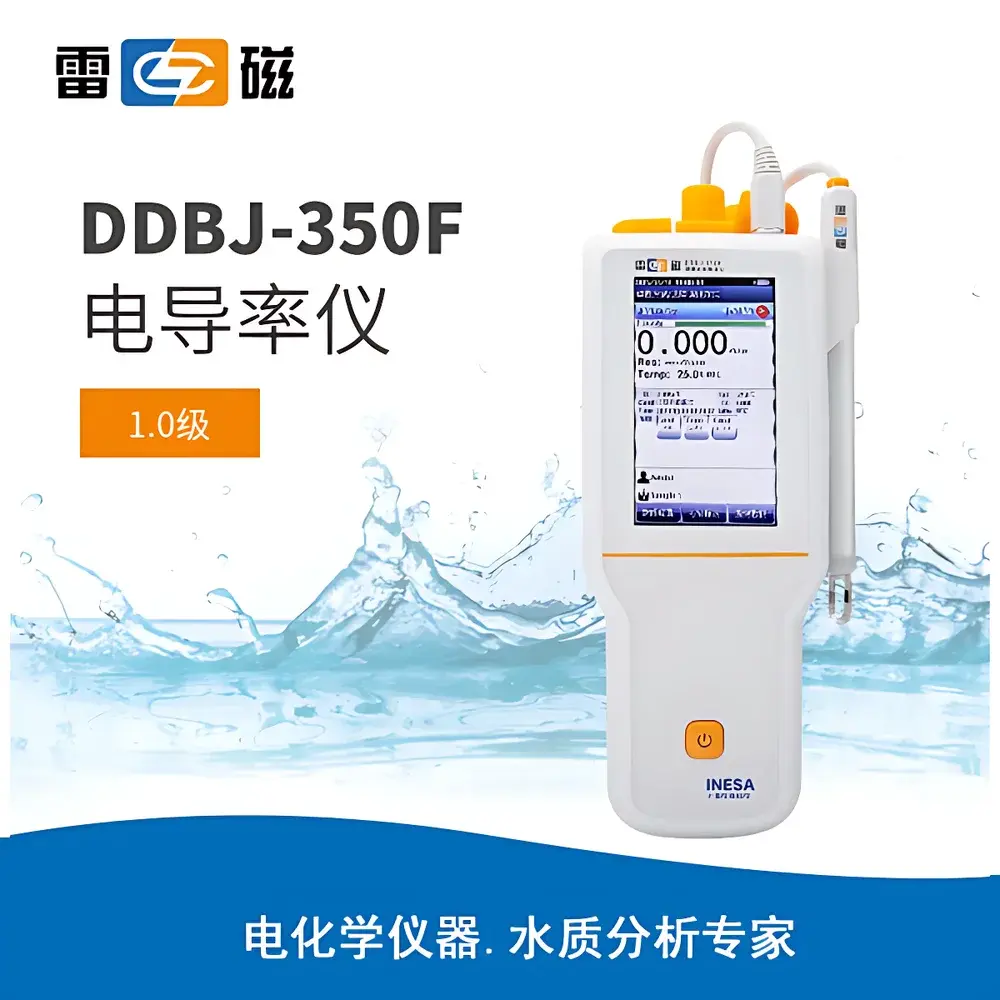
Leici DDBJ-350F Portable Conductivity Meter
| Brand | Leici |
|---|---|
| Origin | Shanghai, China |
| Manufacturer Type | Direct Manufacturer |
| Regional Origin | Domestic (China) |
| Model | DDBJ-350F |
| Price Range | USD 420–690 |
| Measured Parameters | Conductivity, Resistivity, TDS, Salinity, Temperature |
| Portability | Handheld & Field-Deployable |
| Intended Use | Laboratory, Field Sampling, Quality Control |
| Conductivity Range | 0.000 µS/cm to 1000 mS/cm |
| TDS Range | 0.000 mg/L to 300 g/L |
| Resistivity Range | 5.00 Ω·cm to 20.00 MΩ·cm |
| Salinity Range | 0.00–8.00% |
| Temperature Range | −5.0 to 110.0 °C (23.0–230.0 °F) |
| Accuracy | ±1.0% FS (Conductivity/Resistivity/TDS), ±0.2% FS (Salinity), ±0.2 °C (Temperature) |
| Minimum Resolution | 0.001 µS/cm (Conductivity), 0.01 Ω·cm (Resistivity), 0.001 mg/L (TDS), 0.01% (Salinity), 0.1 °C/°F (Temperature) |
| IP Rating | IP65 |
| Electrode Compatibility | Auto-recognizing K=0.1, K=1.0, and K=0.01 conductivity cells |
| Calibration | 1–3 point, auto-identification of GB standard solutions (1413 µS/cm, 12.88 mS/cm, etc.) |
| Compensation Modes | Non-compensated, Linear (α=2.0%/°C), Pure Water (non-linear), Manual/ATC |
| Data Storage | 1000 datasets with timestamp, temperature, and electrode ID |
| Connectivity | USB-B port (PC/LIMS), RS-232 (printer), GLP-compliant audit trail |
| Power | Rechargeable Li-ion battery (≥100 h typical operation), USB-C charging support |
Overview
The Leici DDBJ-350F Portable Conductivity Meter is a field- and lab-grade electrochemical analyzer engineered for high reproducibility in measuring aqueous solution conductivity, resistivity, total dissolved solids (TDS), salinity, and temperature. Based on the fundamental principle of two-electrode or four-electrode AC conductometric measurement—applying a low-frequency alternating current across an immersed conductivity cell and calculating conductance from the resulting voltage drop—the instrument delivers traceable, stable readings across six decades of conductivity (0.000 µS/cm to 1000 mS/cm). Its design adheres to ISO 7888 (water quality — determination of electrical conductivity) and aligns with ASTM D1125 and USP for pharmaceutical water testing. The DDBJ-350F is calibrated against certified Chinese national standard solutions (GB/T 601, GB/T 603), enabling direct comparability with regulatory reference methods. Its dual-range automatic frequency switching ensures optimal signal-to-noise ratio across low-conductivity ultrapure water and high-salinity brine samples—critical for applications ranging from boiler feedwater monitoring to coastal estuary profiling.
Key Features
- High-resolution 4.3-inch color TFT touchscreen with adjustable backlight and glove-friendly touch response
- IP65-rated enclosure for dust resistance and protection against low-pressure water jets—suitable for outdoor sampling, wastewater plants, and cleanroom peripheries
- Intelligent endpoint detection with configurable reading modes: auto-hold, timed interval (1–300 s), manual trigger, and continuous display
- Multi-mode temperature compensation: selectable reference temperatures (20 °C or 25 °C), linear (α = 2.0 %/°C), pure-water non-linear, or manual offset
- Auto-recognition of K=0.01, K=0.1, and K=1.0 conductivity cells; dynamic range optimization via automatic frequency selection (1 kHz / 10 kHz)
- Onboard diagnostics: power-on self-test, battery health indicator, low-voltage warning, and full factory reset capability
- Firmware-upgradable architecture supporting future parameter extensions (e.g., dissolved oxygen integration) and regional language packs
Sample Compatibility & Compliance
The DDBJ-350F accommodates diverse sample matrices—including drinking water, process streams, seawater, hydroponic nutrient solutions, and pharmaceutical purified water—without requiring hardware modification. Its K=1.0 cell (included) covers 20 µS/cm–1000 mS/cm; for ultrapure water (<20 µS/cm), optional K=0.1 or K=0.01 cells are recommended to minimize polarization error and improve resolution at sub-µS/cm levels. All measurements comply with Good Laboratory Practice (GLP) requirements: each stored record includes date/time stamp, operator ID (user-definable), electrode serial number, calibration history, temperature, and raw conductance value. Audit trails are exportable in CSV format and support 21 CFR Part 11–compatible electronic signatures when integrated with validated LIMS platforms via USB or RS-232.
Software & Data Management
- Internal memory stores up to 1000 complete measurement sets with metadata (temperature, unit, compensation mode, electrode constant)
- Data review options: chronological list view, trend graphing (conductivity vs. time), and statistical summary (mean, SD, min/max)
- USB-B interface enables direct connection to Windows PCs using Leici’s proprietary PC Link software—supporting batch export, report generation (PDF/Excel), and firmware updates
- RS-232 output compatible with Epson-compatible thermal printers; customizable print templates include header fields, units, and GLP headers
- Native LIMS integration via ASCII protocol over USB virtual COM port—enabling automated data ingestion into LabVantage, Thermo Fisher SampleManager, or custom middleware
Applications
The DDBJ-350F serves as a primary verification tool in environmental monitoring (EPA Method 120.1), food & beverage QC (ISO 21804), semiconductor ultrapure water validation (SEMI F63), and academic teaching labs. It is routinely deployed for: routine calibration checks of online conductivity sensors; spot-checking reverse osmosis permeate quality; verifying conductivity specifications of cleaning agents in GMP facilities; mapping salinity gradients in aquaculture ponds; and validating sterilization cycle efficacy through post-rinse water conductivity. Its portability and battery endurance (>100 hours) make it ideal for unattended field campaigns—paired with GPS-enabled tablets for geotagged sampling logs.
FAQ
What electrode constants are supported, and how does auto-recognition work?
It supports K=0.01, K=0.1, and K=1.0 cells via embedded resistor coding. The meter reads the cell’s identification resistor upon insertion and configures measurement parameters accordingly—including excitation frequency and gain settings.
Does the instrument meet international calibration traceability requirements?
Yes. When calibrated using NIST-traceable or GB-certified standard solutions (e.g., 1413 µS/cm KCl), measurement uncertainty is documented per ISO/IEC 17025 guidelines. Calibration certificates can be generated within the PC Link software.
Can the device operate continuously while charging?
Yes. It functions normally during USB-C charging—enabling uninterrupted long-term monitoring in fixed installations or mobile carts.
Is temperature compensation mandatory, or can raw conductance be recorded?
Both modes are available. Users may disable compensation to log uncorrected conductance (G, in µS), enabling custom post-processing with site-specific α values or non-linear models.
How is data integrity ensured during transfer to LIMS?
Each exported dataset includes CRC-16 checksums and timestamped digital signatures. The USB communication layer implements retry-on-failure logic and packet-level acknowledgment—minimizing transmission errors in noisy industrial environments.






