
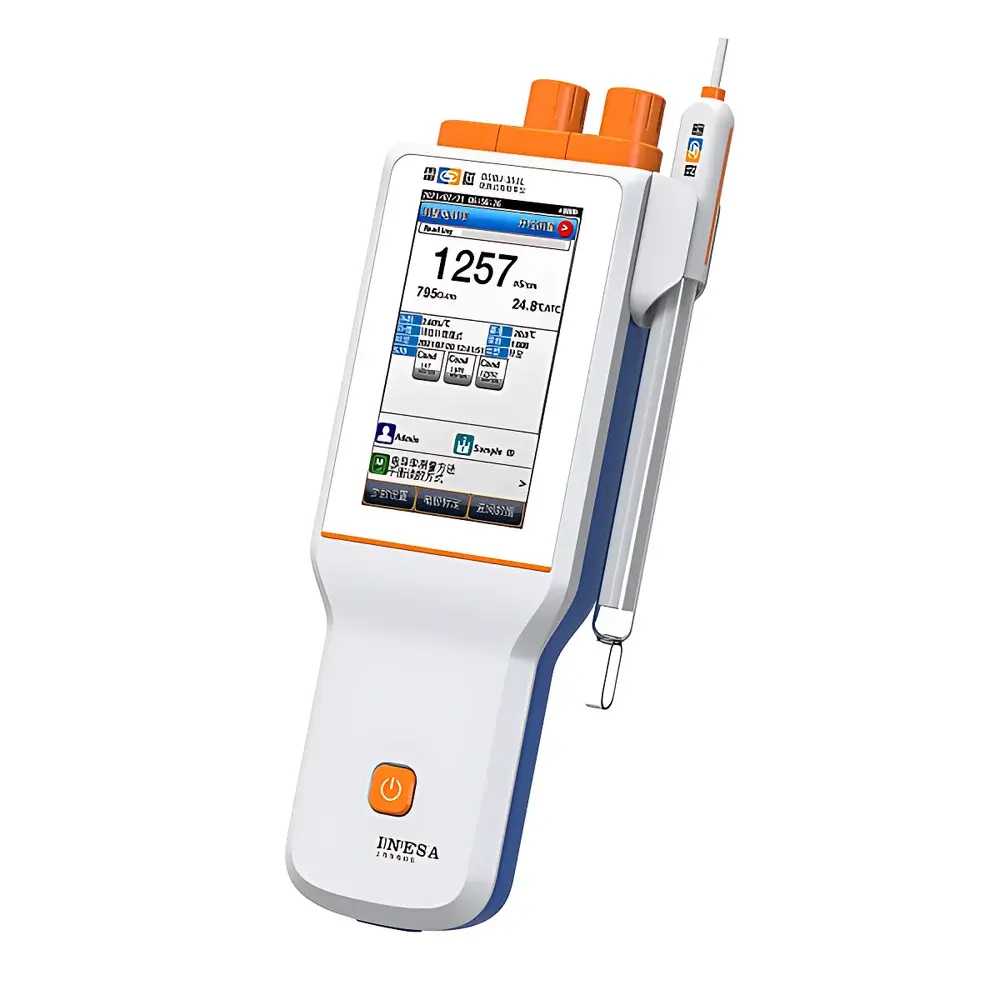
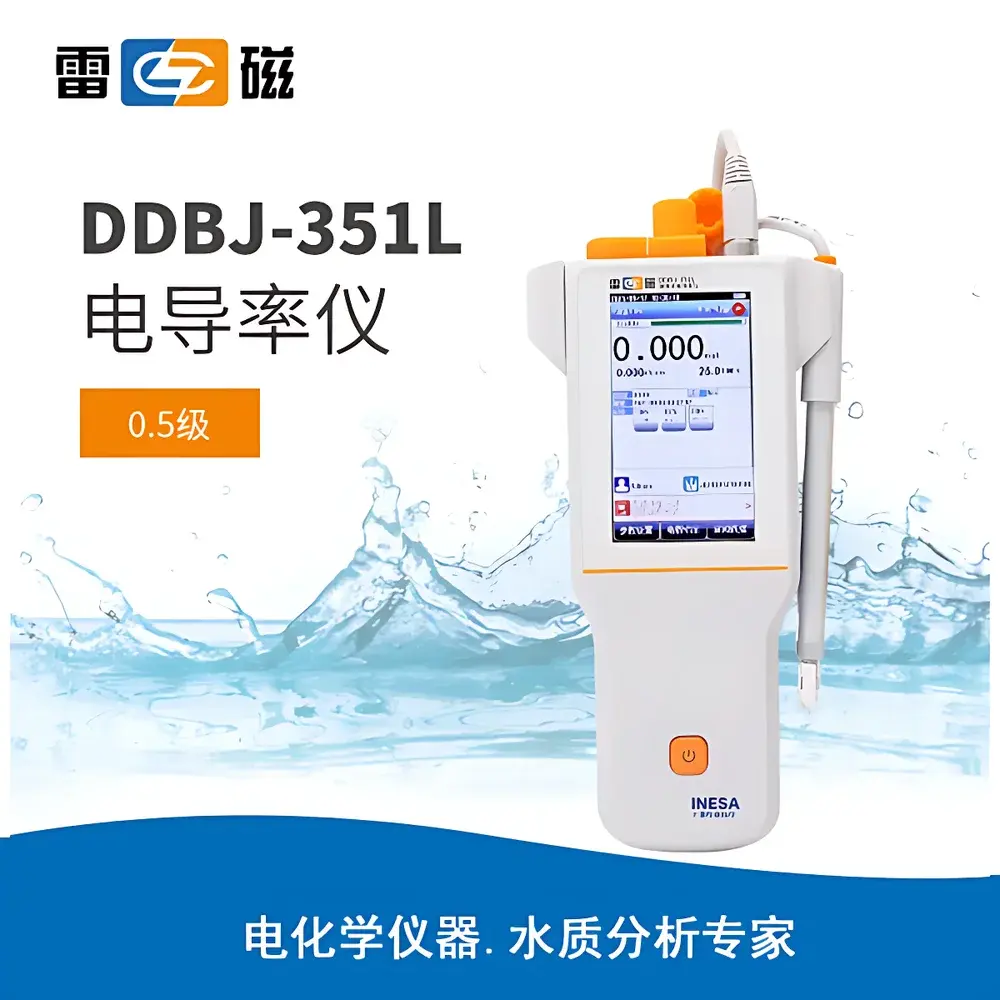
Leici DDBJ-351L Portable Conductivity Meter
| Brand | Leici |
|---|---|
| Origin | Shanghai, China |
| Manufacturer Type | Direct Manufacturer |
| Product Origin | Domestic (China) |
| Model | DDBJ-351L |
| Detection Parameters | Conductivity, Resistivity, TDS, Salinity, Ash Content, Temperature |
| Portability | Portable |
| Intended Use | Laboratory & Field |
| Conductivity Range | 0.000 μS/cm to 3000 mS/cm |
| TDS Range | 0.000 mg/L to 1000 g/L |
| Resistivity Range | 5.00 Ω·cm to 100.0 MΩ·cm |
| Salinity Range | 0.00–8.00% |
| Temperature Range | −10.0–135.0 °C / 14.0–275.0 °F |
| Accuracy | ±0.5% FS (Conductivity/Resistivity/TDS), ±0.1% FS (Salinity), ±0.1 °C (Temperature) |
| Minimum Resolution | 0.001 μS/cm (Conductivity), 0.01 Ω·cm (Resistivity), 0.001 mg/L (TDS), 0.01% (Salinity), 0.1 °C/°F (Temperature) |
| IP Rating | IP65 |
| Electrode Compensation | Automatic temperature compensation (ATC) with selectable reference temperatures (5.0, 10.0, 15.0, 18.0, 20.0, 25.0 °C) |
| Calibration | 1–5-point conductivity calibration |
| Data Storage | 1000 datasets per parameter group |
| Connectivity | USB, Bluetooth 5.0, U-disk support, barcode scanner interface |
| Power | Rechargeable Li-ion battery (DC5V input compatible with universal AC adapters) |
| Dimensions & Weight | 90 × 255 × 40 mm, 0.5 kg |
Overview
The Leici DDBJ-351L Portable Conductivity Meter is an engineered electrochemical instrument designed for high-precision, multi-parameter measurement of aqueous solutions in both laboratory and field environments. Based on the fundamental principle of conductometric analysis—measuring the electrical conductance of a solution via a two-electrode or four-electrode cell—the DDBJ-351L delivers traceable, reproducible results across six interrelated parameters: conductivity, resistivity, total dissolved solids (TDS), salinity, ash content (per standardized sugar and HFCS methods), and temperature. Its architecture integrates dual-mode sensor excitation (auto-frequency switching) to ensure optimal signal-to-noise ratio across the full 0.000 μS/cm–3000 mS/cm dynamic range, eliminating manual electrode constant selection during routine operation. The instrument conforms to national metrological verification regulation JJG 376–2007 and supports compliance with international quality frameworks including ISO/IEC 17025, ASTM D1125, and USP , enabling validated use in regulated QC laboratories.
Key Features
- High-resolution 4.3-inch color TFT touchscreen with intuitive icon-based navigation and dual-language UI (English/Chinese)
- IP65-rated enclosure for dust-tight and water-jet resistant operation—suitable for humid labs, cleanrooms, and outdoor sampling sites
- Intelligent electrode management system: automatic recognition of cell constants (0.01, 0.1, 1.0 cm⁻¹), real-time diagnostics, and calibration status logging
- Multi-mode temperature compensation: user-selectable reference temperatures (5.0–25.0 °C) and algorithm options (linear, non-compensated, pure-water mode per ISO 7888)
- GLP-compliant data integrity: timestamped records with operator ID, electrode serial number, calibration history, and environmental metadata
- Expandable firmware architecture supporting method templates (e.g., GB/T 10498 for white sugar ash, GB/T 20885 for HFCS ash), user-defined units, and audit-trail-enabled permissions
- Integrated rechargeable Li-ion battery (≥12 h typical runtime) with USB-C charging, state-of-charge display, and seamless hot-swap capability via external power banks
Sample Compatibility & Compliance
The DDBJ-351L accommodates a broad spectrum of sample matrices—from ultrapure water (≥18.2 MΩ·cm) and pharmaceutical buffers to industrial brines and wastewater effluents—without hardware modification. Its auto-ranging circuitry dynamically adjusts excitation frequency (10 Hz–1 MHz) and gain to maintain measurement stability under varying ionic strength and polarization conditions. For low-conductivity samples (<20 μS/cm), optional 0.1 cm⁻¹ or 0.01 cm⁻¹ electrodes are recommended to minimize capacitive error. The meter meets IEC 61010-1 safety standards and complies with electromagnetic compatibility requirements per EN 61326-1. All calibration and measurement procedures align with traceable reference materials certified to ISO Guide 34 and NIST SRM equivalents.
Software & Data Management
- On-device storage of up to 1000 complete measurement records per parameter group, each containing raw readings, compensated values, metadata, and calibration logs
- Graphical data review: time-series plots, trend overlays, and statistical summaries (mean, SD, CV%, min/max) directly on the instrument display
- USB and Bluetooth 5.0 interfaces enable secure bidirectional communication with PCs running Leici LabLink Pro software—supporting CSV export, PDF report generation, and LIMS integration via HL7 or ASTM E1384 protocols
- U-disk file transfer and barcode scanner compatibility streamline batch identification and SOP-driven workflows
- Firmware updates delivered via encrypted OTA packages; version-controlled revision history maintained in internal flash memory
Applications
The DDBJ-351L serves critical roles across multiple sectors: monitoring conductivity drift in purified water systems (PW, WFI) per EU GMP Annex 1 and FDA guidance; verifying TDS compliance in drinking water per WHO Guidelines and EPA Method 120.1; quantifying salinity in aquaculture and desalination plant intake/outflow; performing ash content analysis in food-grade syrups and refined sugars per GB/T standards; and conducting field-based resistivity surveys for geological and environmental assessment. Its portability and ruggedized design make it suitable for ISO 17025-accredited mobile labs, contract testing organizations, and university teaching laboratories requiring metrologically sound, educationally transparent instrumentation.
FAQ
What electrode constants are supported, and how does auto-frequency switching improve accuracy?
The DDBJ-351L natively supports 0.01, 0.1, and 1.0 cm⁻¹ electrodes. Auto-frequency switching selects optimal excitation frequency based on measured conductance to suppress electrode polarization and stray capacitance—critical for accurate low-μS/cm and high-mS/cm measurements.
Does the instrument meet FDA 21 CFR Part 11 requirements for electronic records?
While the DDBJ-351L itself is not Part 11-certified as a standalone system, its audit-trail-capable data structure—including immutable timestamps, user authentication, and calibration event logging—provides foundational elements required for validation within a compliant IT environment when paired with Leici LabLink Pro software.
Can the device be used for ultra-pure water resistivity measurement?
Yes. With a dedicated 0.01 cm⁻¹ cell and proper guarding techniques, the instrument achieves reliable measurement down to 5.00 Ω·cm and up to 100.0 MΩ·cm—covering the full specification range for Type I ultrapure water per ISO 3696 and ASTM D1193.
Is third-party calibration certificate available?
Factory calibration certificates (traceable to CNAS-accredited labs) are provided with each unit. Optional UKAS-accredited calibration services are available through Leici’s authorized service centers upon request.
How is data security enforced across user levels?
Three-tier password-protected access (Operator, Supervisor, Administrator) governs functions including method editing, calibration execution, data deletion, and system configuration—enabling role-based accountability per GLP and ISO/IEC 17025 clause 5.9.




