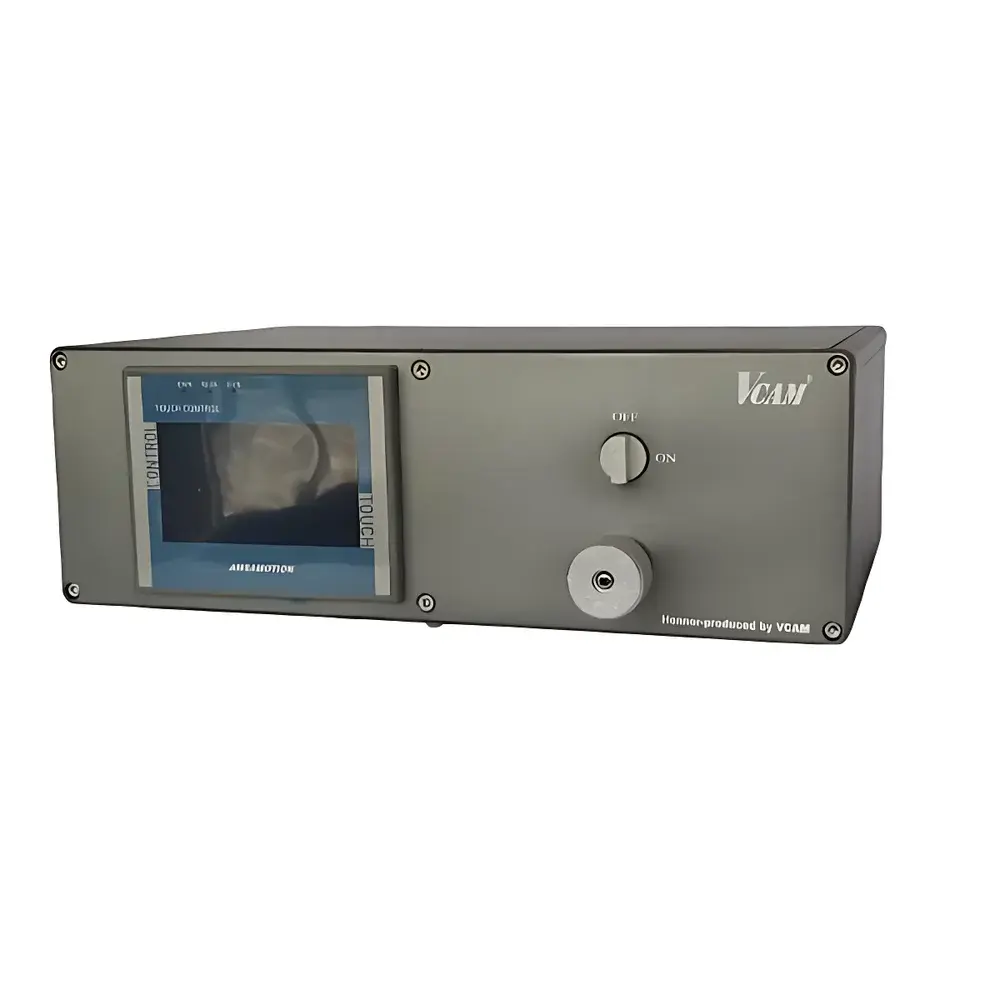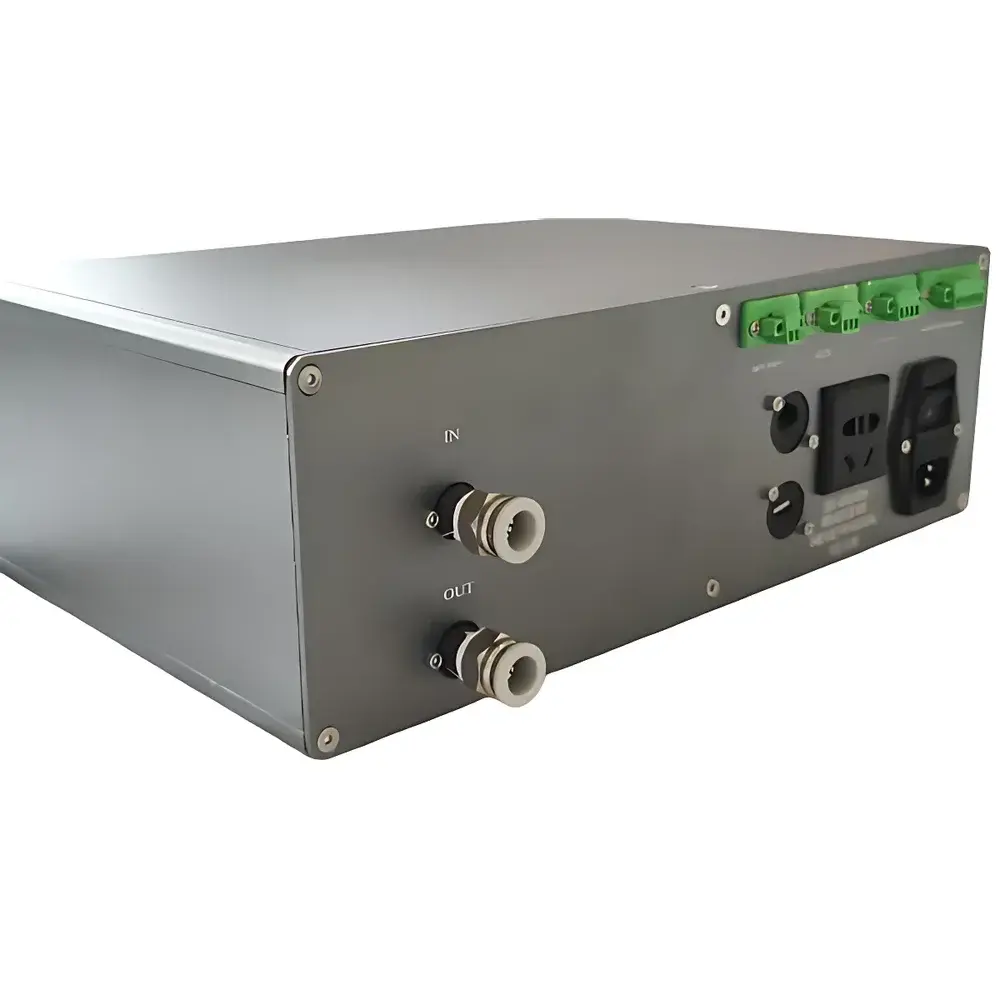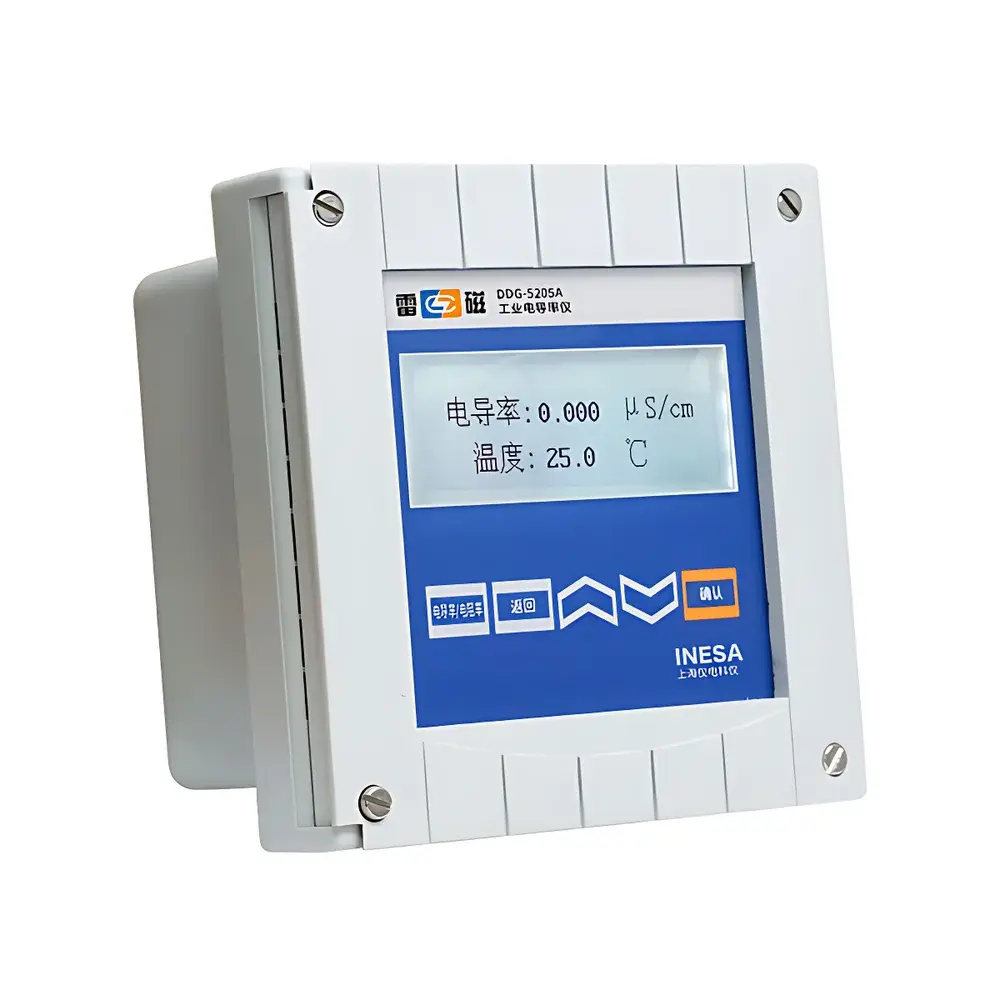
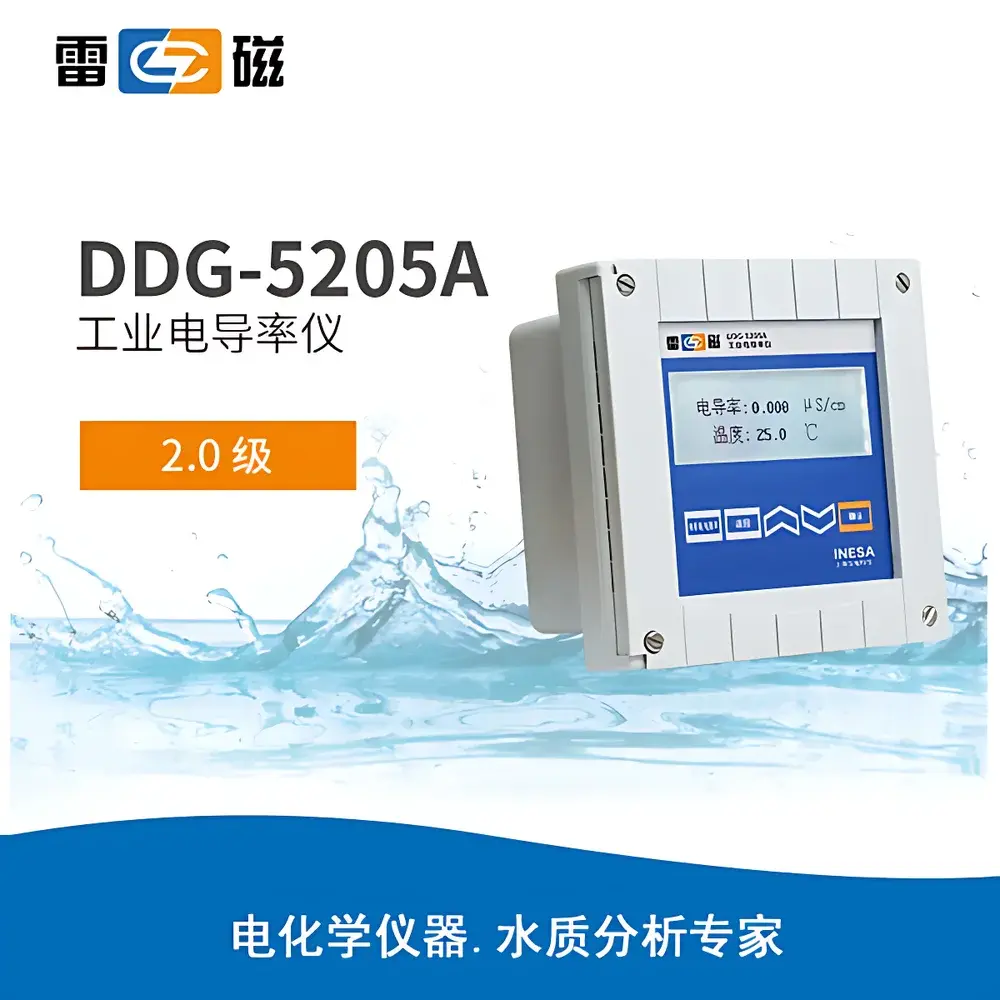
Leici DDG-5205A Online Conductivity Analyzer
| Brand | Leici |
|---|---|
| Origin | Shanghai, China |
| Manufacturer Type | Original Equipment Manufacturer (OEM) |
| Product Category | Domestic Industrial Instrument |
| Model | DDG-5205A |
| Price Range | USD 850–1,420 (FOB Shanghai) |
| Conductivity Range | 0.000 µS/cm to 10.0 mS/cm (dependent on cell constant: K=0.01 cm⁻¹: 0–20 µS/cm |
| K=0.1 cm⁻¹ | 1–200 µS/cm |
| K=1.0 cm⁻¹ | 10–10,000 µS/cm) |
| Temperature Range | −10.0 to 120.0 °C |
| Temperature Compensation Range | 5.0 to 60.0 °C (reference temp: 25.0 °C) |
| Conductivity Resolution | 0.001 / 0.01 / 0.1 / 1 µS/cm (auto-ranging) |
| Temperature Resolution | 0.1 °C |
| Basic Error | ±2.0% FS (conductivity), ±0.5 °C (0.0–60.0 °C), ±1.0 °C (outside range) |
| Repeatability | 1.0% FS |
| Electronic Unit Accuracy | ±1.0% FS (conductivity), ±0.3 °C (temperature) |
| Drift Stability | ±0.5% FS/24 h |
| Enclosure Rating | IP65 |
| Power Supply | AC 220 V ±10%, 50 Hz ±1% or DC 24 V ±15% |
| Dimensions | 166 × 166 × 110 mm |
| Weight | ~2.0 kg |
| Data Storage | 400 records with configurable logging interval |
| Output | Isolated 4–20 mA DC (user-defined upper/lower limits) |
| Digital Interface | RS-232 or RS-485 (selectable) |
| Auto-Cleaning Support | Yes |
| Alarm Functions | Programmable high/low limit alerts with relay output |
| Power Failure Protection | Non-volatile memory retention |
Overview
The Leici DDG-5205A Online Conductivity Analyzer is an industrial-grade, microprocessor-controlled conductivity monitoring system engineered for continuous, real-time measurement of aqueous solution conductivity in demanding process environments. Based on the fundamental principle of two-electrode or four-electrode conductometric measurement—where electrical conductance is derived from the reciprocal of resistance across a known electrode geometry—the instrument delivers stable and traceable readings across a wide dynamic range (0.000 µS/cm to 10.0 mS/cm). Its design integrates temperature compensation per the internationally accepted linear or non-linear (e.g., ASTM D1125, ISO 7888) algorithms, referencing 25.0 °C as default, ensuring thermally corrected conductivity values suitable for regulatory reporting and process control loops. The analyzer is purpose-built for integration into water purification, steam cycle chemistry, desalination pre-treatment, and pharmaceutical water systems where compliance with USP , EP 2.2.38, and pharmacopeial conductivity specifications is required.
Key Features
- High-resolution graphical LCD display showing simultaneous conductivity and temperature values with intuitive navigation
- Embedded single-chip microcontroller enabling precise digital signal processing, auto-ranging, and adaptive temperature compensation
- Intelligent auto-switching between conductivity ranges based on measured value and selected cell constant (K = 0.01, 0.1, or 1.0 cm⁻¹)
- Configurable data logging: up to 400 timestamped records with programmable sampling intervals (1 min to 24 h)
- Dual alarm outputs supporting high/low limit triggers with latching or non-latching behavior; relay contacts rated for 250 VAC / 3 A
- Isolated 4–20 mA analog output with fully adjustable span mapping (e.g., 0–200 µS/cm → 4–20 mA), compliant with NAMUR NE43 fault signaling standards
- Choice of serial communication interface: RS-232 (point-to-point) or RS-485 (multi-drop, up to 32 nodes), supporting Modbus RTU protocol for SCADA/HMI integration
- IP65-rated enclosure constructed from UV-stabilized polycarbonate and stainless-steel fasteners, suitable for wall or pipe-mount installation in humid or washdown-prone areas
- Non-volatile memory preserving configuration, calibration history, and last-measured values during power interruption
- Optional automatic electrode cleaning module compatible with pneumatic or timed mechanical actuation
Sample Compatibility & Compliance
The DDG-5205A is validated for use with low-conductivity purified waters—including WFI (Water for Injection), PW (Purified Water), condensate, boiler feedwater, and reverse osmosis permeate—as well as higher-conductivity streams such as cooling tower blowdown and brackish intake water. It supports three interchangeable conductivity cells (2043-205B, 2043-405B, 2043-605B), each certified to ISO 17025-accredited calibration protocols and supplied with individual cell constant certificates. The analyzer meets electromagnetic compatibility requirements per IEC 61326-1 (industrial environment) and safety standards per IEC 61010-1. Its firmware architecture supports audit trail functionality for GLP/GMP environments when paired with compatible host software, and it can be configured to comply with FDA 21 CFR Part 11 requirements for electronic records and signatures via external validation documentation.
Software & Data Management
Data retrieval and configuration are performed via the optional Leici PC-based configuration utility (Windows 10/11 compatible), which enables full parameter setup, calibration curve editing, alarm threshold definition, and export of logged datasets in CSV or Excel format. All calibration events—including date, operator ID (manual entry), standard used (e.g., KCl 0.01 mol/L), and deviation from reference—are stored locally with time stamps. The RS-485 interface allows integration into distributed control systems (DCS) or supervisory control and data acquisition (SCADA) platforms using standard Modbus register maps. For long-term trend analysis, historical data may be ingested into LIMS or MES systems via OPC UA gateways when deployed with third-party middleware.
Applications
- Continuous monitoring of deionized water resistivity in semiconductor ultrapure water (UPW) distribution loops
- Steam condensate purity verification in thermal power plants and cogeneration facilities
- Real-time tracking of membrane integrity in RO and EDI systems
- Conductivity profiling in pharmaceutical water-for-injection (WFI) generation and storage loops per USP
- Salinity control in seawater desalination pre-treatment and post-treatment stages
- Process water quality assurance in food & beverage production lines subject to HACCP and BRCGS standards
- Environmental effluent discharge compliance monitoring per local regulatory thresholds (e.g., EPA 120.1)
FAQ
What cell constants are supported, and how do they affect measurement accuracy?
The DDG-5205A accepts three standardized conductivity cells: K = 0.01 cm⁻¹ (for ultra-pure water), K = 0.1 cm⁻¹ (for low-conductivity process water), and K = 1.0 cm⁻¹ (for municipal or industrial wastewater). Selection must match the expected conductivity range to optimize signal-to-noise ratio and minimize polarization error.
Does the instrument support linear and non-linear temperature compensation?
Yes—users may select between linear (default) and polynomial-based compensation modes, with coefficients aligned to ASTM D1125 Annex A1 for natural waters or custom user-defined curves.
Can the 4–20 mA output be scaled to represent temperature instead of conductivity?
No—the analog output is dedicated exclusively to conductivity; temperature is available only via digital interface or display.
Is calibration traceable to NIST or other national metrology institutes?
Calibration solutions used with the DDG-5205A are certified to ISO/IEC 17025 by accredited providers; the instrument itself does not carry inherent NIST traceability but supports documentation of calibration chain per ISO 9001 Clause 7.1.5.
What is the maximum cable length for RS-485 communication?
Up to 1,200 meters at 9.6 kbps, assuming twisted-pair shielded cable (AWG 24) with proper termination and grounding per TIA/EIA-485-A.