
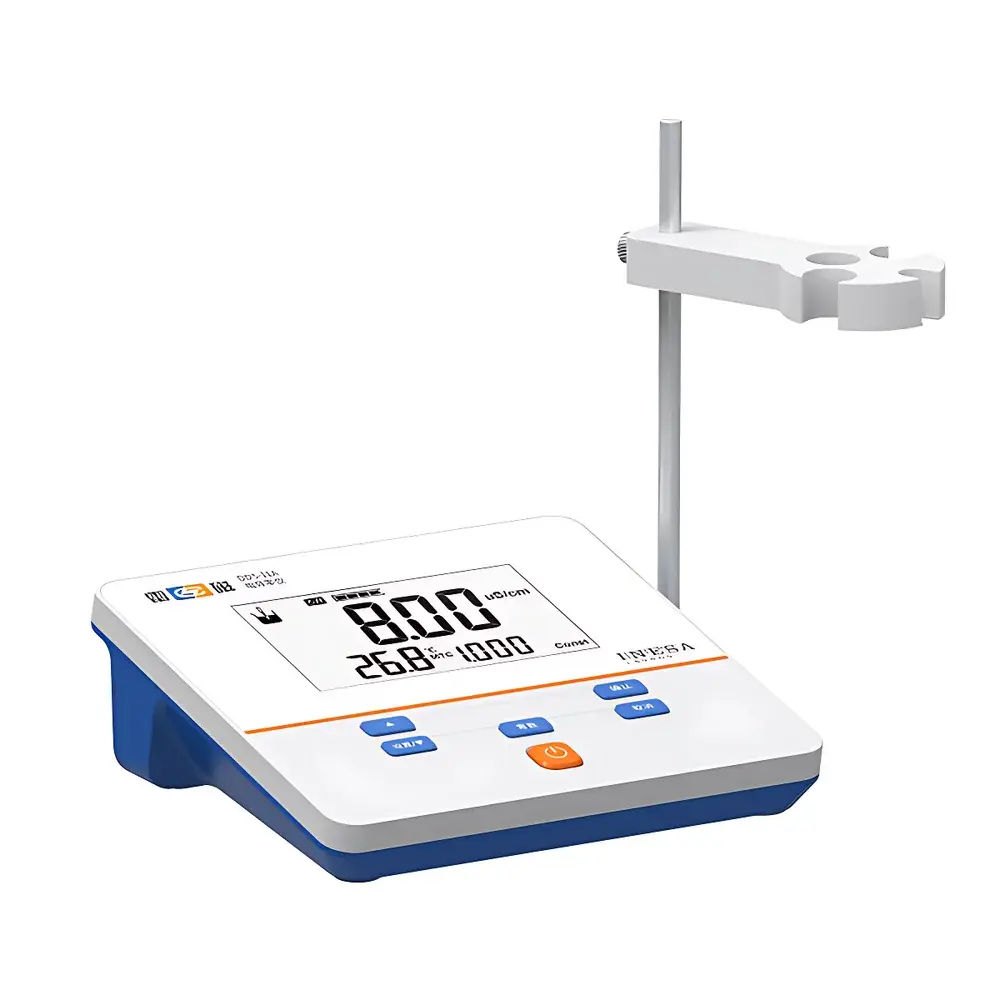
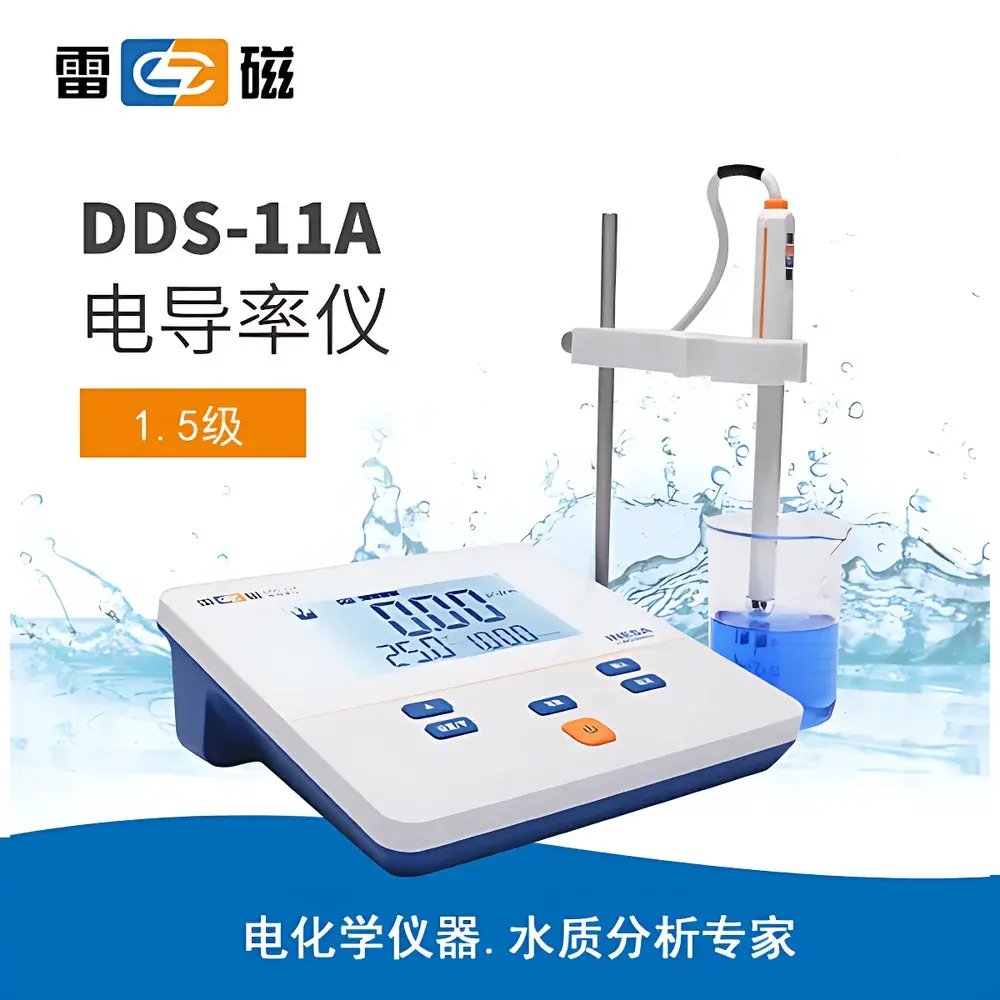
Leici DDS-11A Benchtop Conductivity Meter
| Brand | Leici |
|---|---|
| Origin | Shanghai, China |
| Manufacturer Type | Original Equipment Manufacturer (OEM) |
| Product Origin | Domestic (China) |
| Model | DDS-11A |
| Detection Parameter | Single-parameter (Conductivity) |
| Form Factor | Benchtop |
| Intended Use | Laboratory |
| Conductivity Measurement Range | 0.00 μS/cm to 100.0 mS/cm |
| Accuracy | ±1.5% of Full Scale (F.S.) |
| Minimum Resolution | 0.01 μS/cm (auto-ranging with scale-dependent resolution switching) |
| Temperature Compensation | Manual |
| Electrode Constant Input | Direct entry supported |
| Frequency Auto-switching | Yes (enables full-range coverage with K = 1.0 cell) |
| Display | High-contrast LCD with stability indicator |
| Protection Rating | IP54 |
| Power Supply | AC/DC adapter (Input: 100–240 VAC, Output: 20 VDC / 1500 mA) |
| Dimensions (L×W×H) | 200 × 160 × 63 mm |
| Weight | 0.6 kg |
Overview
The Leici DDS-11A Benchtop Conductivity Meter is a precision-engineered electrochemical instrument designed for reliable, repeatable measurement of electrical conductivity in aqueous solutions across academic laboratories, quality control environments, and routine water analysis applications. Based on the fundamental principle of conductometric measurement—applying an alternating current (AC) voltage across a pair of platinum electrodes immersed in solution and quantifying the resulting current to determine solution conductance—the DDS-11A delivers stable, drift-resistant readings under controlled benchtop conditions. Its dual-range architecture supports seamless transition from ultra-low-conductivity ultrapure water (0.00 μS/cm) to high-salinity industrial effluents (up to 100.0 mS/cm), making it suitable for calibration verification, environmental monitoring, boiler feedwater testing, and basic electrolyte characterization. The instrument complies with national metrological verification regulations for Class 1.5 conductivity meters (JJG 376–2007), ensuring traceable performance within specified uncertainty limits.
Key Features
- Benchtop form factor with compact footprint (200 × 160 × 63 mm) and lightweight design (0.6 kg), optimized for space-constrained laboratory benches.
- High-contrast monochrome LCD display with real-time stability indicator—flashing icon confirms signal convergence before data capture.
- Auto-ranging conductivity measurement with dynamic resolution scaling: minimum detectable increment is 0.01 μS/cm at low ranges, automatically adjusting per selected decade to maintain optimal signal-to-noise ratio.
- Manual temperature compensation (MTC) with user-defined coefficient (β) input, enabling correction to 25 °C reference using standard linear or fixed-coefficient models per ISO 7888 and ASTM D1125.
- Integrated electrode constant (K-cell) entry function—supports direct numeric input for cells with certified constants ranging from 0.01 to 10.0 cm⁻¹, eliminating reliance on factory presets.
- Automatic frequency switching (1 kHz / 10 kHz) ensures optimal excitation for varying solution resistivities, minimizing polarization error and enabling accurate measurement across the full 0.00 μS/cm–100.0 mS/cm span using only a single K = 1.0 cm⁻¹ sensor.
- IP54-rated enclosure provides protection against dust ingress and water splashes, supporting operation in non-hazardous general laboratory environments.
- Power management suite includes auto-shutdown after 10 minutes of inactivity, power-loss memory retention, and one-button factory reset for configuration recovery.
Sample Compatibility & Compliance
The DDS-11A is validated for use with standard two-electrode conductivity cells (e.g., Leici DJS-1C, DJS-10C) conforming to IEC 60746-3:2020 requirements for electrochemical sensors. It supports aqueous samples only—including deionized water, tap water, wastewater, buffer solutions, and mild electrolyte solutions (pH 2–12, non-corrosive, non-viscous). It is not intended for organic solvents, high-viscosity fluids, or strongly oxidizing/reducing media. The instrument meets GB/T 2829–2002 sampling inspection standards for electronic measuring instruments and adheres to electromagnetic compatibility (EMC) requirements per GB/T 18268.1–2010 (IEC 61326-1:2012). While not 21 CFR Part 11–compliant out-of-the-box, its manual operation mode supports GLP-aligned documentation when paired with lab notebook protocols and calibrated reference standards.
Software & Data Management
The DDS-11A operates as a standalone instrument without embedded data logging or PC connectivity. All measurements are displayed in real time and must be manually recorded. No proprietary software, drivers, or cloud interface is provided. This architecture prioritizes operational simplicity, regulatory transparency, and long-term serviceability—eliminating firmware update dependencies or cybersecurity exposure vectors common in networked instruments. For laboratories requiring audit trails, users are advised to integrate the meter into documented SOPs that specify electrode calibration frequency (minimum daily), standard verification (using certified KCl solutions at 1413 μS/cm and 12.88 mS/cm), and environmental monitoring (ambient temperature logged alongside each reading).
Applications
- Routine conductivity verification of purified water systems (PW, WFI pre-testing) in pharmaceutical pilot labs.
- Environmental field-lab analysis of surface water, groundwater, and wastewater effluent per EPA Method 120.1 and ISO 7888.
- Quality assurance of cleaning agents, rinse waters, and process coolants in electronics manufacturing.
- Teaching laboratories for undergraduate electrochemistry experiments—demonstrating Kohlrausch’s law, ion mobility, and temperature dependence of conductivity.
- Calibration support for online conductivity transmitters via grab-sample cross-validation.
FAQ
Does the DDS-11A support automatic temperature compensation (ATC)?
No—it provides manual temperature compensation only. Users must measure sample temperature separately and enter the value to apply linear correction.
Can the instrument store calibration data between power cycles?
Yes—calibration parameters and electrode constant settings are retained in non-volatile memory during power interruption or shutdown.
Is a conductivity standard solution included with purchase?
No—standard solutions (e.g., 1413 μS/cm KCl) must be sourced separately and certified per NIST SRM or equivalent national metrology institute traceability.
What is the recommended calibration frequency?
Daily calibration is recommended for critical applications; weekly calibration is acceptable for stable, low-risk routine checks—always preceded by electrode cleaning and rinsing with deionized water.
Can the DDS-11A measure total dissolved solids (TDS)?
No—it reports conductivity only. TDS estimation requires external conversion using a user-defined factor (typically 0.5–0.7 for natural waters), which is not implemented in the instrument firmware.





