
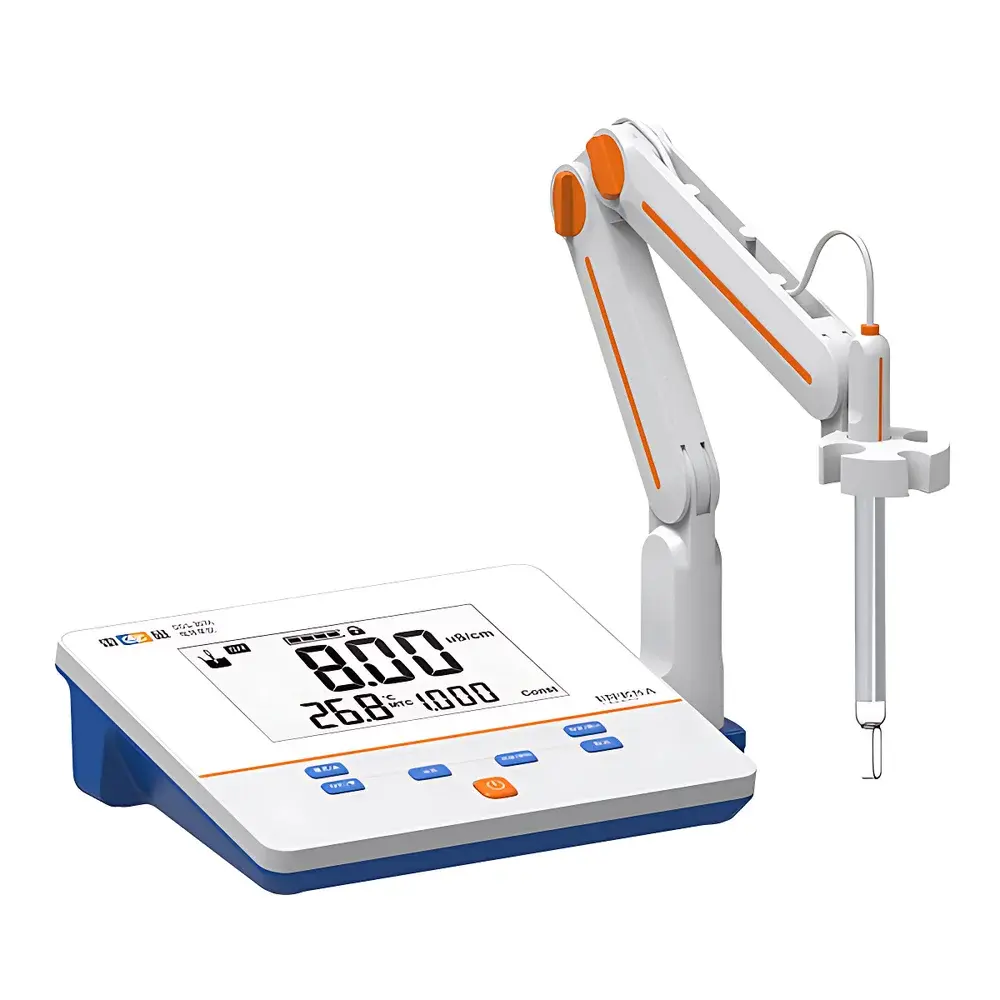
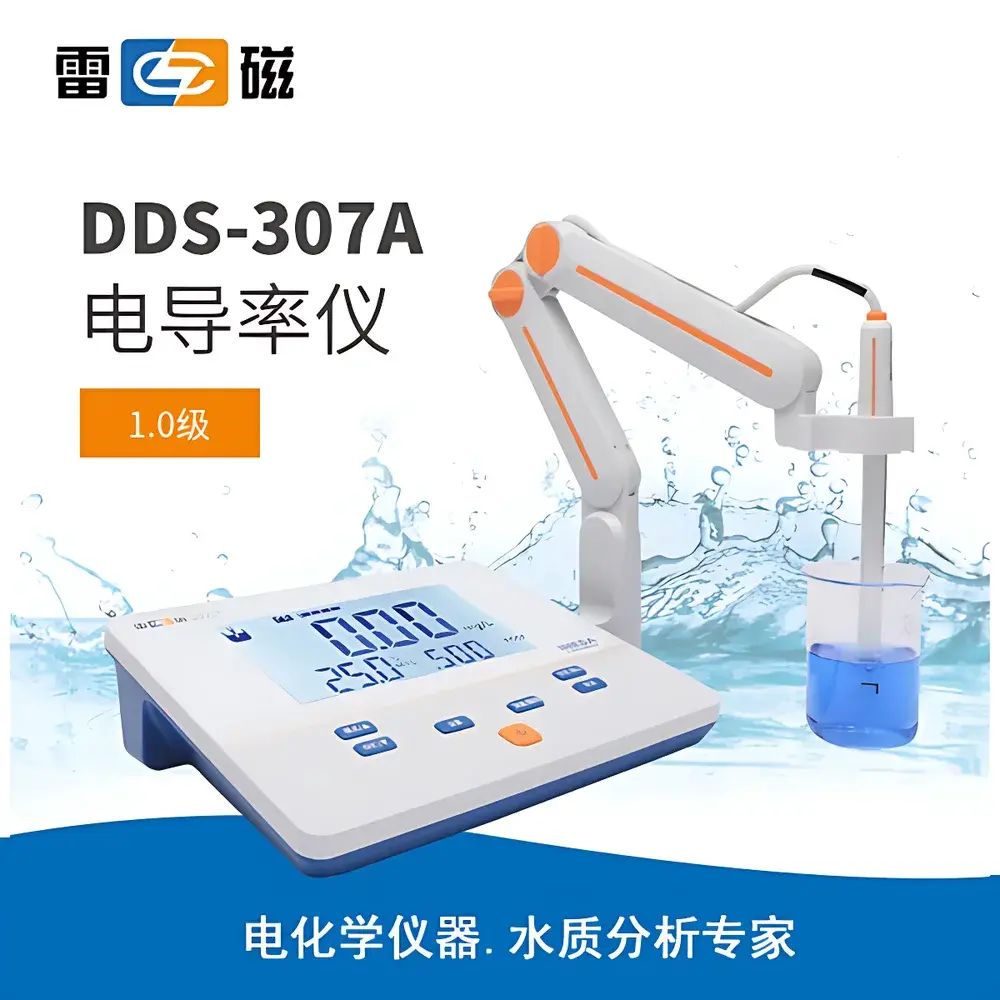
Leici DDS-307A Benchtop Conductivity Meter
| Brand | Leici |
|---|---|
| Origin | Shanghai, China |
| Manufacturer Type | Original Equipment Manufacturer (OEM) |
| Product Category | Domestic |
| Model | DDS-307A |
| Price Range | USD 280–420 (FOB) |
| Measurement Parameters | Conductivity, TDS, Temperature |
| Form Factor | Benchtop |
| Intended Use | Laboratory |
| Conductivity Range | 0.00 µS/cm to 200.0 mS/cm |
| TDS Range | 0.00 mg/L to 100.0 g/L |
| Temperature Range | −5.0 °C to 110.0 °C |
| Accuracy | ±1.0% FS |
| Minimum Conductivity Resolution | 0.01 µS/cm (auto-ranging) |
| TDS Resolution | 0.01 mg/L (auto-ranging) |
| Temperature Resolution | 0.1 °C |
| Temperature Accuracy | ±0.2 °C |
| Power Supply | AC 100–240 V input / DC 20 V, 1.5 A output |
| Dimensions | 242 × 195 × 68 mm |
| Weight | 0.9 kg |
| IP Rating | IP54 |
| Conductivity Class | Class 1.0 per GB/T 11018–2021 |
| Calibration | Single-point conductivity calibration with auto-recognition of four standard GB solutions (e.g., 1413 µS/cm, 12.88 mS/cm, etc.) |
| Measurement Modes | Auto-endpoint detection, continuous mode, equilibrium mode |
| Compensation | Automatic and manual temperature compensation (ATC/MTT) |
| Frequency Switching | Auto-frequency selection for optimal cell constant matching (1.0 cm⁻¹ electrode supported) |
| Data Storage | 50 measurement records with timestamp, parameter set, and temperature stamp |
| Compliance | Meets GB/T 11018–2021, JJG 376–2007, and general laboratory instrument requirements for GLP environments |
Overview
The Leici DDS-307A Benchtop Conductivity Meter is a precision-engineered electrochemical analyzer designed for routine and quality-critical conductivity, total dissolved solids (TDS), and temperature measurements in regulated laboratory environments. Based on the principle of two-electrode AC conductometric measurement at selectable frequencies (typically 1 kHz or 10 kHz), the instrument determines solution conductivity by applying a low-amplitude alternating current across a standardized cell and measuring the resulting voltage drop. Conductivity values are automatically converted to TDS using user-selectable conversion factors (default: 0.50–0.70, configurable), and all readings are referenced to 25 °C via built-in temperature compensation algorithms compliant with ISO 7888 and ASTM D1125. Its Class 1.0 accuracy rating—defined under GB/T 11018–2021—ensures traceable performance suitable for QC/QA workflows in water treatment, pharmaceutical excipient testing, academic research, and food & beverage process validation.
Key Features
- Benchtop form factor with compact footprint (242 × 195 × 68 mm) and lightweight design (0.9 kg) for space-constrained lab benches
- High-contrast LCD display with backlight and intuitive membrane keypad navigation
- IP54-rated enclosure providing protection against dust ingress and water splashes during daily operation
- Auto-endpoint detection algorithm that identifies measurement stability per IUPAC-recommended criteria, reducing operator dependency
- Intelligent electrode recognition and auto-frequency switching to maintain optimal signal-to-noise ratio across the full 0.00 µS/cm–200.0 mS/cm range when used with a standard 1.0 cm⁻¹ cell
- Dual-compensation support: automatic temperature compensation (ATC) using integrated Pt1000 sensor, plus manual temperature override (MTT) for method-specific protocols
- Factory-programmed recognition of four Chinese national conductivity standards (GB solutions), enabling rapid single-point calibration without manual entry
- Configurable data logging: stores up to 50 complete measurement sets—including conductivity, TDS, temperature, date/time stamp, and calibration status—for audit-ready traceability
Sample Compatibility & Compliance
The DDS-307A is validated for aqueous samples within pH 2–12 and non-corrosive ionic matrices. It accommodates standard DIN/ISO-compatible 1.0 cm⁻¹ two-electrode conductivity cells (e.g., Leici DJS-1C) and supports optional temperature probes with 3-wire Pt1000 configuration. The instrument meets metrological requirements outlined in JJG 376–2007 (Verification Regulation for Conductivity Meters) and conforms to general-purpose laboratory instrument provisions under Good Laboratory Practice (GLP). While not certified for FDA 21 CFR Part 11 compliance out-of-the-box, its immutable timestamped data storage, absence of editable fields, and factory-resettable calibration history support retrospective audit readiness in regulated settings where electronic records are retained as printed reports or exported CSV files.
Software & Data Management
Data management is implemented via onboard memory only—no proprietary software or USB connectivity is included. Each stored record contains conductivity (µS/cm or mS/cm), calculated TDS (mg/L or g/L), measured temperature (°C), and system timestamp (YYYY-MM-DD HH:MM). Records can be reviewed, navigated, and selectively deleted using front-panel controls. Export functionality is not embedded; however, users may manually transcribe data or integrate the meter into custom LIMS workflows via RS-232 (optional accessory interface, not standard). All calibration events—including date, standard used, slope, and offset—are logged and retrievable alongside measurement data.
Applications
- Drinking water and wastewater effluent monitoring per GB 5749–2022 and HJ/T 342–2007
- Pharmaceutical water system qualification (Purified Water, Water for Injection) per ChP and USP
- Electrolyte concentration verification in battery electrolyte R&D and quality control
- TDS estimation in hydroponic nutrient solutions and aquaculture systems
- Raw material screening for salts, acids, and bases in fine chemical synthesis
- Academic teaching labs for fundamental electrochemistry experiments including Kohlrausch’s law verification and ion mobility studies
FAQ
What conductivity cell constant is required for full-range coverage?
A 1.0 cm⁻¹ two-electrode cell (e.g., Leici DJS-1C) is recommended and fully supported with auto-frequency switching.
Does the instrument support multi-point calibration?
No—it implements single-point calibration with auto-recognition of four GB-standard solutions; multi-point calibration is not available in firmware.
Can measurement data be exported electronically?
Not natively; data must be manually recorded or captured via optional RS-232 interface with third-party terminal software.
Is the temperature sensor integrated or external?
The Pt1000 temperature sensor is integrated into the standard conductivity electrode assembly; no separate probe is needed.
What is the warm-up time before first measurement?
Less than 60 seconds after power-on; stable readings are achieved within 2–3 minutes under ambient conditions (23 ± 2 °C).





