
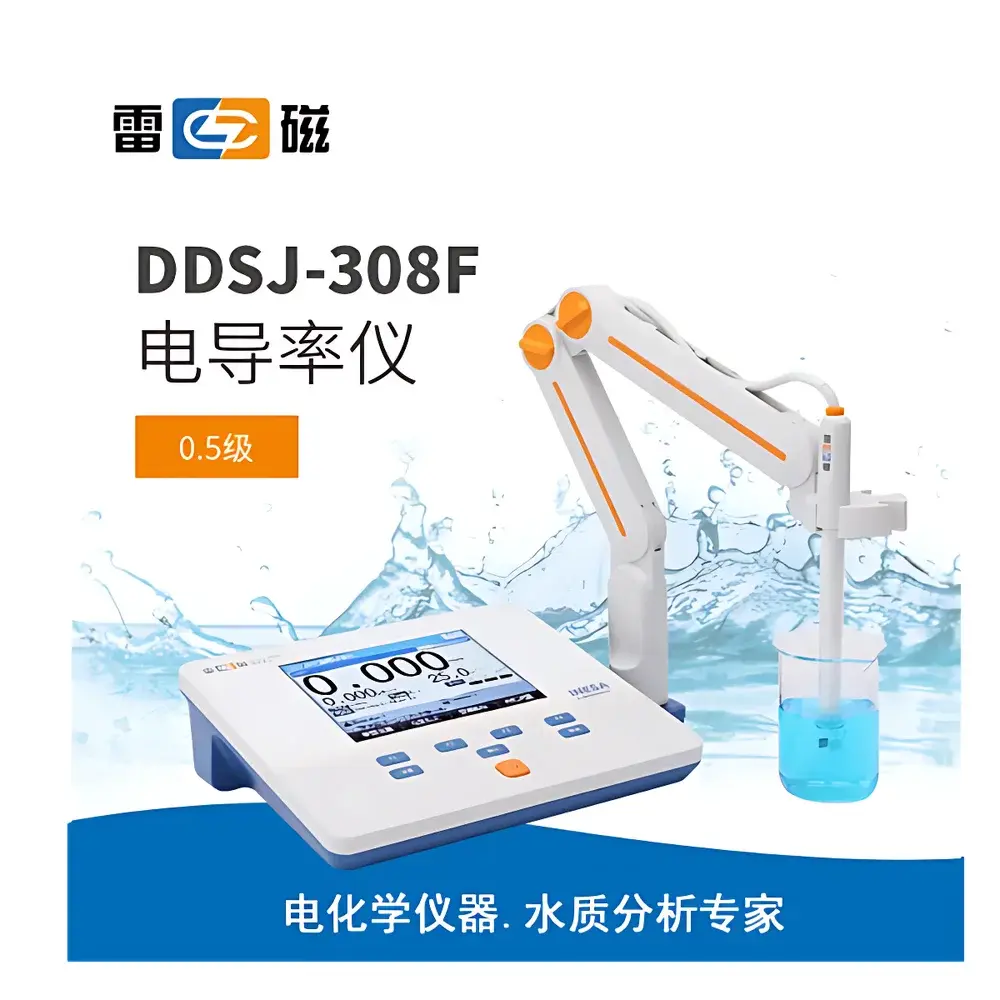
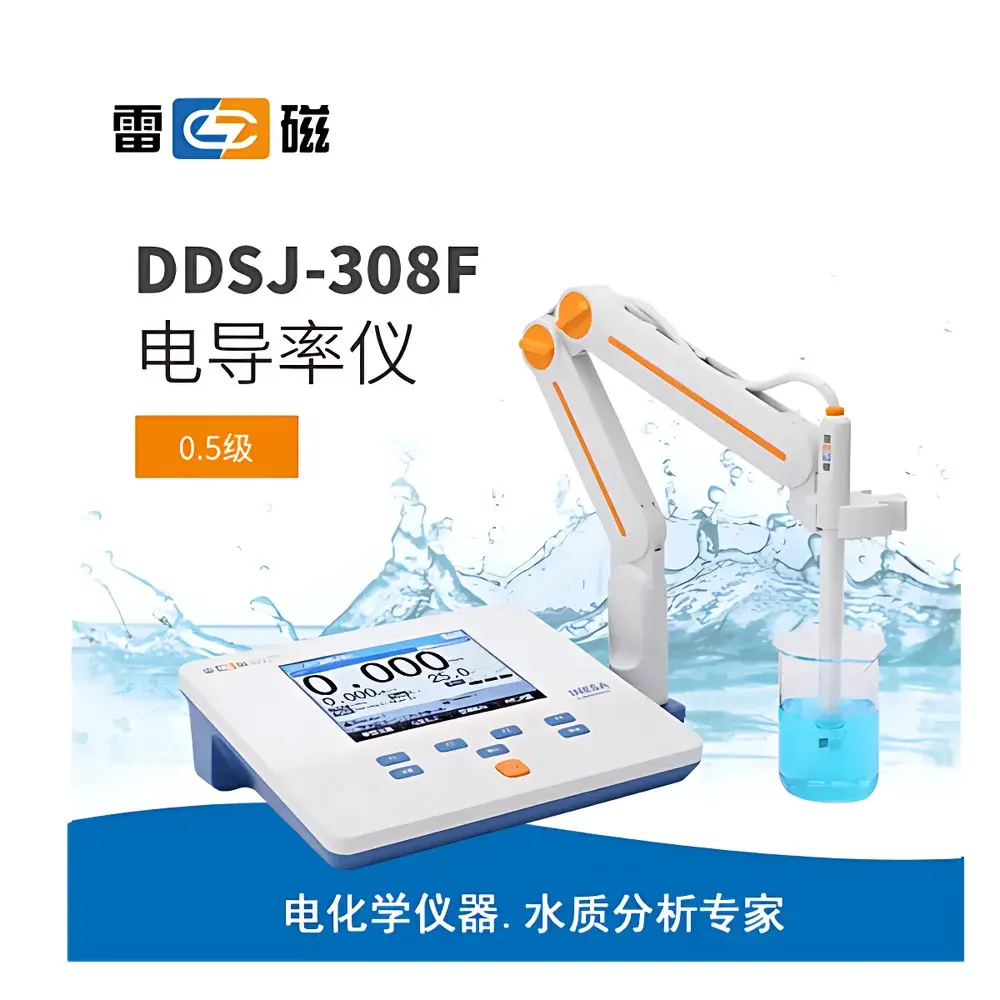
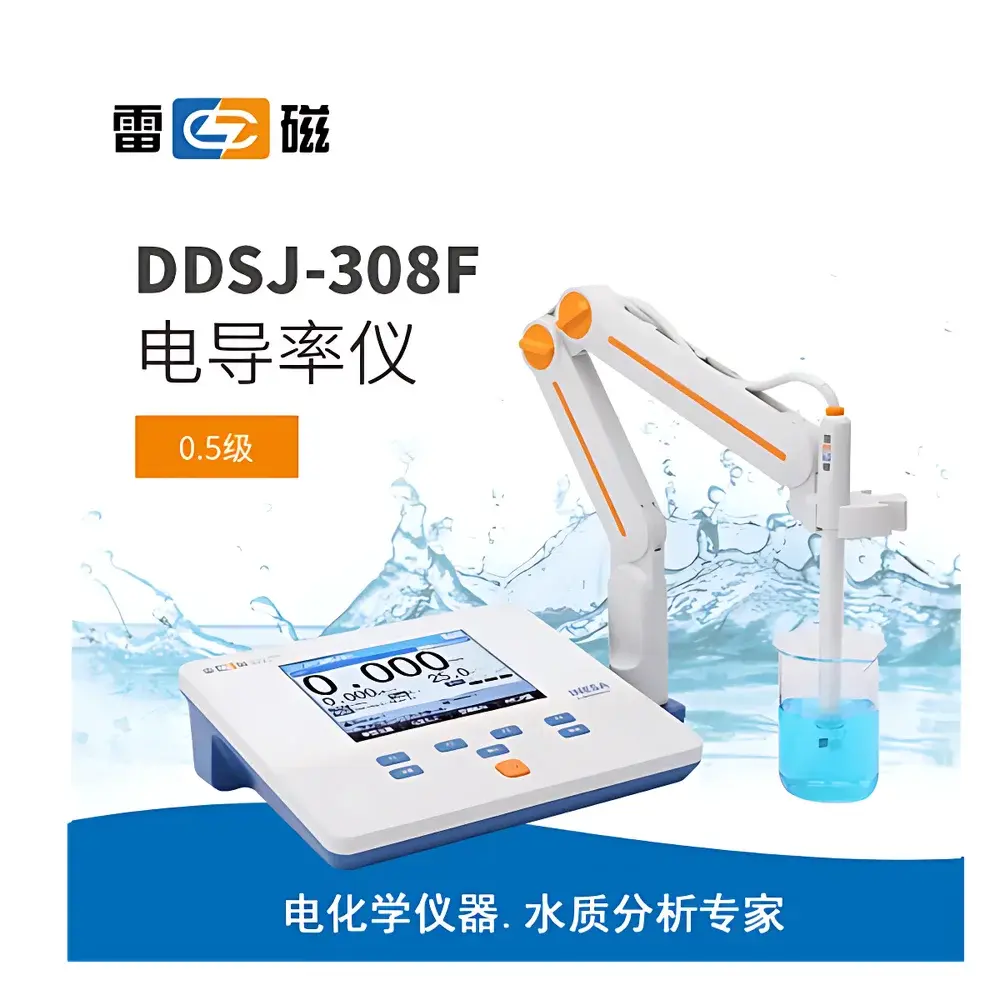
Leici DDSJ-308F Benchtop Conductivity Meter
| Key | Brand: Leici |
|---|---|
| Origin | Shanghai, China |
| Model | DDSJ-308F |
| Form Factor | Benchtop |
| Application Environment | Laboratory |
| Conductivity Range | 0.000 μS/cm to 1000 mS/cm |
| TDS Range | 0.000 mg/L to 1000 g/L |
| Resistivity Range | 5.00 Ω·cm to 100.0 MΩ·cm |
| Salinity Range | 0.00–8.00 % |
| Temperature Range | −10.0–135.0 °C (14.0–275.0 °F) |
| Accuracy | ±0.80 % of Full Scale |
| Minimum Resolution | 0.001 μS/cm (auto-ranging) |
| IP Rating | IP54 |
| Calibration | 1–3 point with auto-recognition of GB-standard KCl solutions |
| Compensation Modes | Non-compensated, Linear (α), Pure Water |
| Auto-Frequency Switching | Yes |
| Interfaces | RS-232, USB |
| Data Storage | 500 datasets per parameter type |
| GLP Compliance | Yes (audit trail, timestamp, operator ID support via software) |
Overview
The Leici DDSJ-308F Benchtop Conductivity Meter is a precision electrochemical instrument engineered for reliable, traceable measurement of electrical conductivity, total dissolved solids (TDS), resistivity, and salinity in aqueous solutions. It operates on the principle of two-electrode or four-electrode AC conductance measurement—applying a low-frequency alternating current across a pair of platinum electrodes immersed in the sample, then calculating conductivity based on the measured conductance and cell constant (K = L/A). The instrument supports automatic frequency switching to minimize polarization effects and capacitive interference, enabling accurate measurements across six decades of conductivity—from ultrapure water (≥5.00 Ω·cm) to highly concentrated brines (up to 1000 mS/cm). Designed for routine QC/QA laboratories, environmental testing facilities, and academic research settings, the DDSJ-308F delivers consistent performance under controlled benchtop conditions while meeting foundational requirements for data integrity in regulated environments.
Key Features
- High-resolution 4.3-inch color TFT LCD with intuitive icon-based navigation and dual temperature unit display (°C/°F)
- Configurable reference temperature selection (20 °C or 25 °C) for standardized reporting per ISO 7888 and ASTM D1125
- Integrated self-diagnostics at power-on, auto-shutdown after user-defined idle time, and non-volatile memory retention during power loss
- Firmware upgrade capability via USB—enabling future protocol updates and functional enhancements without hardware replacement
- IP54-rated enclosure providing protection against dust ingress and incidental water splashes—suitable for general laboratory use
- Auto-recognition of four national standard GB/T 6682–2008 KCl calibration solutions (0.01 mol/L, 0.1 mol/L, 1.0 mol/L, and saturated KCl), reducing operator error during calibration
- Intelligent endpoint detection with multiple read modes: auto-hold, timed reading, interval logging, and manual capture
Sample Compatibility & Compliance
The DDSJ-308F accommodates a broad range of aqueous matrices—including drinking water, wastewater, boiler feedwater, pharmaceutical process streams, and electroplating baths—when paired with appropriate cell constants (e.g., K = 0.1 cm⁻¹ for low-conductivity samples <20 μS/cm; K = 1.0 cm⁻¹ for mid-range applications; optional K = 10 cm⁻¹ for high-salinity media). Its linear and pure-water temperature compensation algorithms align with ISO 7888 Annex B and USP , supporting both general-purpose and pharmacopeial-grade measurements. The device complies with GLP principles through embedded metadata stamping (date/time, operator ID placeholder, calibration history), and its RS-232 and USB interfaces facilitate integration into validated laboratory information management systems (LIMS) when used with compliant communication software.
Software & Data Management
The meter stores up to 500 individual records each for conductivity, TDS, resistivity, salinity, and temperature—retaining raw values, compensated results, calibration parameters, and timestamps. Data export is supported via USB to PC using Leici’s proprietary communication suite, which enables CSV export, report generation, and batch archival. RS-232 output permits direct connection to serial printers for hard-copy documentation with customizable formatting (e.g., header fields, units, pass/fail flags). All stored entries are immutable post-acquisition; deletion requires explicit user confirmation, preserving auditability. While the instrument itself does not implement 21 CFR Part 11 electronic signature controls, its structured data schema and time-stamped logs serve as foundational elements for laboratories implementing supplementary validation protocols.
Applications
- Environmental monitoring: compliance testing of surface water, groundwater, and effluent per EPA Method 120.1 and ISO 15839
- Pharmaceutical manufacturing: conductivity verification of purified water (PW) and water for injection (WFI) per USP Stage 1–3 testing
- Power generation: real-time tracking of condensate purity and demineralizer breakthrough in thermal cycle chemistry programs
- Food & beverage QA: TDS assessment of brines, syrups, and rinse waters to verify consistency and regulatory thresholds
- Academic teaching labs: hands-on instruction in solution electrolyte theory, Kohlrausch’s law, and temperature dependence of ionic mobility
FAQ
What cell constants are compatible with the DDSJ-308F?
The instrument supports electrode cells with K = 0.01, 0.1, 1.0, and 10 cm⁻¹. Automatic frequency switching ensures optimal excitation for each range; however, K = 0.1 or 0.01 cells are recommended for measurements below 20 μS/cm.
Does the DDSJ-308F meet FDA 21 CFR Part 11 requirements?
The device provides timestamped, operator-attributable data and secure storage but lacks built-in electronic signatures or role-based access control. Full Part 11 compliance requires supplemental system-level validation and procedural controls.
Can the meter perform simultaneous multi-parameter logging?
Yes—it continuously acquires and displays conductivity, temperature, and calculated TDS/resistivity/salinity in real time, storing all five parameters independently with synchronized timestamps.
Is calibration traceable to national standards?
Calibration uses GB/T 6682–2008 certified KCl reference solutions; users may further establish traceability by correlating with NIST-traceable standards or accredited secondary references.
How is temperature compensation applied during measurement?
Users select between no compensation, linear (with adjustable α coefficient), or pure-water mode (non-linear, per ISO 7888); compensation is applied in real time using the integrated Pt1000 sensor.






