
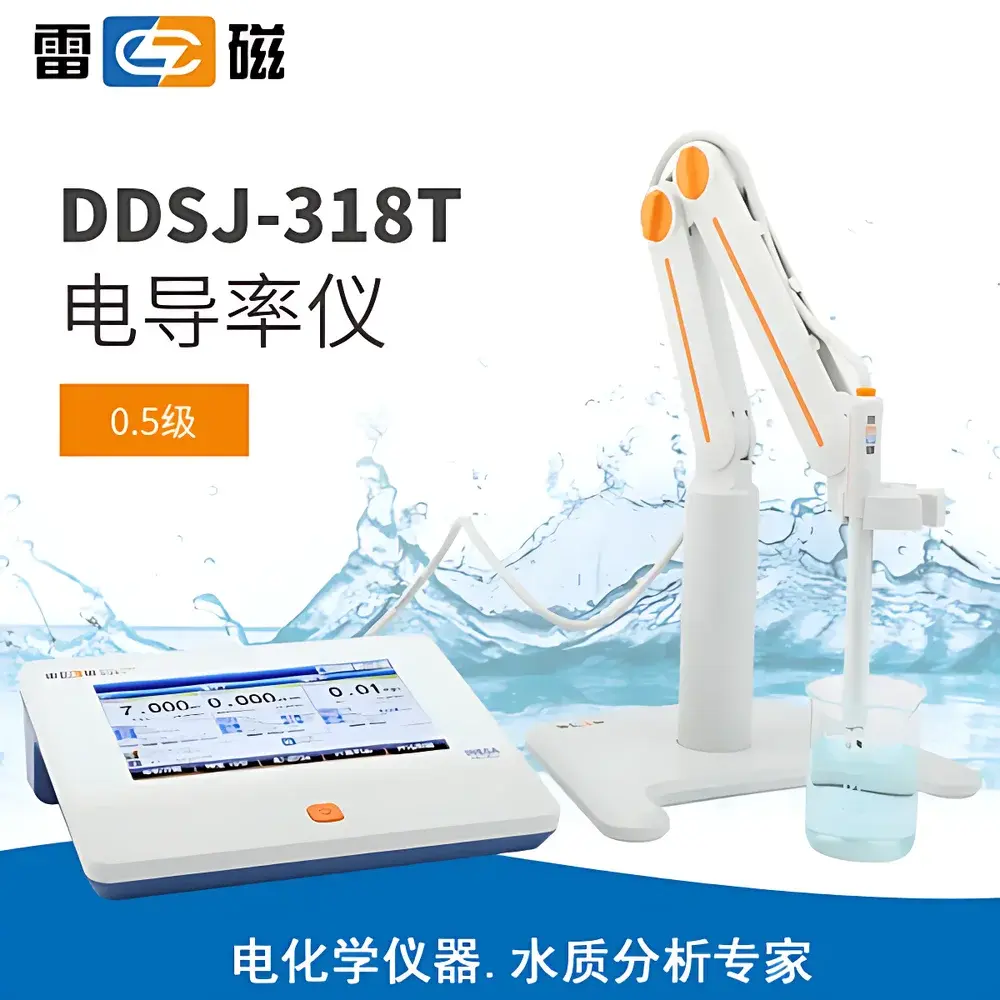
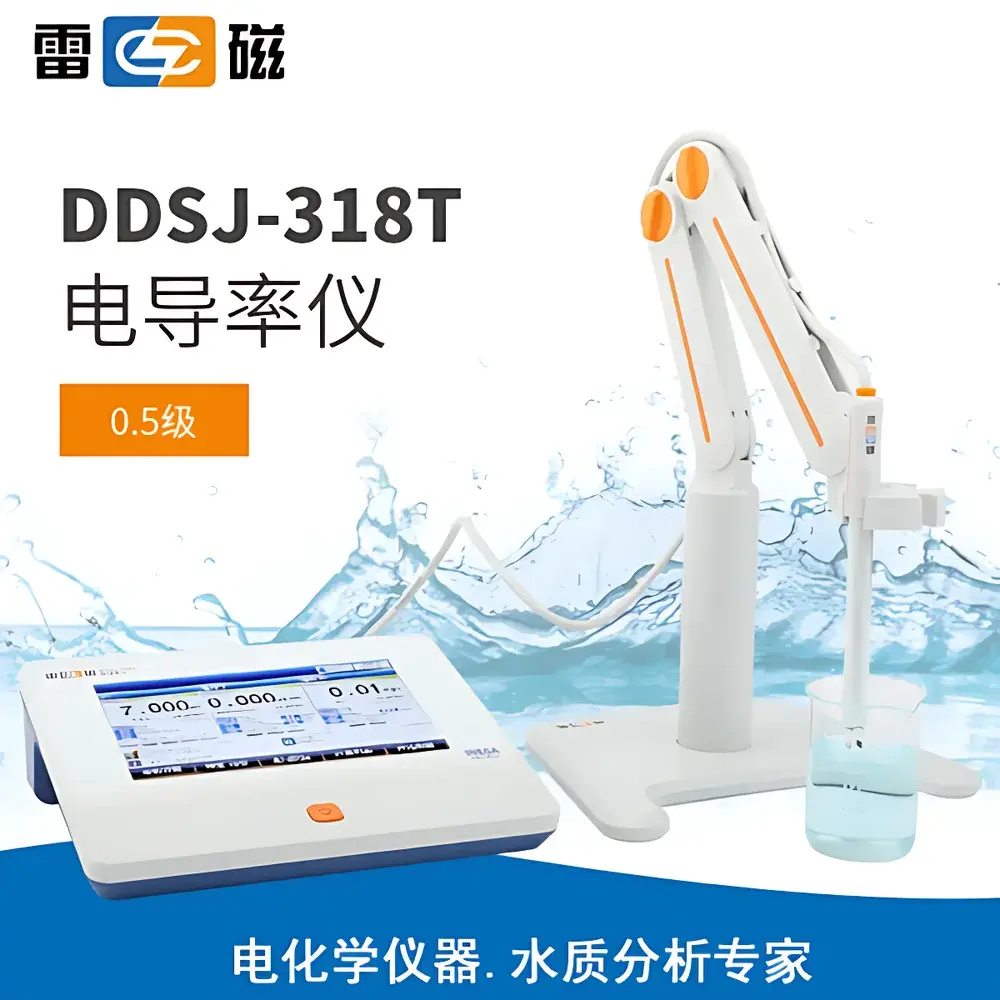
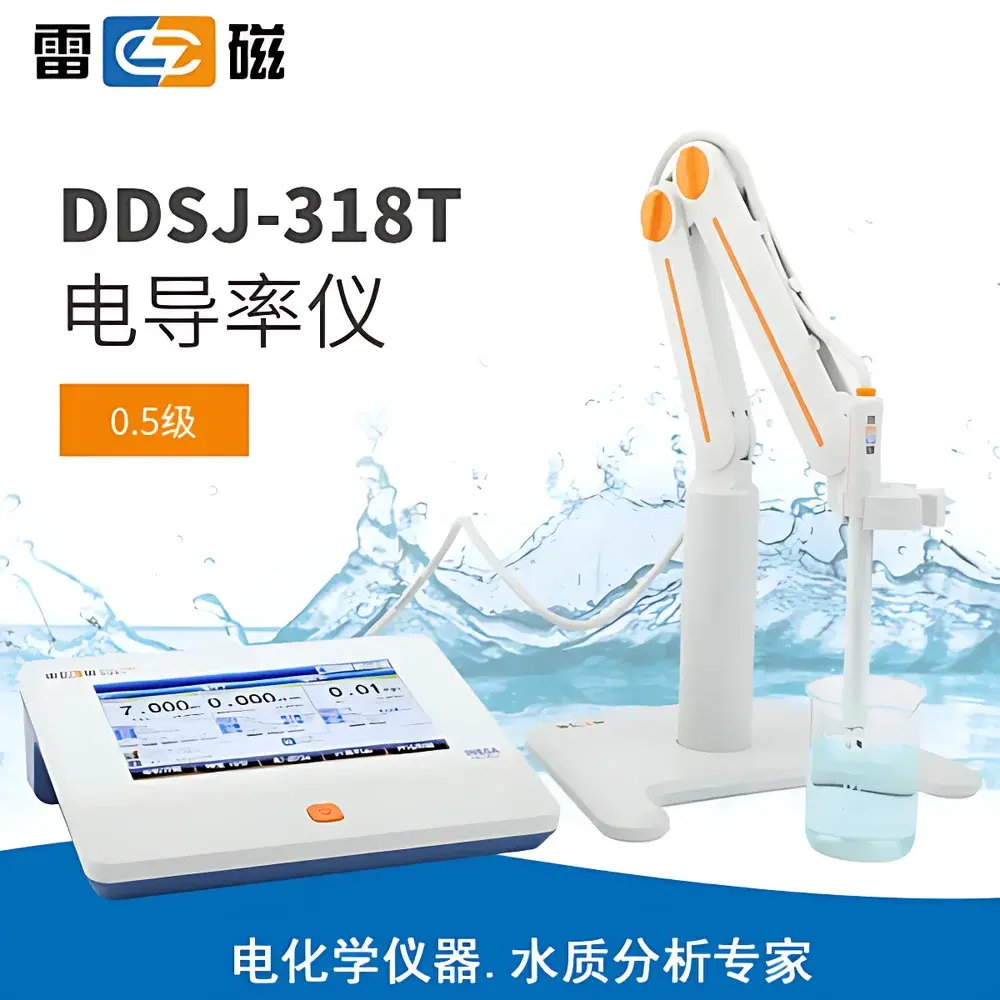
Leici DDSJ-318T Benchtop Conductivity Meter
| Brand | Leici |
|---|---|
| Origin | Shanghai, China |
| Model | DDSJ-318T |
| Measurement Parameters | Conductivity, TDS, Resistivity, Salinity, Temperature |
| Form Factor | Benchtop |
| Application Environment | Laboratory |
| Conductivity Range | 0.000 μS/cm to 2000 mS/cm |
| TDS Range | 0.000 mg/L to 1000 g/L |
| Resistivity Range | 5.00 Ω·cm to 100.0 MΩ·cm |
| Salinity Range | (0.00–8.00)% |
| Temperature Range | 0.00–100.00 °C |
| Accuracy | ±0.5% FS |
| Minimum Resolution | 0.001 μS/cm |
| Temperature Compensation Modes | None, Linear, Non-linear, Pure Water |
| Reference Temperatures | 5.0, 10.0, 15.0, 18.0, 20.0, 25.0 °C (default) |
| Electrode Constant Auto-Detection | Yes |
| Calibration Points | 1–5 points |
| IP Rating | IP54 |
| Data Storage Capacity | 1000 datasets |
| Compliance | GLP, GMP-supportive audit trail, FDA 21 CFR Part 11-ready data handling via optional software |
| Interfaces | RS-232, USB, U-disk support, barcode scanner compatibility, optional autosampler integration |
Overview
The Leici DDSJ-318T is a high-precision benchtop conductivity meter engineered for rigorous laboratory environments where trace-level ionic characterization, regulatory compliance, and long-term measurement stability are critical. It operates on the principle of two-electrode or four-electrode AC conductometric measurement—applying a low-frequency alternating current across an electrode cell to determine solution conductivity while minimizing polarization effects and electrode fouling. The instrument simultaneously calculates derived parameters—including total dissolved solids (TDS), resistivity, and practical salinity—using configurable conversion algorithms aligned with ISO 7888, ASTM D1125, and USP . Designed for routine QC/QA workflows in pharmaceutical water systems, environmental monitoring labs, and industrial process water validation, the DDSJ-318T delivers reproducible results across six decades of conductivity (0.000 μS/cm to 2000 mS/cm), covering ultrapure water through saturated brines.
Key Features
- 7-inch full-color capacitive touchscreen interface with intuitive icon-driven navigation and dual-language support (English/Chinese)
- Multi-mode temperature compensation: selectable linear, non-linear (based on polynomial coefficients), pure water-specific (ISO 7888 Annex B), and seawater salinity compensation
- Auto-ranging circuitry with intelligent electrode constant recognition—enables seamless use of K=0.01, K=0.1, K=1.0, and K=10.0 cells without manual input
- GLP-compliant data integrity architecture: timestamped measurements, operator ID logging, calibration history with checksum verification, and immutable audit trail export
- IP54-rated enclosure for dust resistance and limited moisture protection during routine lab operation
- Configurable endpoint detection: auto-hold, timed reading (1–120 s), interval sampling, and manual capture modes
- Integrated method management system supporting up to 20 user-defined test protocols with parameter presets, alarm thresholds, and reporting templates
- Onboard firmware update capability via USB drive—ensuring future-proof adaptability to evolving regulatory requirements
Sample Compatibility & Compliance
The DDSJ-318T accommodates a broad spectrum of aqueous matrices—from Type I ultrapure water (resistivity ≥18.2 MΩ·cm at 25 °C) to aggressive industrial effluents and concentrated electrolyte solutions. Its automatic frequency switching (10 Hz–10 kHz) optimizes signal-to-noise ratio across conductivity ranges, reducing errors from capacitive coupling or electrode coating. The instrument supports calibration against certified reference standards per ISO/IEC 17025-accredited providers, including KCl solutions traceable to NIST SRM 3961. All stored data meet GLP documentation requirements and are compatible with GMP environments when paired with validated PC software enabling 21 CFR Part 11-compliant electronic signatures, role-based access control, and secure data archiving.
Software & Data Management
Data handling is structured around traceability and interoperability. Each measurement record includes sample ID, operator code, electrode serial number, calibration status, ambient temperature, and full metadata required for audit readiness. Internal storage retains 1000 complete datasets with search, statistical analysis (mean, SD, RSD), and customizable export (CSV, PDF). USB host port enables direct transfer to LIMS via standardized CSV or XML schema; RS-232 supports legacy thermal printers with programmable report formatting (e.g., header/footer, unit display, pass/fail flags). Optional Leici LabLink Pro software provides advanced features: trend charting, multi-instrument fleet monitoring, electronic signature workflows, and automated backup to network drives or cloud repositories.
Applications
- Pharmaceutical water systems: USP compliant conductivity testing of Purified Water (PW) and Water for Injection (WFI) at specified temperatures
- Environmental laboratories: EPA Method 120.1 and ISO 13395 field-deployable verification of surface/groundwater quality
- Power generation: Condensate and boiler feedwater purity assurance per ASTM D4582
- Food & beverage: TDS verification in brewing, dairy processing, and desalination pre-treatment streams
- Academic research: Electrolyte characterization in battery electrolyte development and membrane transport studies
FAQ
Does the DDSJ-318T support four-electrode conductivity measurement?
Yes—it accepts both two-electrode and four-electrode sensor configurations via its universal BNC + auxiliary connector interface, enabling accurate measurement in high-conductivity or polarizable media.
Can calibration be performed using non-KCl standards?
Calibration is optimized for KCl solutions per ISO 7888, but custom calibration curves may be imported via USB for proprietary reference materials, provided traceability documentation is maintained.
Is the instrument suitable for continuous unattended operation?
While designed primarily for discrete sample analysis, it supports timed interval mode and autosampler integration for batched workflows; however, no built-in environmental monitoring sensors (e.g., humidity, pressure) are included.
How is data security enforced under GMP conditions?
User accounts are tiered (Admin, Supervisor, Operator) with password enforcement, session timeout, and encrypted local storage. Full 21 CFR Part 11 compliance requires Leici LabLink Pro with digital certificate authentication and tamper-evident audit logs.
What electrode constants are validated for full-range coverage?
K=0.01 cm⁻¹ for ultrapure water (≤1 μS/cm); K=0.1 cm⁻¹ for low-ionic-strength samples (1–100 μS/cm); K=1.0 cm⁻¹ for general-purpose use (100 μS/cm–200 mS/cm); K=10.0 cm⁻¹ for high-salinity applications (>200 mS/cm).
Related Products





