
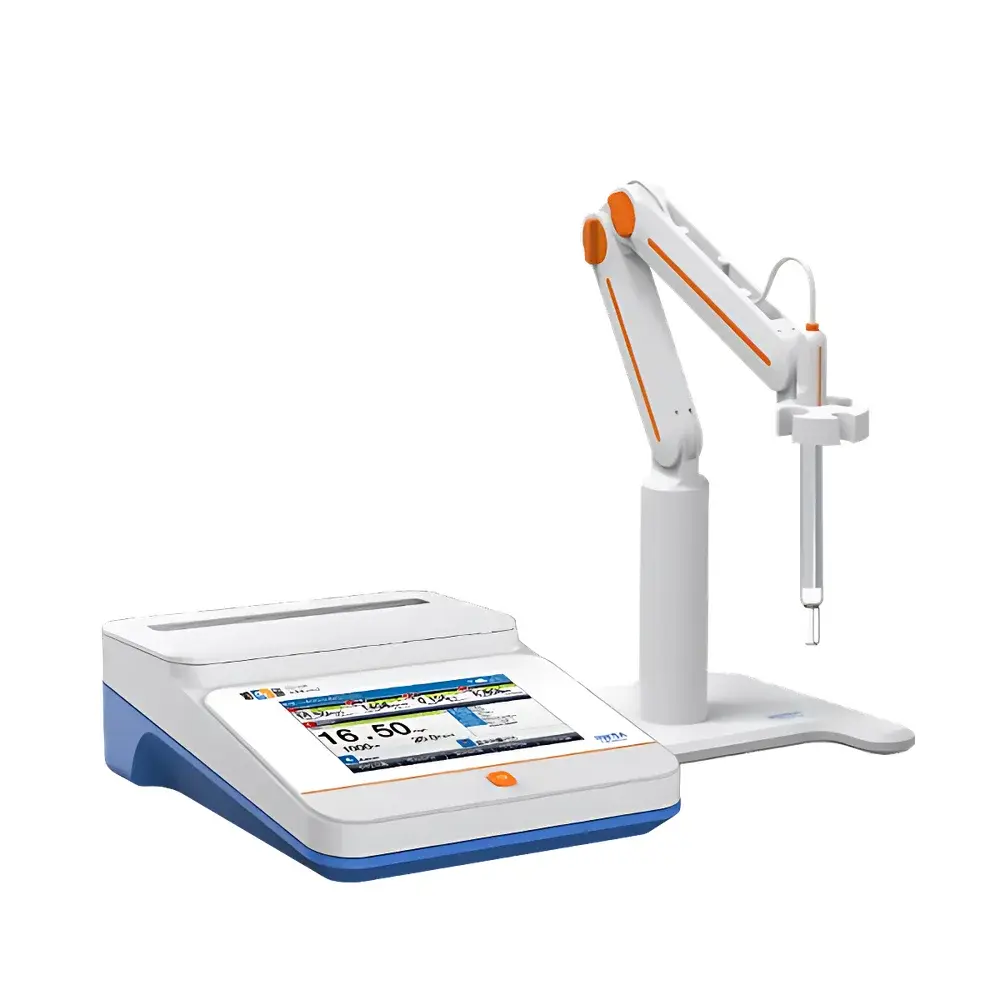
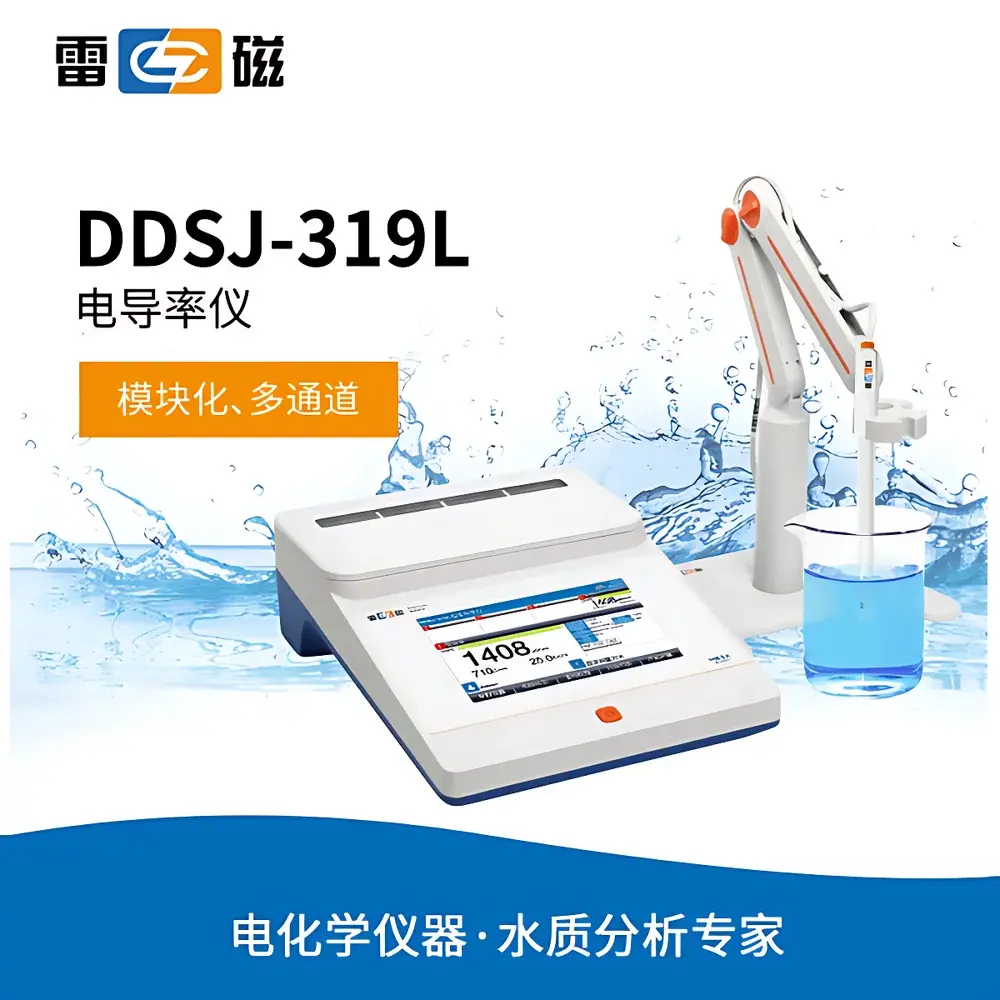
Leici DDSJ-319L Benchtop Conductivity Meter
| Brand | Leici |
|---|---|
| Origin | Shanghai, China |
| Manufacturer Type | Original Equipment Manufacturer (OEM) |
| Product Category | Domestic |
| Model | DDSJ-319L |
| Price Range | USD 700–1,400 |
| Measured Parameters | Conductivity, Resistivity, TDS, Salinity, Temperature |
| Form Factor | Benchtop |
| Intended Use | Laboratory |
| Conductivity Range | 0.000 µS/cm to 3000 mS/cm |
| TDS Range | 0.000 mg/L to 1000 g/L |
| Resistivity Range | 5.00 Ω·cm to 100.0 MΩ·cm |
| Salinity Range | 0.00–8.00 % |
| Temperature Range | −5.0 to 130.0 °C |
| Accuracy | ±0.5 % of Full Scale (FS) for conductivity/resistivity/TDS |
| Minimum Resolution | 0.001 µS/cm (conductivity), 0.01 Ω·cm (resistivity), 0.001 mg/L (TDS), 0.01 % (salinity), 0.1 °C (temperature) |
| Compliance | GLP-compliant data management, supports ASTM D1125, ISO 7888, USP <645>, and China GB/T 6682 & GB/T 11025 standards |
Overview
The Leici DDSJ-319L is a high-precision benchtop conductivity meter engineered for rigorous laboratory environments requiring traceable, reproducible measurements of aqueous solution ionic strength. It operates on the principle of two-electrode or four-electrode AC conductivity measurement—applying a low-frequency alternating current to minimize polarization effects and electrode fouling—enabling accurate determination of conductivity across six decades of dynamic range (0.000 µS/cm to 3000 mS/cm). The instrument simultaneously computes and displays derived parameters—including resistivity, total dissolved solids (TDS), practical salinity (PSU), and temperature—using configurable algorithms compliant with internationally recognized conversion models (e.g., linear TDS factor, NaCl-equivalent salinity, and pure water compensation per ISO 7888 Annex B). Its 0.5-class accuracy rating per IEC 60746-3 and adherence to GB/T 11025 (China National Standard for Conductivity Meters) ensure metrological integrity suitable for QC/QA labs, pharmaceutical water system validation, environmental monitoring, and academic research.
Key Features
- Intelligent endpoint detection: Supports auto-read, timed-read, interval-read, and manual-read modes—optimized for both rapid screening and kinetic studies.
- Automatic temperature compensation (ATC): Integrated Pt1000 sensor enables real-time correction using selectable algorithms (linear, non-linear, or custom coefficient tables) referenced to 25 °C.
- Multi-point calibration management: Recognizes up to five standard solutions; defaults to four certified GB-standard KCl solutions (e.g., 1413 µS/cm, 12.88 mS/cm); stores calibration history with timestamps and operator IDs.
- Smart frequency switching: Single-cell electrode compatibility across 0–200 mS/cm via automatic excitation frequency adjustment—eliminating manual range switching and reducing cross-contamination risk.
- Application-specific compensation: Includes dedicated modes for ultrapure water (low-conductivity correction per ASTM D1125), seawater (PSS-78 salinity algorithm), and industrial brines.
- Benchtop integration readiness: RS-232 and USB-B ports support connection to automated sample handlers, printers, and external PCs; optional UVC-compatible USB flash drive interface for secure offline data export.
Sample Compatibility & Compliance
The DDSJ-319L accommodates standard 12-mm or 14-mm diameter conductivity cells (including DIN/ISO-compliant 2-, 4-, or 10-cell geometries) and supports flow-through, immersion, and dip-style configurations. It meets functional requirements of ISO/IEC 17025-accredited laboratories when operated under documented SOPs. Data integrity is reinforced through GLP-compliant audit trails—capturing user login, method selection, calibration events, measurement timestamps, and electrode ID logging. All stored datasets include metadata required for FDA 21 CFR Part 11 compliance when paired with validated PC software (e.g., Leici LabSuite v3.2+ with electronic signature and role-based access control).
Software & Data Management
Onboard memory retains up to 1000 complete measurement records—including raw readings, calculated values, calibration coefficients, and environmental conditions—with searchable indexing by date, parameter, or operator. Export formats include CSV and XML for LIMS integration. The embedded method manager allows saving and recalling multi-step workflows (e.g., “Pharmaceutical Purified Water Test” with predefined TDS factor = 0.64, salinity mode = PSS-78, and auto-print trigger). User permissions are tiered (Admin, Technician, Viewer) to enforce procedural discipline. When connected to a Windows PC via USB or RS-232, the instrument functions as a virtual COM port—enabling direct acquisition into Excel, MATLAB, or custom SCADA systems without proprietary drivers.
Applications
- Pharmaceutical water systems: Monitoring purified water (PW), water for injection (WFI), and clean steam condensate per USP and EU Annex 1 requirements.
- Environmental testing: Field-deployable lab verification of surface water, groundwater, and wastewater effluent conductivity per EPA Method 120.1 and ISO 7888.
- Chemical manufacturing: In-process control of electrolyte concentration in plating baths, acid/base titration endpoints, and solvent purity checks.
- Food & beverage QA: Salt content verification in brines, dairy processing water, and brewing liquor—traceable to AOAC 973.43.
- Academic research: Teaching electrochemistry fundamentals, calibrating reference electrodes, and characterizing ion-exchange membranes.
FAQ
What calibration standards are preloaded in the DDSJ-319L?
The instrument ships with four factory-programmed Chinese national standard KCl solutions (84.0 µS/cm, 1413 µS/cm, 12.88 mS/cm, and 111.8 mS/cm) aligned with GB/T 11025. Users may add up to one custom standard.
Does the meter support four-electrode conductivity measurement?
Yes—the DDSJ-319L accepts both two-electrode and four-electrode cells. Four-electrode operation is recommended for high-conductivity samples (>100 mS/cm) or viscous media to eliminate cable capacitance errors.
Can the device store calibration curves independently per electrode?
Yes—each electrode ID (user-defined alphanumeric tag) maintains its own calibration history, slope, offset, and cell constant, enabling traceability across multiple sensors in shared-lab environments.
Is temperature measurement performed with an integrated sensor or external probe?
An integrated Pt1000 RTD is built into the main unit; however, the instrument also accepts external ATC probes (e.g., Leici ECT-100 series) via the auxiliary input for immersed temperature referencing.
How is data security ensured during USB transfer?
USB mass storage mode requires explicit user confirmation before mounting; exported files are write-protected and timestamped. No executable code or firmware updates are permitted via USB—preventing unauthorized modification.
Related Products





