
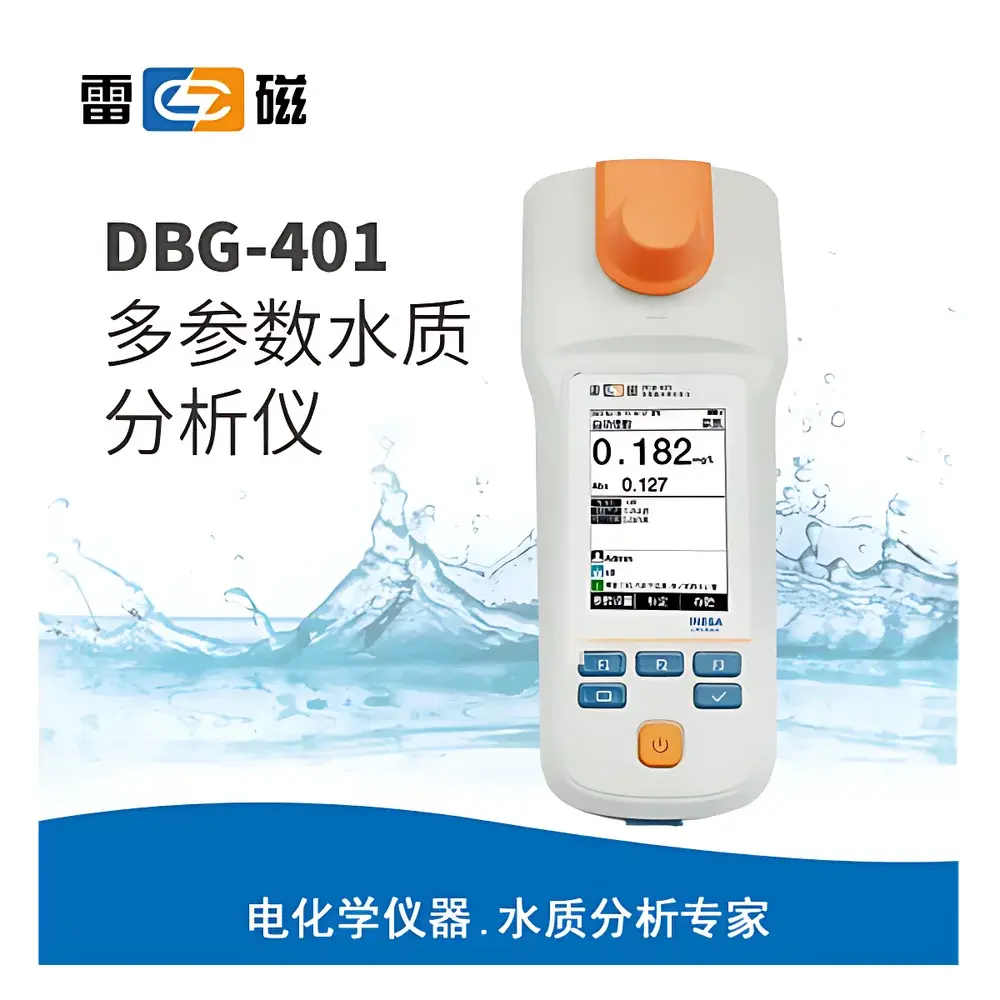
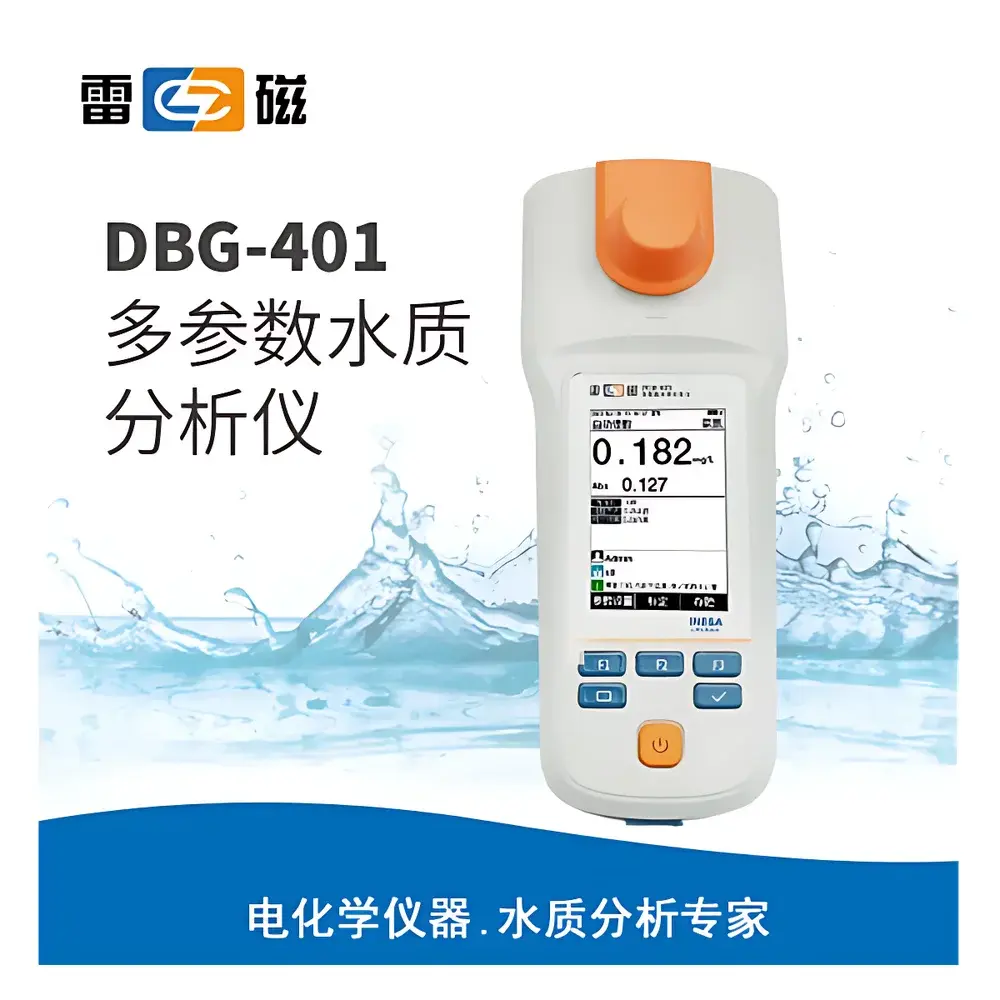
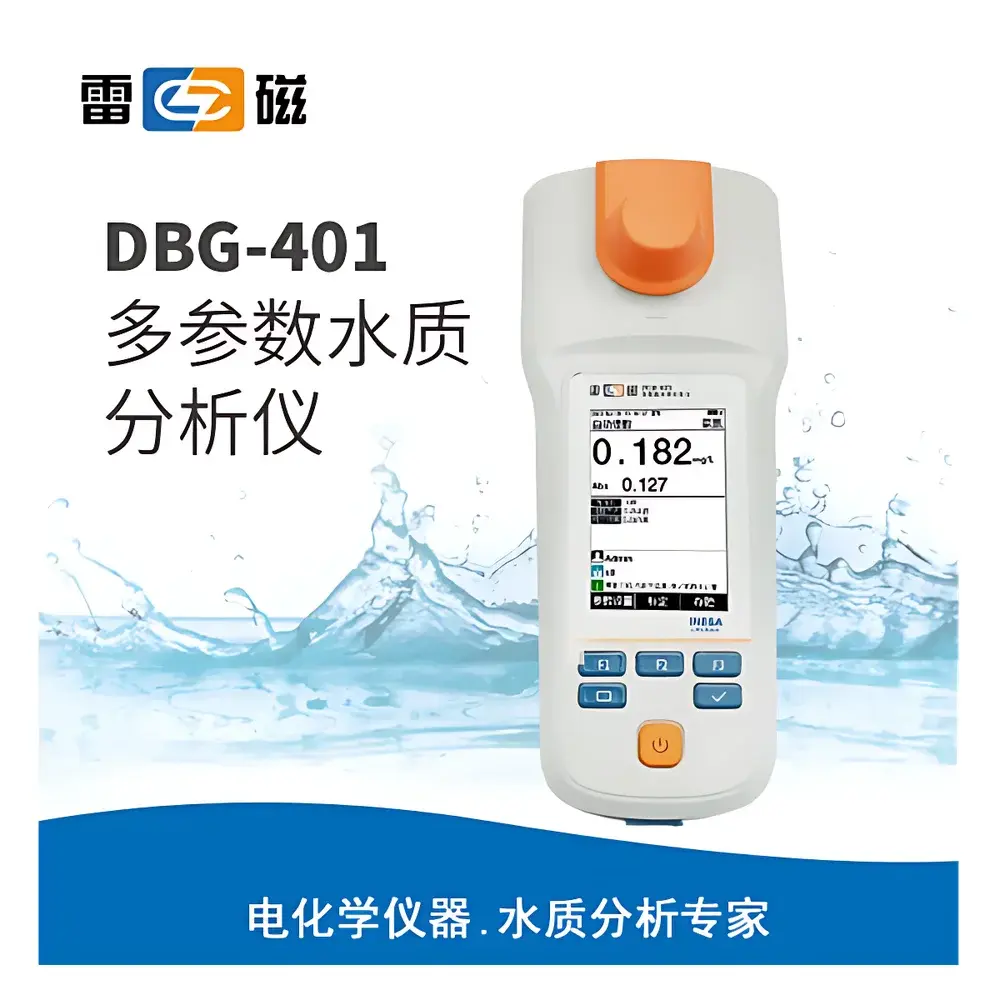
Leici DGB-401 Multi-Parameter Water Quality Analyzer
| Brand | Leici |
|---|---|
| Origin | Shanghai, China |
| Model | DGB-401 |
| Instrument Type | Portable/HANDHELD Water Quality Analyzer |
| Detection Principle | Spectrophotometry (LED-based, 420 nm / 470 nm / 620 nm / 650 nm) |
| Measured Parameters | Ammonia-Nitrogen, High-Range COD, Low-Range COD, Total Phosphorus, Total Nitrogen |
| Ammonia-Nitrogen Range | 0.000–10.00 mg/L |
| Repeatability | ±3% |
| IP Rating | IP65 |
| Data Storage | 1,000 total entries (200 per parameter) |
| Power Supply | Rechargeable Li-ion battery with USB/PC charging and low-voltage warning |
| Interface | RS-232 printer port, USB for PC communication |
| Compliance | GLP-compliant data traceability, audit-ready data management |
Overview
The Leici DGB-401 Multi-Parameter Water Quality Analyzer is a field-deployable, spectrophotometric instrument engineered for reliable quantification of critical water quality indicators in environmental monitoring, municipal wastewater treatment, surface water surveillance, and regulatory compliance applications. It operates on the principle of absorbance measurement using four discrete, high-stability LED light sources—centered at 420 nm, 470 nm, 620 nm, and 650 nm—to enable selective detection across multiple analyte-specific wavelength bands. Each optical channel is calibrated to meet standard method requirements for ammonia-nitrogen (Nessler or salicylate-based), total phosphorus (ascorbic acid-molybdate reduction), total nitrogen (alkaline persulfate digestion followed by nitrate/nitrite quantification), and both high- and low-range chemical oxygen demand (COD) via dichromate oxidation. The analyzer employs fixed-wavelength photometry rather than scanning monochromators, ensuring robustness, minimal drift, and consistent performance under variable ambient conditions typical of field use.
Key Features
- Four-wavelength LED optical system with certified spectral stability and extended service life (>100,000 hours), eliminating lamp replacement and warm-up delays.
- Pre-programmed, method-validated measurement protocols aligned with Chinese EPA standards (e.g., HJ 535–2009 for ammonia-N, HJ 636–2012 for TN, HJ 671–2013 for TP) and compatible with international equivalents (e.g., ISO 7150-1, ISO 6060).
- High-resolution graphical LCD with adjustable backlight, supporting intuitive icon-driven navigation and multilingual menu options (English interface standard).
- Intelligent endpoint detection algorithm that dynamically identifies reaction completion during colorimetric assays, enabling precise automatic reading without user timing intervention.
- On-device dilution ratio configuration and real-time concentration back-calculation, reducing manual error in sample preprocessing workflows.
- IP65-rated enclosure with shock-absorbing rubberized casing and sealed keypad—certified for operation in humid, dusty, or splash-prone environments including riverbanks, pump stations, and mobile labs.
- Firmware upgrade capability via USB, allowing method expansion, calibration updates, and security patch deployment without hardware modification.
Sample Compatibility & Compliance
The DGB-401 accepts standard 16 mm round glass or quartz digestion/cuvette tubes (10–25 mL volume) and integrates seamlessly with included Leici-certified reagent kits and pre-filled disposable cuvettes. All onboard methods comply with Good Laboratory Practice (GLP) requirements: each measurement record stores timestamp, operator ID (user-defined), calibration status, lot numbers of reagents used, and raw absorbance values. Audit trails are immutable and exportable in CSV format. Data integrity meets the minimum functional expectations for regulatory submissions under ISO/IEC 17025-accredited laboratories and supports alignment with US EPA Method 351.2 (COD), ASTM D1426 (ammonia), and EN ISO 11908 (total nitrogen) when paired with validated digestion accessories.
Software & Data Management
Data storage accommodates up to 1,000 individual results (200 per parameter group), with time/date stamping, parameter identification, and operator tagging. Records can be reviewed, filtered, deleted individually or in batches, and exported via USB mass-storage mode to Windows/macOS systems. Optional Leici AquaLink™ PC software provides full traceability dashboards, statistical reporting (mean, SD, CV%), calibration curve visualization (2–6-point linear/nonlinear fitting), and PDF report generation compliant with internal QA/QC documentation standards. RS-232 serial output supports direct connection to thermal printers with configurable print templates—including headers, units, confidence flags, and GLP metadata.
Applications
- Routine monitoring of influent/effluent streams in WWTPs for rapid ammonia-N and COD screening prior to BOD analysis.
- Field verification of nutrient removal efficiency (TN/TP) in constructed wetlands and tertiary treatment units.
- Emergency response testing following industrial spills or agricultural runoff events where immediate on-site triage is required.
- Educational use in university environmental science labs for teaching standardized colorimetric techniques and method validation principles.
- Contract laboratory support for municipal clients requiring portable, auditable instruments capable of generating defensible data for regulatory reporting.
FAQ
Does the DGB-401 require external calibration standards for daily use?
No—factory-loaded calibration curves are provided for all five parameters; however, users may perform 2–6 point custom calibration using NIST-traceable standards to align with site-specific matrix effects or updated reference materials.
Is the instrument suitable for seawater or high-salinity samples?
It is validated for freshwater and secondary-treated wastewater matrices. For saline samples (>5,000 µS/cm), dilution and matrix-matched calibration are recommended to mitigate chloride interference in COD and ammonia assays.
Can measurement data be synchronized with LIMS platforms?
Yes—CSV exports are structured for direct ingestion into common LIMS systems; optional AquaLink™ software includes configurable field mapping for automated database insertion via ODBC or API endpoints.
What maintenance is required beyond routine cleaning?
Optical path inspection every 6 months, LED intensity verification annually, and battery health assessment after 300 charge cycles—documented in the included maintenance log template.
Does the device support FDA 21 CFR Part 11 compliance?
While not fully Part 11-certified out-of-the-box, its audit trail architecture, electronic signature placeholder fields, and role-based access controls (via optional password-protected user profiles) provide a foundational framework for validation in GxP environments.







