
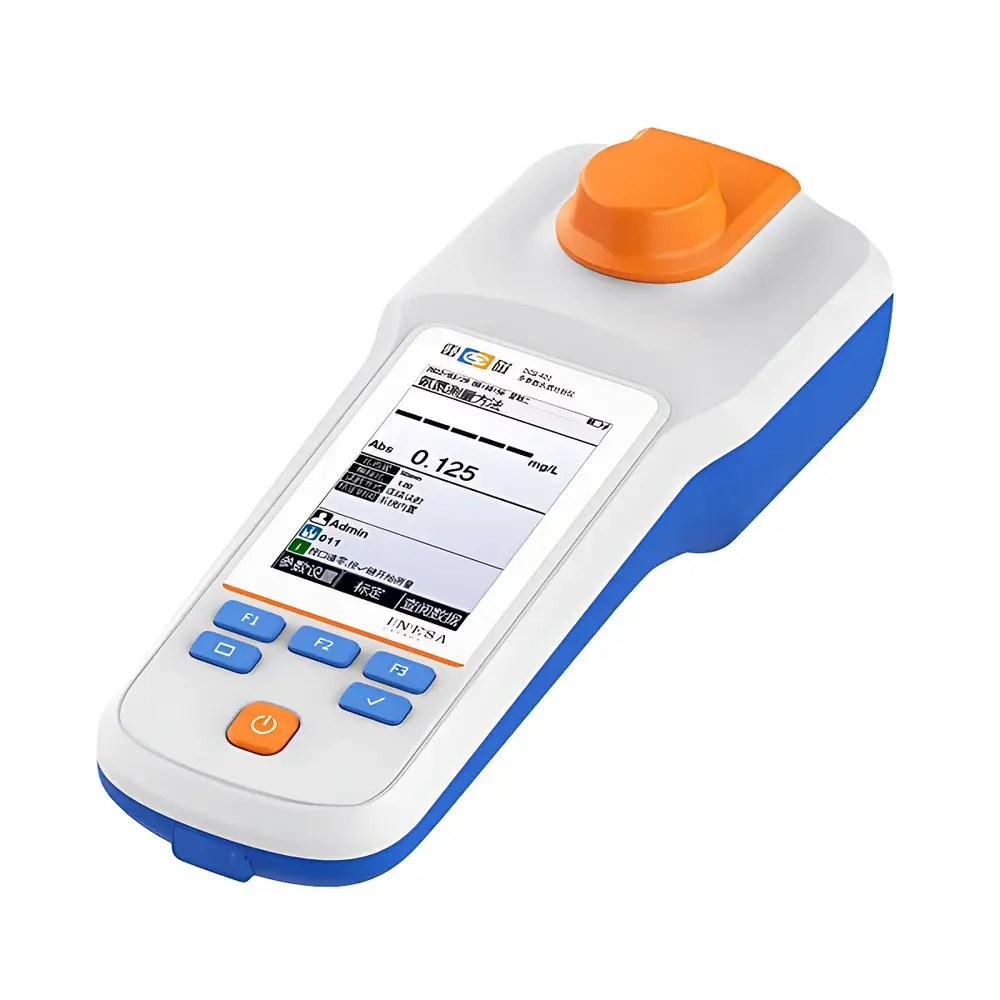
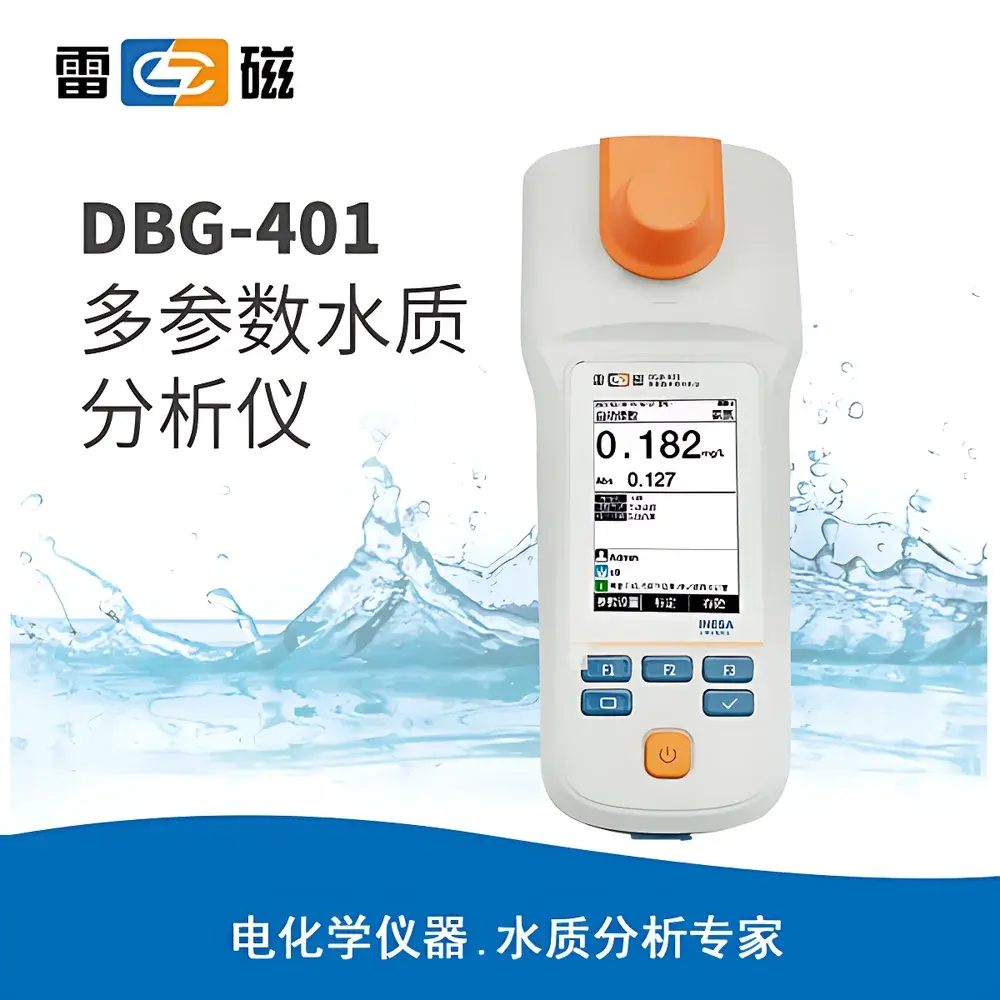
Leici DGB-401 Portable Multi-Parameter Water Quality Analyzer
| Brand | Leici |
|---|---|
| Origin | Shanghai, China |
| Manufacturer Type | Original Equipment Manufacturer (OEM) |
| Country of Origin | China |
| Model | DGB-401 |
| Instrument Type | Portable / Handheld Water Quality Analyzer |
| Measurable Parameters | Total Phosphorus, Low-Range COD, High-Range COD, Total Nitrogen, Ammonia-Nitrogen |
| Light Sources | 420 nm, 470 nm, 620 nm, 650 nm LEDs |
| Calibration Points | 2–6 points |
| Data Storage | 1,000 total entries (200 per parameter) |
| Optical Cell | 16 mm and 25 mm round cuvettes |
| Power Supply | Rechargeable Li-ion battery (DC 5 V input, AC 100–240 V compatible) |
| Protection Rating | IP65 |
| Dimensions | 100 × 240 × 80 mm |
| Weight | 0.6 kg |
| Measurement Principles | Nesslerization (NH₃-N), Dichromate Oxidation (COD), Molybdate Blue (TP), Alkaline Persulfate Digestion + Chromotropic Acid (TN) |
| Compliance | GLP-compliant data traceability, RS-232 and USB interfaces for audit-ready data export |
Overview
The Leici DGB-401 Portable Multi-Parameter Water Quality Analyzer is a field-deployable spectrophotometric instrument engineered for simultaneous quantification of five critical water quality parameters—ammonia-nitrogen (NH₃-N), low-range and high-range chemical oxygen demand (COD), total phosphorus (TP), and total nitrogen (TN)—in compliance with standard environmental testing protocols. It operates on the principle of absorbance-based photometry using discrete-wavelength light-emitting diodes (LEDs) at 420 nm, 470 nm, 620 nm, and 650 nm, each matched to the optimal absorption peak of the corresponding colorimetric reaction product. The system integrates digestion-compatible measurement workflows: alkaline persulfate digestion for TN, molybdate-based reduction for TP, dichromate oxidation under acidic reflux conditions for COD, and Nessler reagent complexation for NH₃-N. Designed for routine monitoring in municipal wastewater treatment plants, surface water surveillance stations, industrial effluent discharge points, and environmental field surveys, the DGB-401 delivers laboratory-grade repeatability (≤3% RSD) in a rugged, battery-powered platform certified to IP65 ingress protection.
Key Features
- Four-wavelength LED optical engine with calibrated spectral output at 420 nm, 470 nm, 620 nm, and 650 nm—ensuring stable photometric performance over extended operational life without lamp replacement.
- Automated endpoint detection with configurable reading modes: single-point, continuous, or timed acquisition—minimizing operator-dependent variability in kinetic or equilibrium-based assays.
- Intelligent dilution factor compensation: user-defined dilution ratios are applied automatically during result calculation to report original sample concentrations without manual recalculation.
- Flexible calibration architecture supporting both factory-loaded standard curves and user-defined 2–6 point calibration sets—enabling method adaptation for matrix-specific interferences or regulatory method deviations.
- Integrated power management: rechargeable lithium-ion battery with real-time charge-level indicator, auto-power-off timer, and dual charging options (USB-C and AC adapter); supports operation while charging from mobile power banks.
- Ruggedized field design: IP65-rated enclosure, shock-absorbing portable case, ergonomic grip, and adjustable backlight—optimized for prolonged outdoor use under variable ambient lighting and temperature conditions.
Sample Compatibility & Compliance
The DGB-401 accommodates aqueous samples across drinking water, wastewater, surface water, and industrial process streams. Sample preparation follows standardized pretreatment procedures: filtration (for suspended solids removal), acidification (for NH₃-N stabilization), and mandatory thermal digestion using the optional COD-401-1 portable digester for COD, TP, and TN measurements. All onboard methods align with internationally recognized reference techniques—including ISO 7890-2 (ammonia), ISO 6060 (COD), ISO 8678 (total phosphorus), and ISO 11905-1 (total nitrogen)—and support documentation required for GLP audits. Data integrity safeguards include timestamped records, operator ID tagging (via optional software configuration), and immutable storage logs compliant with basic 21 CFR Part 11 principles for electronic record retention.
Software & Data Management
Data transfer and archival are enabled via dual communication interfaces: RS-232 for direct connection to serial printers (with configurable print templates for lab notebooks or field reports), and USB 2.0 for bidirectional synchronization with Windows-based desktop software. The proprietary Leici DataLink application provides structured import/export of measurement histories, calibration logs, and QC check records in CSV and PDF formats. Each stored entry contains full metadata: parameter ID, measurement date/time, operator code (if assigned), raw absorbance values, applied dilution factor, calibration curve ID, and pass/fail flags against user-defined acceptance criteria. Up to 1,000 results (200 per parameter) are retained onboard with non-volatile memory—preserving data integrity during unexpected power loss.
Applications
- Regulatory compliance monitoring of municipal wastewater discharge permits (e.g., EPA NPDES, EU Urban Wastewater Treatment Directive).
- Process control in activated sludge systems, denitrification basins, and tertiary polishing units—tracking NH₃-N breakthrough or TP removal efficiency.
- Field screening of eutrophication indicators in lakes, rivers, and reservoirs—supporting early warning assessments for algal bloom risk.
- Industrial pretreatment verification for food processing, textile dyeing, and chemical manufacturing facilities prior to sewer discharge.
- Educational and research applications requiring transportable, multi-analyte capability with traceable calibration and reproducible methodology.
FAQ
Does the DGB-401 require external digestion equipment for all parameters?
Yes—digestion is mandatory for COD (both ranges), TP, and TN measurements. The optional COD-401-1 portable digester (16-position, 150 °C programmable heating block) is recommended for consistent, field-compatible digestion. NH₃-N analysis does not require digestion.
Can calibration curves be imported from external laboratories?
User-defined curves may be entered manually via the instrument interface or loaded through the Leici DataLink software; however, the device does not support direct import of third-party .csv or .xlsx calibration files.
Is the instrument suitable for saline or brackish water samples?
Matrix interference from chloride ions may affect COD and NH₃-N accuracy above 2,000 mg/L Cl⁻; users should apply chloride correction protocols per ISO 6060 or perform matrix-matched calibration when analyzing estuarine or coastal waters.
What is the typical service interval for optical alignment or LED recalibration?
No routine optical recalibration is required—the LED sources are factory-aligned and thermally stabilized; performance verification is conducted annually using NIST-traceable absorbance standards (e.g., potassium dichromate solutions at specified wavelengths).
How is data security maintained during USB transfer to PC?
Data transmission occurs in plain-text CSV format; encryption or password protection is not implemented onboard. For regulated environments, users must implement host-side file access controls and audit logging via institutional IT policies.







