
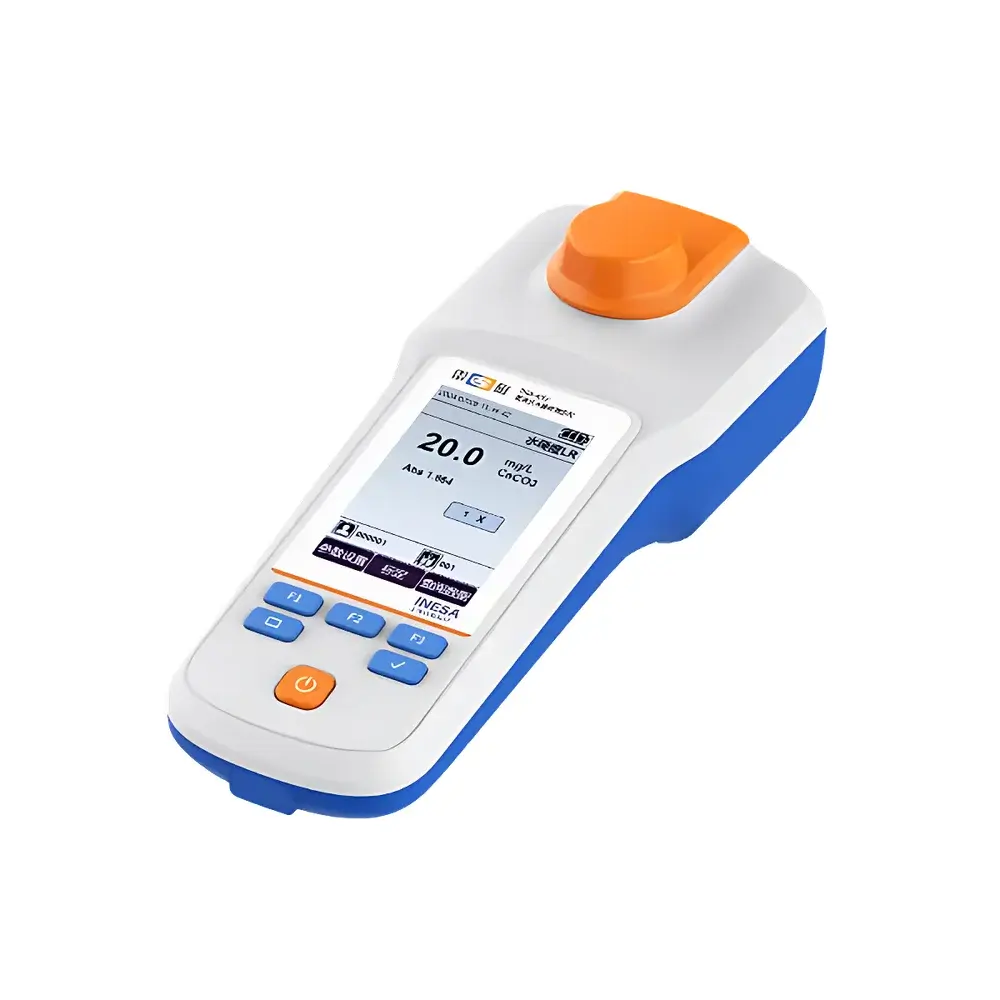
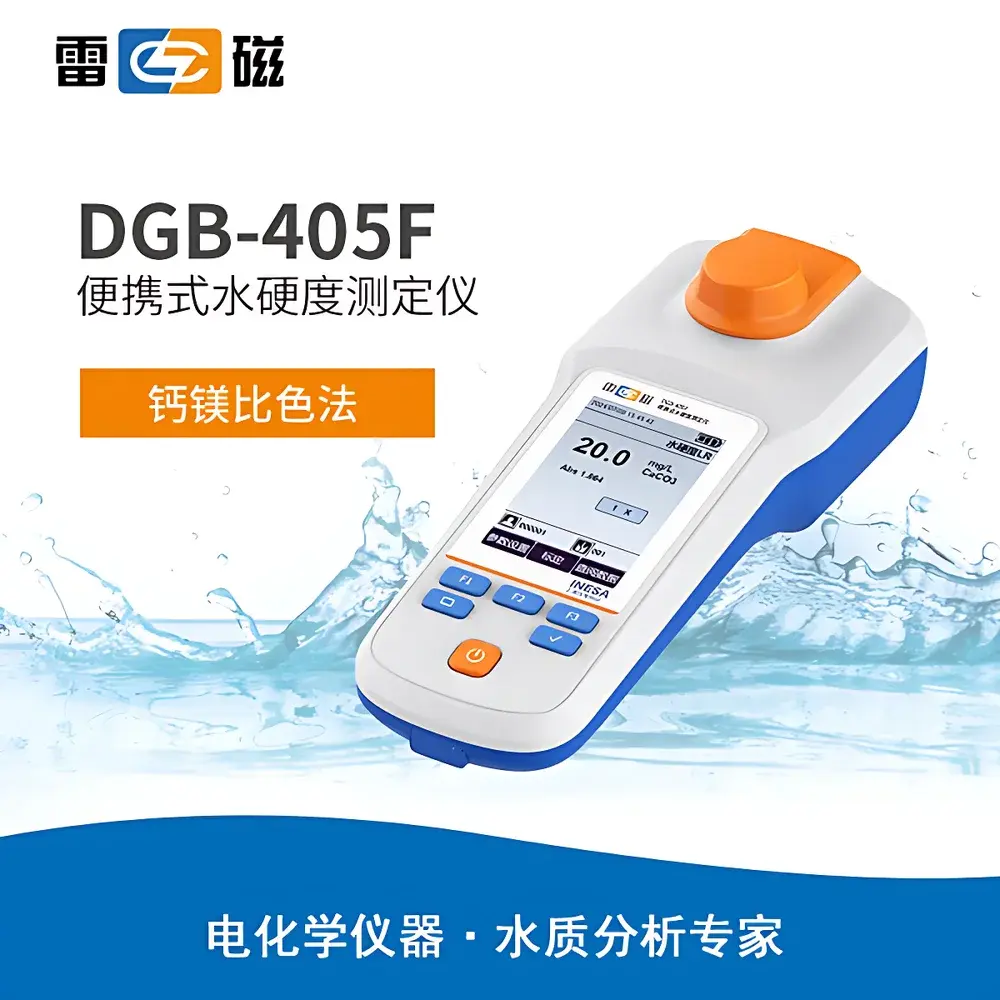
Leici DGB-405F Portable Water Hardness Analyzer
| Brand | Leici |
|---|---|
| Origin | Shanghai, China |
| Manufacturer Type | Manufacturer |
| Country of Origin | China |
| Model | DGB-405F |
| Instrument Type | Portable / Handheld Water Quality Analyzer |
| Measured Parameter | Water Hardness |
| Measurement Principle | Calcium-Magnesium Colorimetry (at 515 nm) |
| Range | (3.00–20.0) mg/L, (20.0–100) mg/L, (100–500) mg/L as CaCO₃ |
| Accuracy | ±5% or ±3 mg/L as CaCO₃ |
| Repeatability | ≤2.0% |
| LOD | <3 mg/L as CaCO₃ |
| Operating Temp. | 5–35 °C |
| RH | ≤85% |
| Power | Rechargeable Li-ion battery |
| Dimensions | 100 × 245 × 90 mm |
| Weight | ~0.5 kg |
| IP Rating | IP65 |
| Data Storage | 600 groups (200 per range) |
| Interface | USB, RS-232 |
| Compliance | GLP-compliant data traceability |
Overview
The Leici DGB-405F Portable Water Hardness Analyzer is a field-deployable, colorimetric instrument engineered for rapid, on-site quantification of total water hardness—expressed as calcium carbonate (CaCO₃)—in drinking water, surface water, groundwater, boiler feedwater, and wastewater treatment streams. It operates on the standardized calcium-magnesium complexometric colorimetric principle, utilizing a stable 515 nm LED light source to excite the chromogenic reaction between hardness ions (Ca²⁺ and Mg²⁺) and the Eriochrome Black T (EBT) or similar metallochromic indicator under buffered conditions. The resulting absorbance is measured via a precision photometric detection system calibrated across three discrete ranges—Low Range (LR), Medium Range (MR), and High Range (HR)—ensuring optimal signal-to-noise ratio and minimal dilution errors across the full 3.00–500 mg/L (as CaCO₃) measurement span. Designed for environmental monitoring personnel, municipal water operators, and industrial hygiene technicians, the DGB-405F delivers laboratory-grade reproducibility in a rugged, handheld form factor compliant with international field testing expectations.
Key Features
- Triple-range auto-ranging capability: LR (3.00–20.0 mg/L), MR (20.0–100 mg/L), HR (100–500 mg/L) as CaCO₃—eliminates manual range selection errors
- High-stability 515 nm LED optical source with >100,000-hour lifetime and <0.5 nm spectral bandwidth for consistent photometric accuracy
- Intelligent endpoint detection algorithm that identifies reaction completion automatically, reducing operator dependency and inter-user variability
- Seven unit conversion options: mg/L CaCO₃, mg/L Ca, mg/L CaO, mmol/L, mmol/L (Boiler), °dH (German), °fH (French), °eH (English)
- Configurable dilution factor input—automatically calculates original sample concentration post-dilution
- Dual calibration mode: pre-loaded factory curves or user-defined 2–5 point calibration with editable slope/intercept parameters
- GLP-compliant data management: timestamped entries, operator ID tagging, and audit-ready storage of raw absorbance, calculated result, and method metadata
- IP65-rated enclosure with shock-absorbing rubberized housing and sealed keypad for reliable operation in humid, dusty, or rain-exposed environments
Sample Compatibility & Compliance
The DGB-405F is validated for use with clarified aqueous samples meeting standard turbidity limits (<5 NTU). Turbid or colored matrices require filtration (0.45 µm membrane) or pretreatment per ISO 6059:2022 and ASTM D1126–21 guidelines. It complies with GLP requirements for field instrumentation through mandatory data logging—including measurement time, ambient temperature, battery voltage, calibration status, and user-defined notes. While not FDA 21 CFR Part 11 certified out-of-the-box, its USB and RS-232 interfaces support secure, encrypted data export to LIMS platforms configured for electronic signature and audit trail compliance. All reagents supplied (2024 formulation) conform to ISO 3696 Grade 3 water purity and are traceable to NIST SRM 169a reference material for hardness validation.
Software & Data Management
Data transfer is supported via native USB interface using Leici’s dedicated PC communication software (Windows 10/11 compatible), enabling batch export in CSV or Excel-compatible XML formats. RS-232 output supports direct connection to serial thermal printers with configurable print templates—including sample ID, date/time stamp, range used, unit selected, and pass/fail flags against user-set action limits. Internal memory retains 600 measurements (200 per range) with full recall, selective deletion, and chronological or parameter-based search. Battery level indicators and low-power warnings ensure uninterrupted field operation; auto-shutdown activates after 10 minutes of inactivity but preserves unsaved data via non-volatile memory backup.
Applications
- Routine hardness screening at municipal water intake and distribution points per WHO Guidelines for Drinking-water Quality (4th Ed.)
- Boiler water conditioning control in power plants and HVAC systems—monitoring against ASME B31.1 and EN 12952-12 thresholds
- Pre-treatment verification for reverse osmosis and ion exchange units
- Field validation of lab-reported hardness values during EPA Method 130.1 or ISO 6059 audits
- Educational use in environmental science laboratories for teaching colorimetric analysis fundamentals
- Emergency response deployment during flood or infrastructure failure events where rapid hardness assessment informs disinfection protocol adjustments
FAQ
What is the detection limit for the DGB-405F, and how is it verified?
The instrument specifies a limit of detection (LOD) of <3 mg/L as CaCO₃, determined per IUPAC recommendations using the standard deviation of 10 blank measurements multiplied by 3.14.
Can the DGB-405F measure hardness in seawater or brackish samples?
No—high ionic strength and chloride interference invalidate the EBT-based colorimetric reaction. For saline matrices, ICP-OES or EDTA titration remains the recommended method per APHA Standard Methods 2340 C.
Is calibration traceable to national standards?
Yes. Factory calibrations are performed using Leici-certified reference standards traceable to CNAS-accredited laboratories and aligned with ISO/IEC 17025 calibration hierarchies.
How often should the LED light source be recalibrated?
The 515 nm LED requires no periodic recalibration; its stability is verified during annual performance verification using NIST-traceable neutral density filters.
Does the device support multi-language UI?
The firmware currently supports English and Simplified Chinese interfaces; additional languages may be added via future firmware updates distributed through Leici’s authorized service channels.







