
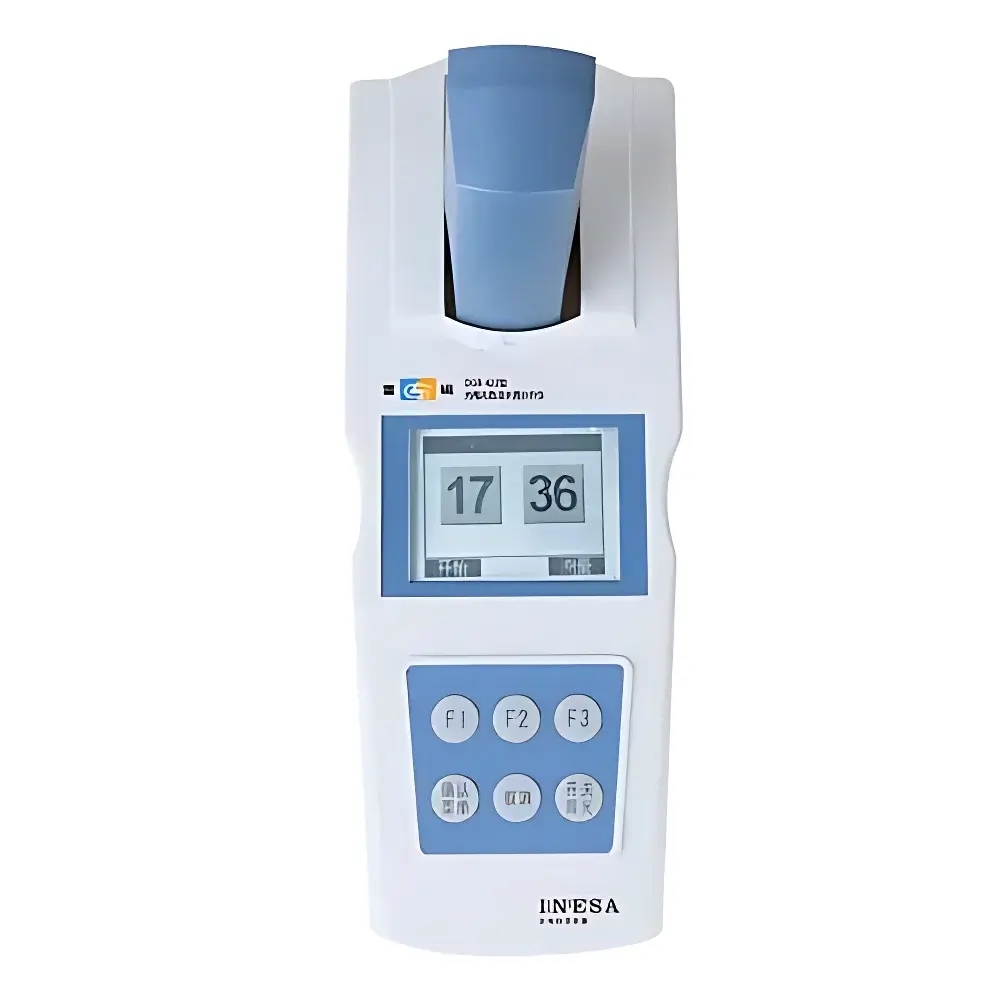
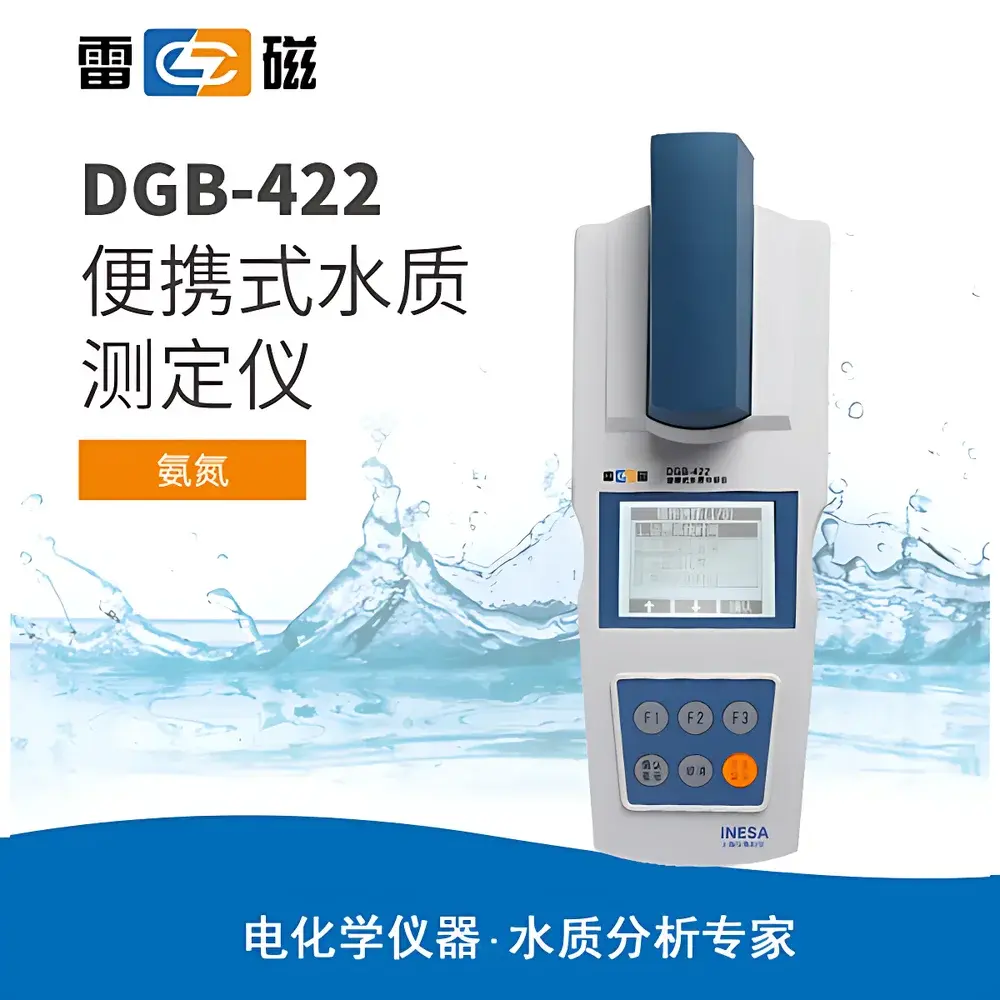
Leici DGB-422 Portable Water Quality Analyzer
| Brand | Leici |
|---|---|
| Origin | Shanghai, China |
| Manufacturer Type | Direct Manufacturer |
| Regional Origin | Domestic (China) |
| Model | DGB-422 |
| Instrument Type | Portable |
| Measurement Principle | Colorimetry |
| Measurement Range | 0.000–500.0 mg/L |
| Accuracy | ±5 mg/L |
| Display | Backlit LCD with Adjustable Contrast & Backlight Duration |
| Protection Rating | IP65 |
| Calibration | Up to 5-point calibration |
| Data Management | GLP-compliant storage, recall, deletion, and print export |
| Power Supply | 4 × AA alkaline batteries or USB-powered |
| Interface | USB for PC/printer connectivity |
| Operating Environment | 5–35 °C, 0–85% RH |
| Dimensions | 220 × 85 × 50 mm |
| Weight | ~0.4 kg |
| Cuvette Specification | Ø16 mm × 100 mm, 10 mL capacity |
Overview
The Leici DGB-422 Portable Water Quality Analyzer is an engineered field-deployable instrument designed for rapid, on-site quantification of key water quality parameters—including ammonia nitrogen, total hardness (as CaCO₃), urea, residual chlorine, total chlorine, chlorine dioxide, total phosphorus, permanganate index, aluminum, and others—using standardized colorimetric methodology. It operates on the Beer–Lambert principle, where analyte-specific chromogenic reactions generate absorbance proportional to concentration at precisely selected LED emission wavelengths (e.g., 470 nm for hardness and urea). Unlike benchtop spectrophotometers requiring cuvette handling and wavelength scanning, the DGB-422 integrates fixed-wavelength LEDs matched to the peak absorption bands of common reagent systems, eliminating mechanical moving parts and enhancing long-term optical stability. Its compact form factor (220 × 85 × 50 mm), lightweight construction (~0.4 kg), and dual-power capability (AA batteries or USB bus power) enable uninterrupted operation during mobile environmental monitoring campaigns, wastewater inspection, drinking water compliance checks, and recreational water safety assessments—including swimming pools, landscape reuse systems, and hospital effluent streams.
Key Features
- Fixed-wavelength LED optical system optimized for high signal-to-noise ratio and minimal photometric drift over time
- Integrated pre-programmed calibration curves for multiple parameters; eliminates manual curve generation and reduces operator error
- Direct measurement using standard 10 mL glass colorimetric tubes (Ø16 mm × 100 mm), minimizing cross-contamination risk and cleaning overhead
- Backlit LCD display with adjustable contrast and user-configurable backlight timeout—optimized for variable ambient lighting conditions in field settings
- IP65-rated enclosure ensures dust resistance and protection against low-pressure water jets during outdoor use
- Automatic endpoint detection with value locking—provides stable, repeatable readings without manual timing intervention
- Up to five-point calibration support enables traceable accuracy across extended concentration ranges per parameter
- Built-in GLP data logging with timestamp, operator ID (optional), measurement unit, and calibration history—supports audit-ready documentation
- USB interface compliant with CDC ACM class drivers for seamless integration with Windows-based laboratory information management systems (LIMS) and reporting software
- Firmware upgradability via USB allows future expansion of analytical capabilities without hardware replacement
Sample Compatibility & Compliance
The DGB-422 accommodates aqueous samples from diverse matrices: surface water, municipal and industrial wastewater, treated effluent, potable water, swimming pool water, and healthcare facility discharge streams. Sample pretreatment—such as filtration (0.45 µm membrane), pH adjustment, or masking agent addition—is performed according to standard methods (e.g., ISO 7890-3 for ammonia nitrogen, ISO 6059 for total hardness, ISO 11511 for urea). The instrument’s optical architecture and reagent compatibility align with internationally recognized colorimetric protocols referenced in ASTM D1253 (residual chlorine), EPA Method 350.1 (ammonia), and Chinese national standards HJ 535–2009 and GB/T 5750.5–2023. Its GLP-compliant data structure—including electronic signatures, audit trails, and calibration verification logs—facilitates alignment with ISO/IEC 17025 requirements and supports regulatory submissions under local environmental protection agency mandates.
Software & Data Management
Data generated by the DGB-422 are stored internally with full metadata: date/time stamp, measured value, unit, parameter name, calibration status, and operator identifier (if configured). Storage capacity supports ≥1000 records. USB export enables CSV-formatted batch transfer to spreadsheet applications or validated LIMS platforms. No proprietary software installation is required—standard USB serial communication allows direct integration with custom QA/QC dashboards. All data entries include immutable timestamps and optional electronic signature fields, satisfying minimum traceability requirements under GLP and foundational elements of FDA 21 CFR Part 11 (when deployed with supplementary access controls and audit log review procedures). Firmware updates retain all existing calibration data and user configurations.
Applications
- Field verification of ammonia nitrogen in riverine and lake monitoring networks
- Routine hardness testing in boiler feedwater and cooling tower circuits
- Urea quantification in recreational water facilities to assess bather load and disinfection demand
- Emergency response screening for residual chlorine decay in distribution systems
- Regulatory compliance checks for wastewater discharge permits (e.g., NH₃-N limits under local effluent guidelines)
- Quality assurance during drinking water treatment process optimization
- Educational laboratories requiring robust, entry-level colorimetric instrumentation with real-world method alignment
FAQ
What sample volume is required for analysis?
A single 10 mL aliquot is loaded directly into a standard 16 mm diameter × 100 mm length glass colorimetric tube.
Is the instrument compatible with third-party reagents?
Yes—provided reagents follow the same reaction chemistry and absorbance peak profile (e.g., 470 nm for hardness/urea); however, Leici-validated reagent kits ensure optimal accuracy and curve linearity.
Can measurement units be switched between mg/L and ppm?
For most parameters (e.g., NH₃-N, hardness), mg/L and ppm are numerically equivalent in dilute aqueous solutions; the instrument displays values exclusively in mg/L per international reporting conventions.
Does the device meet any formal metrological certification standards?
While not individually certified to ISO 17025, its design, calibration traceability, and performance specifications conform to principles outlined in ISO/IEC 17025:2017 Clause 7.2 (method validation) and ISO 8655-7 (volumetric apparatus verification) when used with certified reference materials and documented SOPs.
How often must calibration be performed?
Calibration frequency depends on usage intensity and regulatory context; daily verification with a mid-range standard is recommended for routine compliance work, while multi-point calibration should be repeated after reagent lot changes or instrument servicing.







