
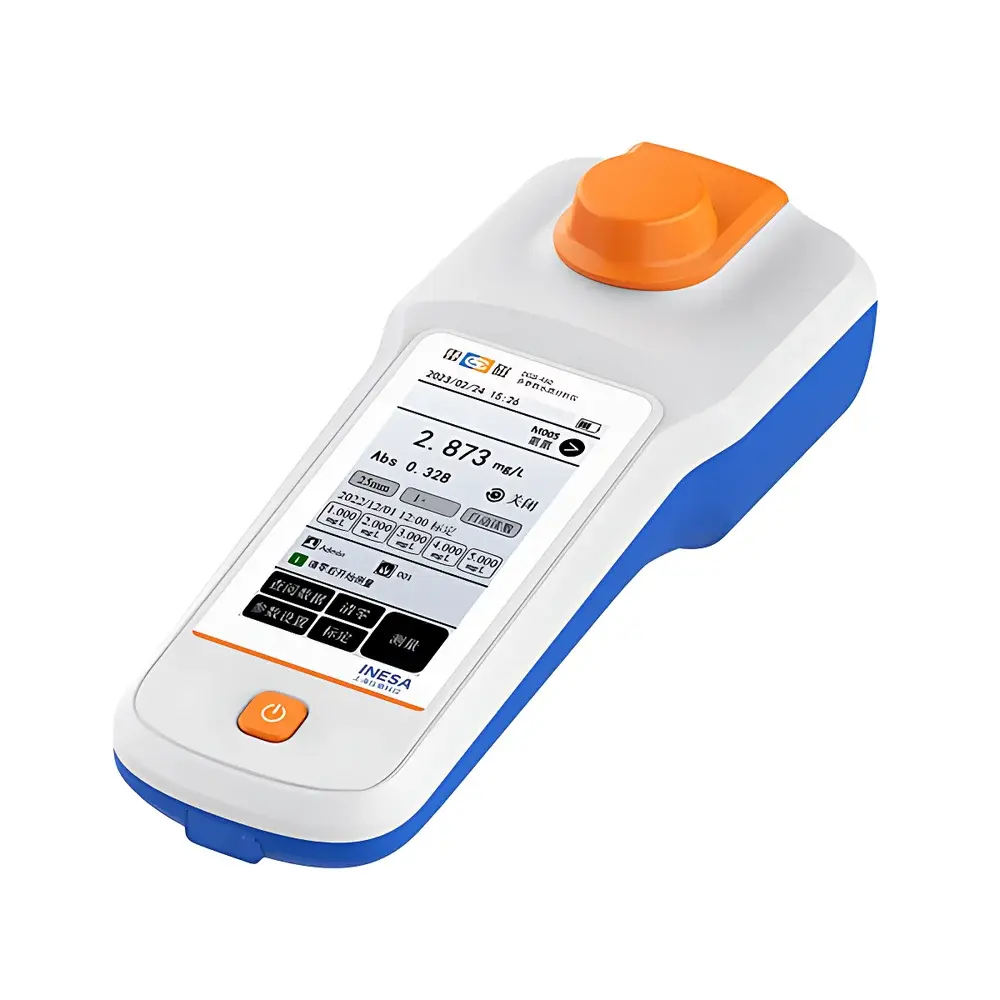
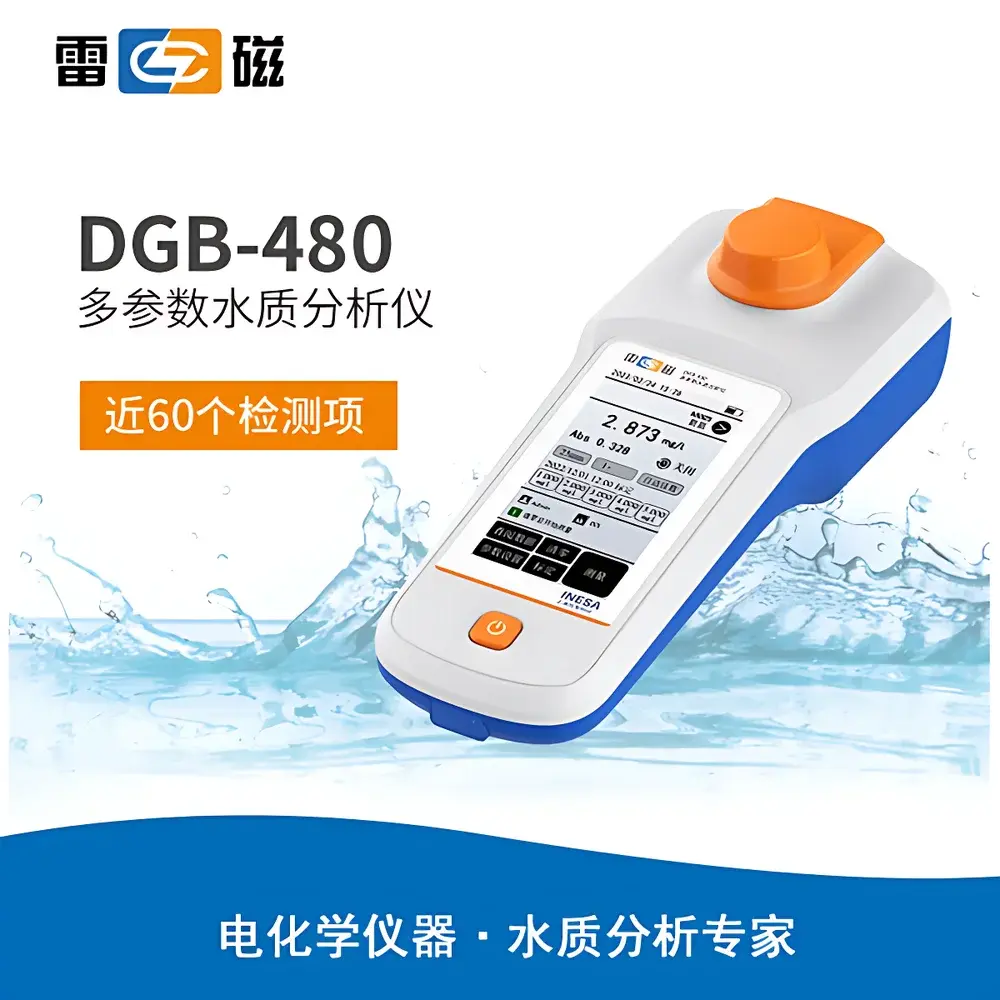
LeiCi DGB-480 Multi-Parameter Water Quality Analyzer
| Brand | LeiCi |
|---|---|
| Origin | Shanghai, China |
| Manufacturer Type | Original Equipment Manufacturer (OEM) |
| Product Category | Domestic |
| Model | DGB-480 |
| Instrument Type | Portable / Handheld Water Quality Analyzer |
| Detection Parameters | Turbidity, Color, Transmittance, Ozone, Nitrite Nitrogen, Urea, Hexavalent Chromium, Manganese, Total Nitrogen, Nitrate Nitrogen, Nitrate, Formaldehyde, Water Hardness, Zinc, Nitrite, Free Chlorine, Total Chlorine, Chlorine Dioxide, Permanganate Index, Low-Concentration COD<sub>Cr</sub>, High-Concentration COD<sub>Cr</sub>, Cadmium, Ammonia Nitrogen, Ammonium Ion, Total Phosphorus, Total Phosphate, Nickel, Ferrous Ion, Iron, Sulfite |
| Wavelengths | 365 nm, 420 nm, 470 nm, 515 nm, 540 nm, 620 nm, 650 nm, 850 nm |
| Measurement Modes | Concentration (mg/L), Absorbance (Abs), Transmittance (%) |
| Compliance | ISO 7027 (turbidity), GLP data traceability |
| Data Storage | 2000 records |
| Power Supply | Rechargeable Li-ion battery (DC 5 V input, AC 100–240 V adapter) |
| Dimensions | 105 × 241 × 90 mm |
| Weight | 0.6 kg |
| IP Rating | IP65 |
| Display | Color LCD touchscreen |
| Sample Vessels | Φ16 mm cuvettes or Φ25 mm vials |
Overview
The LeiCi DGB-480 Multi-Parameter Water Quality Analyzer is an engineered field-deployable photometric instrument designed for rapid, on-site quantification of physicochemical and contaminant parameters in drinking water, swimming pool water, surface water, and wastewater effluents. It operates on the principle of spectrophotometric absorption analysis using eight discrete, high-stability LED light sources—each precisely tuned to a characteristic absorption peak wavelength (365, 420, 470, 515, 540, 620, 650, and 850 nm). The 850 nm channel implements 90° nephelometric turbidity measurement in strict accordance with ISO 7027, ensuring metrological comparability across international laboratories. The 365 nm UV source enables sensitive detection of colorimetric reactions involving aromatic compounds and oxidizable organics (e.g., formaldehyde, urea), while visible-wavelength channels support standardized methods for nutrients (nitrate, nitrite, ammonia nitrogen, total phosphorus), heavy metals (Cr(VI), Cd, Pb, Ni, Mn, Fe), disinfectants (free/total chlorine, ClO₂, O₃), and oxidation demand indicators (CODCr, permanganate index). Its modular optical architecture eliminates mechanical filter wheels, enhancing long-term wavelength repeatability and reducing maintenance intervals.
Key Features
- Eight fixed-wavelength LED optical system with ±4 nm maximum wavelength tolerance, optimized for ASTM, ISO, and Chinese EPA method compatibility
- Triple-mode photometric readout: concentration (mg/L, µg/L, mmol/L), absorbance (0–2.000 Abs), and transmittance (0–100.0 %)
- High-fidelity color LCD touchscreen interface with intuitive icon-driven navigation and real-time graphical feedback
- Support for both proprietary LeiCi reagent kits and user-formulated protocols—enabling method flexibility without hardware modification
- Dual-cuvette compatibility: accepts standard Φ16 mm test tubes and Φ25 mm vials, with automatic pathlength compensation logic
- Smart endpoint recognition algorithm with configurable reaction timing, auto-zeroing, and dynamic baseline correction
- GLP-compliant data management: full audit trail including operator ID (3-tier access control, up to 8 users), sample ID tagging, timestamped measurements, and calibration history logging
- Integrated dilution factor calculation engine—automatically back-calculates original sample concentration from diluted readings
- IP65-rated enclosure with shock-absorbing portable case, enabling reliable operation in humid, dusty, or splash-prone field environments
Sample Compatibility & Compliance
The DGB-480 accommodates liquid samples within standard regulatory viscosity and particulate limits for photometric analysis. It supports direct measurement of clarified aqueous matrices—including potable water, treated effluent, recreational water, and groundwater—with optional pre-filtration (0.45 µm) for turbid or suspended-solid-rich samples. All turbidity measurements comply with ISO 7027:2016 for formazin-based calibration traceability and scatter geometry. Absorbance linearity and transmittance accuracy meet ISO 10566 and DIN 38404-4 specifications across its operational range. The instrument’s firmware and data structure are designed to support future alignment with FDA 21 CFR Part 11 requirements through secure electronic signatures and immutable record archiving when paired with validated PC software. Calibration verification follows multi-point (1–5 point) non-linear curve fitting, supporting both built-in reference curves and user-defined polynomial or logarithmic models (up to 20 custom methods).
Software & Data Management
Data acquisition and reporting are managed via embedded firmware with dual export pathways: RS-232 serial output for direct thermal printer integration (e.g., label or receipt-style reports), and USB 2.0 host interface for bidirectional communication with Windows-based LeiCi DataLink software. The software provides full database synchronization, statistical summary (mean, SD, CV%), outlier detection, trend charting, and PDF report generation compliant with laboratory quality system documentation standards. Stored records (up to 2000 entries) retain complete metadata: measurement mode, wavelength, date/time, operator ID, sample ID, dilution factor, calibration curve ID, raw absorbance/transmittance values, and final calculated concentration. Internal memory retains data during battery replacement or power loss. Firmware updates are delivered via encrypted USB stick to preserve integrity and version control.
Applications
The DGB-480 serves as a primary screening tool in municipal water utilities for routine compliance monitoring of disinfectant residuals (free/total chlorine, ClO₂), turbidity, and color—critical for meeting WHO Guidelines for Drinking-water Quality and GB 5749–2022. Environmental agencies deploy it for rapid assessment of nutrient loading (NH₄⁺, NO₂⁻-N, NO₃⁻-N, TP) in watershed surveys and algal bloom response. Public health departments utilize its formaldehyde and urea assays to verify pool water hygiene per GB/T 18204.29–2019. Industrial pretreatment labs apply its heavy metal modules (Cr(VI), Cd, Ni, Zn) for effluent characterization prior to discharge permitting. Its portability and battery endurance (>12 h typical usage) make it suitable for emergency response teams conducting post-disaster water safety verification or field validation of point-of-use treatment systems.
FAQ
Does the DGB-480 support method validation per ISO/IEC 17025?
Yes—its documented measurement uncertainty, traceable calibration procedures, and full data audit trail enable inclusion in accredited laboratory scope assessments when operated under defined SOPs.
Can custom calibration curves be imported from external spectrophotometers?
No—curves must be entered manually or generated in situ via standard addition; however, slope/intercept and polynomial coefficients can be edited directly in the method editor.
Is the 850 nm turbidity channel certified to ISO 7027?
Yes—the optical path geometry, detector angular acceptance, and scattering calibration protocol fully satisfy ISO 7027:2016 Annex A requirements for ratio-turbidimeters.
What is the minimum detectable absorbance at 420 nm?
Instrument noise floor is ≤0.003 Abs (RMS) at 420 nm under stable ambient conditions, supporting LOD estimation per IUPAC guidelines when combined with assay-specific blank variability.
How is firmware updated, and is rollback supported?
Updates are performed via signed .bin files loaded from FAT32-formatted USB drives; previous firmware versions are retained in protected memory for verified rollback within 72 hours of update.
Related Products







