
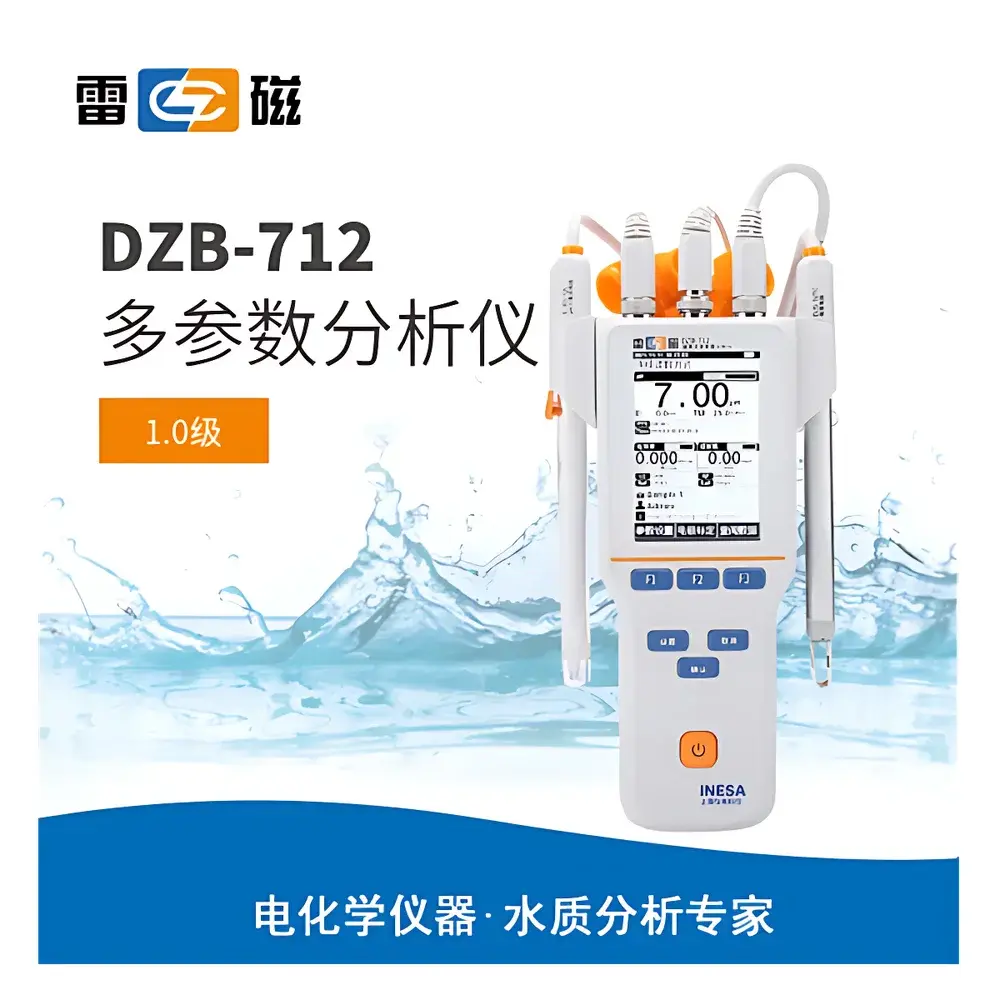
Leici DZB-712 Portable Multi-Parameter Water Quality Analyzer
| Brand | Leici |
|---|---|
| Origin | Shanghai, China |
| Model | DZB-712 |
| Instrument Type | Portable/Handheld Water Quality Analyzer |
| Detection Principle | Electrochemical Method |
| Measured Parameters | pH (−2.00–20.00), mV (−2000.0–2000.0) |
| Repeatability | pH ≤ ±0.01 pH |
| IP Rating | IP65 |
| Built-in Modules | pH/pX, Conductivity, Dissolved Oxygen (DO) |
| Temperature Compensation | Automatic (℃/°F selectable) |
| Data Storage | 500 sets per parameter |
| Compliance | GLP-compliant data traceability |
| Interface | USB, RS-232 |
| Power | Rechargeable Li-ion battery |
Overview
The Leici DZB-712 Portable Multi-Parameter Water Quality Analyzer is an electrochemical field instrument engineered for precise, on-site measurement of critical water quality parameters in environmental monitoring, wastewater treatment, aquaculture, and drinking water distribution systems. Based on potentiometric, conductimetric, and polarographic principles, the DZB-712 integrates three independent analytical modules—pH/pX, conductivity/resistivity/TDS/salinity, and dissolved oxygen (DO)/DO saturation—into a single ruggedized handheld platform. Its design prioritizes operational reliability under variable ambient conditions, with automatic temperature compensation (ATC), atmospheric pressure correction for DO, and intelligent endpoint detection algorithms that minimize operator dependency. The instrument adheres to fundamental metrological requirements for field-deployable analyzers, supporting traceable calibration protocols aligned with ISO 5667 (water sampling), ASTM D1293 (pH of water), ASTM D5391 (conductivity of pure water), and ASTM D888 (dissolved oxygen in water).
Key Features
- High-resolution LCD display with adjustable backlight for legibility in low-light or outdoor environments
- IP65-rated enclosure ensuring dust-tightness and protection against low-pressure water jets—suitable for field use in rain, humidity, or splashing conditions
- Integrated triple-sensor architecture: tri-combination pH electrode, composite conductivity cell (cell constant 1.0 cm⁻¹, compatible with 0.1/0.01 cm⁻¹ cells for low-conductivity applications), and Clark-type polarographic DO sensor with membrane replacement capability
- Intelligent electrode diagnostics—including impedance monitoring, slope verification, and response time assessment—to support preventive maintenance and ensure measurement integrity
- Auto-ranging conductivity measurement with selectable reference temperatures (20 °C or 25 °C) and compensation models (linear, non-linear, pure-water mode)
- Multi-point calibration support: up to 5-point pH/pX calibration using NIST, DIN, or GB buffer sets; customizable ion standards for Na⁺, K⁺, NH₄⁺, Cl⁻, F⁻, and user-defined ions
- Flexible DO calibration: zero-oxygen (sodium sulfite) and air-saturation (100% O₂ at ambient pressure) methods, with manual salinity correction and pressure unit selection (kPa, mbar, Torr, atm)
- Power management system featuring long-life rechargeable Li-ion battery, real-time charge status indicator, low-voltage warning, and dual charging options (PC USB port or external power bank)
Sample Compatibility & Compliance
The DZB-712 is validated for direct immersion measurement in natural waters (rivers, lakes, estuaries), treated effluents, groundwater, and process streams across pH −2.00–20.00, conductivity 0–200 mS/cm (with appropriate cell constant), and DO 0–20 mg/L (0–200% saturation). It supports GLP-compliant workflows through timestamped, operator-ID-tagged data storage (500 records per module), automatic metadata logging (calibration history, electrode ID, ambient temperature/pressure), and audit-ready export via USB or RS-232. Data files are structured for compatibility with LIMS integration and satisfy documentation requirements under ISO/IEC 17025 and EPA Method 150.1 (conductivity), 365.1 (pH), and 360.1 (DO). The device does not require hazardous reagents for routine operation and meets RoHS Directive 2011/65/EU for restricted substances.
Software & Data Management
Data transfer is facilitated via native USB interface using Leici’s proprietary PC communication software (Windows-compatible), enabling batch download, CSV export, graphical trend visualization, and report generation with customizable templates. RS-232 output supports direct connection to serial printers for hardcopy documentation—configurable line spacing, parameter selection, and date/time stamping. All stored measurements include embedded calibration coefficients, sensor serial numbers, and environmental context (temperature, pressure, salinity), fulfilling traceability requirements for regulatory audits. Firmware updates are performed over USB, allowing functional enhancements and regional compliance adaptations without hardware modification.
Applications
- Field-based environmental monitoring programs (EPA Region-specific NPDES compliance checks)
- Wastewater treatment plant influent/effluent QA/QC during commissioning and routine operation
- Aquaculture pond health assessment (pH stability, DO sufficiency, salinity drift)
- Drinking water distribution network surveillance (residual disinfectant interference screening via redox potential)
- Educational laboratory instruction in environmental chemistry and instrumental analysis
- Emergency response deployment for post-spill or flood event water characterization
FAQ
What calibration standards are supported for pH measurement?
The DZB-712 recognizes pre-programmed NIST, DIN, and GB buffer sets and allows up to five-point custom calibration with user-defined standard solutions.
Can the instrument measure low-conductivity ultrapure water?
Yes—when paired with a 0.01 cm⁻¹ or 0.1 cm⁻¹ conductivity cell and configured with pure-water temperature compensation mode.
Is dissolved oxygen measurement compensated for altitude?
Yes—automatic barometric pressure compensation is applied using built-in sensor input; users may also enter manual pressure values in kPa, mbar, Torr, or atm.
Does the device meet FDA 21 CFR Part 11 requirements?
While the DZB-712 supports GLP-aligned data integrity features (audit trail, electronic signatures via optional software modules), full Part 11 compliance requires validated third-party LIMS integration and organizational procedural controls.
How often should the DO membrane be replaced?
Typical service life is 2–3 months under continuous use; replacement frequency increases in high-sediment or organic-rich samples.
Related Products







